Silent revolution: The deaf women of Mtwapa turning coconut waste into environmental gold
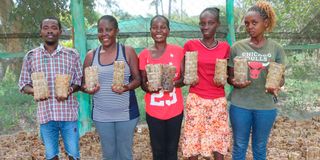
Deaf Association Mtwapa members showcase eco-friendly planting bags crafted from coconut leaves during their visit to Kalro, Kilifi County, on April 1, 2025. They create the biodegradable seedling bags from discarded coconut leaves, earning their first formal wages of Sh440-670 daily.

What you need to know:
- A group of deaf women in Mtwapa are creating biodegradable seedling bags from discarded coconut leaves, earning their first formal wages of Sh440-670 daily.
- Their eco-friendly bags offer a sustainable alternative to Kenya's 20,000 tonnes of annual plastic waste, decomposing naturally in soil to act as organic fertiliser for plants.
In a world obsessed with noise—where success is measured in decibels and influence in volume—the most revolutionary conversations are happening without a single spoken word. While media spotlight follows the loudest voices, a quiet alchemy is taking place in Mtwapa, where discarded coconut leaves are being transformed into environmental solutions, and women, once rendered invisible, are reshaping the future of sustainable agriculture.
Here, beneath the whisper of coconut palms, a group of deaf women sits in a circle, their hands moving with practiced precision. They are not weaving baskets for decoration or crafting souvenirs for tourists. They are engineering an environmental solution, one biodegradable seedling bag at a time.
For long, Mtwapa has been well-known for its vibrant nightlife, with numerous bars, clubs, and restaurants that attract both locals and tourists. But beyond the nightlife and noise, in these quieter corners, something extraordinary is taking root. This group of deaf women is proving that disability is not a limitation, by not only creating employment opportunities but also championing environmental conservation. They are doing so by crafting biodegradable seedling bags from coconut leaves, and in the process, challenging environmental norms, breaking down social exclusion, and reshaping gender roles in a space that has historically overlooked them.

A bridge between two worlds
At the heart of this quiet transformation sits Akali Kyalo—sign language interpreter, mother, artisan, and the unlikely architect of change. Her work, and that of the women around her, is helping to reframe environmental conservation not just as a scientific or economic priority, but as a deeply human story that champions dignity, resilience, and inclusion.
Her journey began not with grand environmental ambitions, but with something far simpler: curiosity about the deaf community living in isolation around her.
"I first encountered sign language in 2018, driven by a desire to connect with the often isolated deaf community around me," she recalls.
Over this period of time, she has trained, volunteered, and slowly become a bridge between two worlds. Today, seven years on, what began as personal curiosity has evolved into a calling, as she leads a pioneering group of deaf artisans—the first deaf employees officially recognized at the quarry.
The project is powered by a group of deaf artisans working under the Deaf Association banner, their core product being biodegradable seedling bags made entirely from discarded coconut leaves. These eco-bags are a sustainable alternative to plastic polythene, long known for clogging Kenya's rivers, choking soils, and contributing to long-term land degradation.
"This eco-friendly alternative to plastic polythene offers farmers a sustainable option that aligns with global efforts to combat plastic pollution and soil degradation," explains Akali.
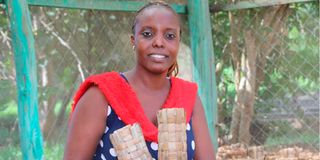
Sign language interpreter Akali Kyalo of the Deaf Association Mtwapa showcases coconut leaf-based biodegradable planting bags at Kalro, Kilifi County, on April 1, 2025.
The idea of biodegradable seedling bags was introduced years ago in Mtwapa by Gabriel Sindani, a Congolese innovator living in Mozambique, whose environmental vision inspired Akali and her team to embrace the initiative. His foresight planted a seed that would grow into something much larger than anyone could have imagined.
The women begin their day early, gathering coconut leaves that are abundant in the coastal region. The process starts with the meticulous harvesting of coconut leaves, which are then carefully separated, softened, and intricately woven into square-shaped bags designed specifically for planting seedlings.
Unlike traditional polythene bags, these bags do not need to be removed before planting. Instead, they decompose naturally in the soil, acting as organic manure that enriches the earth and fosters healthy plant growth. The innovation is as elegant as it is effective.
"This is a circular solution, because we are not only protecting the seedlings, but feeding the soil," Akali explains, her eyes bright with the satisfaction of meaningful work. "We give back what we take."
Meaningful work
The numbers tell their own story of dedication and impact. On average, the team produces 15 bags daily, which is a labour-intensive process that requires patience, skill, and unwavering commitment. Workers earn Sh440 per day, while Akali, in her dual role as interpreter and coordinator, earns Sh670. For many of the women here, this is their first formal job and their first taste of economic independence.
But the impact goes far beyond the financial. In a country where more than 2.5 million people live with hearing impairments, and where deaf women often face compounded discrimination, the project is a beacon of possibility. The significance of this work becomes even more profound when viewed against the backdrop of national statistics.
According to the 2019 Kenya Population and Housing Census, there are approximately 153,381 deaf individuals aged five years and above in the country. Of this population, a significant majority (around 129,518) reside in rural areas, while about 23,843 live in urban centres. This data provides a baseline for understanding the scale of deafness in Kenya but likely underrepresents the full extent of hearing impairment, as it only accounts for those officially identified as deaf and does not include people with partial or moderate hearing loss.
Also read: Weaving their way out of poverty
Estimates from advocacy and health organisations suggest that the actual number of people living with some form of hearing impairment in Kenya may be significantly higher. The Kenya Society for Deaf Children has indicated that up to 6.3 per cent of the population could be affected by hearing loss, translating to roughly three million people. Within this group, around 900,000 individuals are believed to be profoundly deaf, and approximately 300,000 of them are of school-going age.
The Kenya National Association of the Deaf (KNAD) also reports that about 5.5 per cent of the population experiences some form of deafness or hearing loss. These estimates, while not always aligned due to differing definitions and data sources, point to a significant portion of the Kenyan population living with hearing-related challenges. The lack of a recent comprehensive national survey on deafness makes it difficult to determine exact numbers.
Breaking barriers, building community
"Many of these women were told they couldn't work, couldn't learn, and couldn't lead," says Akali. "But here, they're doing all three."
At the workshop, the transformation is visible in every gesture, every shared glance, and every completed bag. Each woman contributes in her own way. Some focus on harvesting and preparation, others on weaving, and some on grafting seedlings. The division of labour flows naturally, born from understanding rather than instruction.
"Communication flows naturally through sign language and gestures, where together, we've built our own rhythm," Akali observes with a smile. "Even without hearing, they listen to each other."
The stories of individual transformation are as compelling as the collective achievement. Kadzo Karisa, one of the artisans, joined the project after years of staying home due to the lack of inclusive job opportunities. Now, she mentors newcomers in the art of bag-making, her expertise becoming a bridge for others seeking meaningful work.
Veronica Muthoni, a mother of two, balances child-rearing with her work at the site. For her, the routine has brought not just income, but self-worth.
"Before this, I felt invisible, but now, I feel needed," Veronica says through Akali's interpretation.
Every two weeks, the women are paid—a dependable rhythm that allows them to budget, save, and plan for their families. Thus, the project has also become a source of emotional stability and identity, creating ripples of positive change that extend far beyond the workshop walls.
Communication challenge
Despite their remarkable success, they continue to face significant challenges, the most pressing being communication. For this group, communication remains a barrier that affects not just their immediate work but their broader integration into society.
According to the World Federation of the Deaf (2021), Kenya has fewer than 500 certified interpreters for a population of over 2.5 million people with hearing impairments. This scarcity creates devastating ripple effects, limiting access to education, healthcare, employment, and legal support. The mathematics of exclusion are stark and unforgiving.
"Deaf women in Kenya face unique and deeply layered challenges," says Dr Gertrude Musuruve Inimah, former senator representing persons with disabilities in the 12th Parliament and a lecturer at JKUAT's School of Media and Technology. Her perspective, shaped by years of advocacy and legislative work, provides crucial context for understanding the broader implications of projects like Akali's.
According to Gertrude, who has been a strong advocate for the rights of deaf and hard-of-hearing Kenyans, deaf women often experience double discrimination—first, for being women, and second, for having a disability.
"They face major barriers to education due to a lack of inclusive learning environments and a serious shortage of qualified sign language interpreters. This leads many to drop out of school early. Even those who complete their education often struggle to find meaningful employment, as most workplaces are neither equipped nor willing to accommodate their needs," she explains.
Back at the workshop, the seedling bags these women produce offer a sustainable alternative to Kenya's plastic problem, addressing an environmental crisis that extends far beyond local boundaries. According to the National Environment Management Authority (Nema), agricultural polythene is still widely used, adding more than 20,000 tonnes of plastic waste every year.
In coastal towns like Mombasa, Malindi, and Lamu, much of this waste is washed into the Indian Ocean through storm water drains, harming marine life and damaging coral reefs. The environmental consequences ripple outward, affecting entire ecosystems and the communities that depend on them.
A 2022 survey by the Kenya Marine and Fisheries Research Institute (KMFRI) found that over 70 per cent of the waste collected during coastal clean-ups was plastic, with single-use plastic bags among the most common items. These statistics underscore the urgency of finding sustainable alternatives.
Kevin Lunzalu, a marine ecologist with the Wildlife Society, explains the cascading effects: "Plastic pollution is threatening marine biodiversity and hurting fisheries by reducing fish populations and contaminating seafood, which impacts both food security and local livelihoods. Littered beaches are also driving tourists away, putting the region's tourism-based economy at serious risk."
Against this environmental crisis, the biodegradable seedling bags represent more than innovation—they offer hope. These bags are locally sourced, low-cost, low-carbon, and fully biodegradable, embodying the principles of circular economy and sustainable development.
"If adopted widely, they could revolutionize the agricultural sector by promoting eco-friendly farming and drastically reducing waste," explains Kevin.
Global context and vision
The work in Mtwapa aligns with broader global initiatives addressing both environmental sustainability and social inclusion. According to Rebecca Grynspan, Secretary-General of UNCTAD, eliminating single-use plastics and tackling land-based pollution are crucial for environmental protection.
"Biodegradable alternatives are a viable substitute for single-use plastics, offering a way to reduce environmental harm while promoting innovation," Grynspan observes.
Organisations like UN Women have long emphasised that women, especially in the Global South, are not only among the most affected by climate change but are also powerful drivers of change. This perspective transforms the Mtwapa project from a local initiative into a model for inclusive climate action.
"Investing in local innovation and empowering women to lead in sustainable industries not only reduce environmental harm but also strengthen livelihoods and resilience," explains Rebecca.
But for Akali's group, scaling up will require investment, partnerships, and policy support. "We need recognition and resources. First of all, with training, we can replicate this across the country," she says.
However, this dream faces substantial obstacles. Financial constraints are a major hurdle, with limited funding to scale their operations, invest in training, or reach wider markets. Additionally, without strong institutional support or inclusion in government programs, their work risks being overlooked despite aligning with national environmental goals.
Despite these challenges, Akali and her group dream of building a national cooperative led by deaf women, producing eco-friendly packaging for farmers across East Africa. Their vision aligns with global calls for inclusive climate action, demonstrating how local innovation can address global challenges.
Gertrude continues to advocate for systemic change, proposing several bills in Parliament aimed at creating a more inclusive society. Among them is legislation to officially recognize Kenyan Sign Language, expand access to interpreter services, and improve inclusive education and employment policies.
"To change the lives of deaf women, we must invest in systems that support their full participation, both in school and in society," she adds.
In the meantime, the stories from the group continue to unfold with quiet power. Kadzo has become a trainer, passing on her skills to newcomers with patience and pride. Veronica balances motherhood and skilled labour with newfound confidence. Akali, with a young child of her own, manages family responsibilities while leading one of the most innovative inclusion-focused green projects in the region.
According to Akali, their work is living proof that environmental justice must include the marginalised. "Social inclusion and sustainability go hand in hand, and empowerment doesn't have to come with a megaphone. Sometimes, it arrives quietly."
Yet significant challenges remain. "Few employers hire deaf women," Gertrude notes. "Even with the right qualifications, it's not uncommon to find them doing odd jobs, and in some cases deaf individuals are hired only to meet quotas, used as 'rubber stamps' without real inclusion."
This reality makes the Mtwapa project even more significant. Akali sees it not as the final goal but as a beginning. "We've started something. But for real change, we need the government, private sector, and civil society to invest in inclusive infrastructure like schools, vocational training, and interpreter services."
Her message to policymakers is direct and unwavering: "Give us tools, not pity."


