Symbolic strides, systemic gaps 1,000 days on: The reality of Ruto’s gender agenda
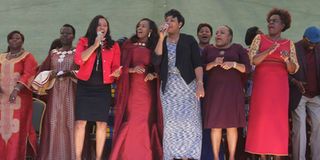
Women leaders allied to President William Ruto during an Inua Mama Movement rally in Nakuru. The Ruto administration’s efforts towards gender equality reveal a mixed record 1,000 days after taking the oath of office.

What you need to know:
- President Ruto’s gender agenda shows symbolic progress, but lacks enforcement, funding, and inclusion for rural, marginalised women.
- Despite high-profile appointments, systemic reform, two-thirds gender rule enforcement, and grassroots impact remain elusive.
As President William Ruto hits 1,000 days in office, his administration’s efforts towards gender equality reveal a mixed record. While symbolic strides have been made, gaps in implementation and systemic change remain glaring.
One of the key policy commitments from his manifesto was the establishment of safe spaces and shelters for survivors of gender-based violence (GBV). He pledged Sh100 million to support GBV survivors, a promise he announced during the 16 Days of Activism against GBV.

Additionally, his administration committed to providing survivors with legal and medical assistance, and promoting gender equality across sectors. Dr Ruto has made tangible steps towards fulfilling these promises. He signed into law the Persons with Disabilities Act, 2025, which enhances support for individuals with disabilities.
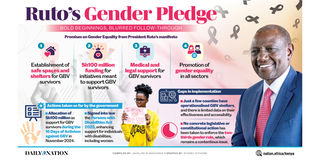
Furthermore, he has delivered public statements supporting traditional gender roles, which influence the direction of gender policies. Despite these initial actions, progress has been uneven. Only a few counties have operationalised GBV shelters, and there is limited data on their effectiveness or accessibility.
Additionally, no concrete legislative or constitutional measures have been enacted to enforce the two-thirds gender rule, a persistent issue in Kenya’s gender equality efforts. According to Rachael Omollo, a public policy and governance expert, the Ruto administration has highlighted its commitment to gender equality through high-profile appointments of women to the Cabinet and leadership roles.
She says policies targeting GBV, female genital mutilation, and women’s empowerment have been adopted. “These are laudable steps, but they remain largely symbolic without deeper systemic reforms.”
Rachael also notes that key promises remain unfulfilled. “The two-thirds gender rule is a glaring oversight, reflecting a lack of political will to address structural barriers to women’s leadership.”
Economic empowerment and gender pay gaps
Rachael notes that the Ruto administration pledged women’s economic empowerment, but initiatives like the Women Enterprise Fund and Hustler Fund have had limited impact. “Marginalised women, particularly in rural areas, continue to be left out,” she observes, noting that the gender pay gap persists, with no enforceable equal pay legislation or robust labour oversight mechanisms in place.
Sharing similar remarks, Amondi Aroko, a gender and development expert, says, “Women at the grassroots, particularly in rural areas, have not benefitted much. Policies lack proper targeting and efficient disbursement.”
She says the promise of allocating a portion of state tenders to women remains underwhelming because of slow payments and bureaucratic hurdles.
Unmet reproductive health and GBV response needs
Rachael says that while the administration has expanded GBV recovery centres and initiated a taskforce to combat femicide, critical gaps remain. “Underfunding of GBV programmes and inadequate support for survivors hinder progress.”
Access to reproductive health services also falls short, particularly in rural areas. “Young mothers and adolescent girls face cultural stigma and uneven access to essential health services.”
Amondi adds that specialised courts for GBV cases were established in 2023, but enforcement remains weak. “We need more trained officers, healthcare workers, and counsellors to support victims. A femicide bill could be a game-changer.”
Minimal inclusion of marginalised groups
Women living with disabilities and those in arid or rural areas are among the most excluded. Despite the recent passage of the Persons with Disability Bill, 2025, Amondi points out that “structural and attitudinal barriers continue to marginalise these groups in planning and policy implementation.”
Inclusivity for marginalised groups has seen slight improvements, but many still lack access to government procurement opportunities and basic services. Dr Ruto’s gender agenda seems to cater more to urban and elite women, leaving rural and differently abled women behind.
Javas Bigambo, the director at Interthoughts Consulting and lawyer specialising in governance, provides a nuanced perspective: “President Ruto took office with a firm focus on pursuing gender parity policies. He demonstrated this by establishing a Cabinet that complies with the two-thirds gender principle and appointed a gender adviser in the Office of the President, Harriet Chigai, a Cabinet-level position.”
Dr Ruto’s national security adviser, Dr Monica Juma, is among his notable female advisers. Further, task forces appointed under his administration have complied with the two- thirds gender principle. “As such, the administration has been constitutionally compliant at the Executive level,” Javas says.
However, the two-thirds gender principle remains unmet in Parliament, with little effort to scale up civic engagement on its necessity. “On this score, the political will demanded does not rest solely on the President, but the entire political class,” Javas observes. “Gender parity advocacy needs conscious buy-in by political parties, civil society, and all political aspirants. The Office of the Registrar of Political Parties must push for this imperative.”
What’s next for Dr Ruto’s gender agenda?
For Ruto’s gender agenda to gain traction, systemic reforms are essential. Rachael emphasises actionable measures, including enforcing the two-thirds gender rule, institutionalising gender-responsive budgeting, and ensuring data disaggregation to improve target policies. “The administration must prioritise marginalised voices and focus on implementation over rhetoric.”
Amondi adds that increasing funding for women-led enterprises and enacting equal pay laws should be priorities. “It’s time to move from promises to measurable action that transforms the lives of Kenyan women.”
Javas, for his part, highlights the need for civic education and political engagement. “The gender gap is a political gap in principle. Achieving it requires collaboration between the government, political parties, and society at large.”
As Dr Ruto’s term progresses, translating promises into measurable action remains crucial. Kenyan women and girls deserve not just symbolic gestures but transformative policies that ensure equality and inclusion. Only through sustained political will and systemic change can these gaps be effectively bridged.


