The making of Mama Safi: Lessons from a leader who refuses to compromise
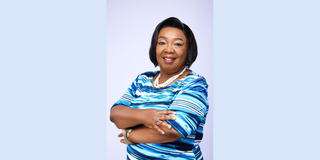
Elizabeth Kailemia, popularly known as Mama Safi, says integrity and honesty are her guiding principles as she leads programmes supporting women, youth, and persons with disabilities in Meru County.

What you need to know:
- Meru Woman Rep Elizabeth Kailemia, known as Mama Safi, has built her political career on integrity, faith, and service.
- When two staff members allegedly stole items meant for the disabled, she chose to let the law take its course despite political backlash.
- Through her foundation, she continues to empower women, youth, and vulnerable groups while championing honest, inclusive leadership.
When two staff members allegedly stole items meant for the physically challenged from her office on September 8, 2025, including wheelchairs, Elizabeth Karambu Kailemia made a decision that would draw political fire: they would be held accountable, regardless of the backlash.
"Integrity is the hallmark of good leadership. If I cannot misappropriate a single shilling in my role as the Woman Rep, my staff should also know they have no room engaging in underhand deals," says the Meru Woman Representative, speaking at her Karen home in Nairobi during an interview punctuated by dozens of calls as she worked to resolve the crisis. "We reported the matter to police; statements were recorded and some of them were taken to court. We will let the law take its course."
For Kailemia, who goes by the moniker Mama Safi, integrity and honesty are non-negotiable virtues. "They tell who you are. Integrity is the measure of how you manage the resources entrusted to you while honesty puts you in a position that you serve people who in turn accord you trust and in any case, God will judge you for all the actions. Other issues to do with political backlash come later."


Building communities
At her home in Igembe Central, Kailemia details the programmes she runs with various community groups.
Her flagship initiative supports women's groups with equipment including tents and chairs for their projects, as well as water projects. She also assists the physically challenged and vulnerable groups. At least 700 young people receive entrepreneurship training, followed by start-up funding for small businesses.
Additionally, she supports street children and orphans, liaising with the community and other stakeholders to help integrate them into society.
Also read: Woman rep role is not a luxury; it’s a right
Gerald Kiara, patron of Lairang'i Kirambii Self Help Group in Tigania West constituency, confirms their group received Sh150,000 for their water project. "Besides working with groups, Kailemia also adopts vulnerable children and educates them," he says.
Much of this work flows through Kailemia Foundation, which she launched more than 10 years ago with her husband's support, Dr Iruki Kailemia. The foundation focuses on helping vulnerable members of society, particularly through education, including paying fees at technical institutions.
Idah Karendi's story illustrates the foundation's impact. When she completed primary education in 2015, her father had just died and her mother couldn't afford high school fees. "Kailemia adopted me, paid for my education and recently I completed my studies at the Cooperative University where I studied entrepreneurship, now awaiting graduation. Without her I could not have realised my dreams," Karendi says.
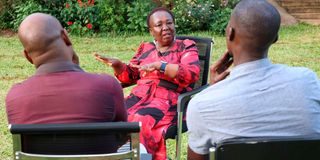
Elizabeth during an interview at her Meru home on January 30, 2024. She says her leadership is driven by faith, integrity, and service to the people of Meru.
Not everyone is satisfied with her reach. Some Meru residents say Kailemia should visit more groups across the county, particularly in neglected areas such as Igembe North. "She listens to everyone without discrimination but she needs to move around the entire county," says George Muika from Mutuati, Igembe North.
Kailemia acknowledges the challenge. With more than 1.5 million people across nine constituencies, complete coverage is nearly impossible with current resources.
"This is the reason the Woman Rep position should be empowered with more resources. The Sh63 million we're allocated is very little and should at the least be doubled."
One project particularly close to her heart is supporting teen mothers, some of whom face harsh conditions.
"I know what it means to get pregnant before marriage since I went through it myself while in college. But then at the time once you had identified a man who committed to be your future husband, you were good to go. My mother encouraged me and I realized that without her support life would have been difficult for me."
Her programme involves working with community women's groups to identify young mothers, then supporting them to raise their children and return to school.
Addressing claims that the Woman Representative position's impact is diminishing, Kailemia argues for a broader approach. "We cannot fund men, but I work with other groups in the society and sensitize men on the importance of supporting their families. We also arrange how those who are engaged in alcohol abuse can be rehabilitated. This is because if men are not responsible, women and children are the ones to suffer."
She advocates for a holistic support system. "A system that brings together women, their husbands, the youth, children and entire society. To me, this is the role the Woman Rep should play."
Thirty years after the Beijing conference on women's rights, Kailemia sees progress but recognizes unfinished business. "At least we have seen the fruits of women and girls' empowerment but there is still room for improvement. After three decades, we are still talking about two thirds gender rule which has not yet been attained. We should review the options explored by the 2010 Constitution and I believe we will get a solution."
Political journey
The quiet, somewhat reserved woman's entry into politics came around 2006 at Citam Church Karen, where Kailemia is a member. During a sermon, her pastor addressed how Christians complain about failed leadership without taking action.
"The preacher spoke about how Christians complain that leaders let them down without doing anything, and that was when I decided to venture into politics," she says.
Around the same time, poor urban planning increasingly frustrated her, and she believed political office could give her a platform to influence decisions. She briefly considered running for councillor in the 2007 election but abandoned the idea, citing the hostile environment councillors operated in—some had been killed.
When the 2010 Constitution created the Woman Representative position, Kailemia knew her moment had arrived.
Her first attempt in 2013 was, by her own admission, a learning experience. "I was clueless, and even if I had gotten carried by a wave, I would have fizzled out," she jokes.
Party politics proved challenging as she navigated the complexities of securing a nomination. Running on an Alliance Party of Kenya (APK) ticket, she came second to Florence Kajuju of The National Alliance (TNA) party. She credits former Governor Kiraitu Murungi, who led APK, for introducing her to "the ground."
In 2017, she came third behind Kawira Mwangaza and Florence Kajuju. The loss stung. "I was disappointed that after spending a lot of resources and time, I did not win," she admits.
Then came 2022—the year everything changed.
"I was about to give up because honestly as the incumbent, Kawira was unbeatable. When she announced intention to run for governor, I went to her and inquired, 'my sister, are you sure you're not playing some games?' She replied that there was no turning back. From that moment I knew God had presented the opportunity."
But victory wasn't guaranteed. Another strong opponent emerged: Felicity Nkirote Biriri, backed by Kiraitu Murungi's Bus party. "Biriri's entry into the race challenged me to work harder and this time with the support of my party, United Democratic Alliance (UDA), I made it."
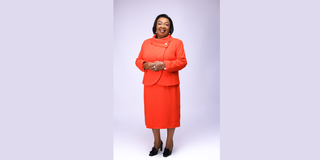
Elizabeth says her Mama Safi initiative is helping restore dignity and economic independence among rural women.
The first-born in a family of six—equal numbers of boys and girls—Kailemia's political consciousness was forged in her childhood home. Her father, the late Nteere Mbogori, served as MP for Imenti North from 1979 to 1983. As a young girl, she would prepare their home for visitors, clean, cook, and while serving food to her father's political strategists, she would eavesdrop on conversations about how to beat the then self-proclaimed "King of Meru" Jackson Angaine.
Yet politics was far from her mind. "Politics was nowhere near my dream careers. Actually, I wanted to be a doctor. But then as fate would have it, we're here, deep into the game," she says with a smile.
Her father's passion for education left an indelible mark. "He did not want to hear anybody being deprived of going to school. He was also generous and supported hundreds of children in schools and colleges, a trait I inherited from him. I think that was one of the reasons he was elected MP," Kailemia recalls. "As for mum, she was a disciplinarian, which played a big role in shaping me into who I am today. They both taught me honesty, which I hold dear."
After completing her studies at Limuru Girls High School and A-Level, Kailemia attended Kenya Science Teachers College, graduating with a Diploma in teaching Biology and Geography. However, teaching proved unfulfilling. After two years, she quit and pursued secretarial studies.
Her career path wound through various organizations: Kenya Power, ACK Diocese of Mt Kenya East where she served as personal secretary to the late Bishop Sospeter Maigua, Plan International, and the insurance sector. Eventually, she left formal employment to focus on her family and help her husband, Dr Iruki Kailemia, a pharmacist, manage his business.
"Working with a Christian organisation opened my mind about how the church deals with the society while at Plan International I interacted with various communities at various levels. It's now I look back and appreciate that these roles helped shape me for the current job where I am constantly involved with the community," she reflects.
Bishop Maigua, she says, reinforced the values instilled by her parents. "He taught me the importance of integrity and honesty and was inspiring. I would open his letters which came from the United Kingdom, some of them with sterling pounds tucked inside, and I never touched anything. I owe a lot to him, a great man to work with."
She credits her husband, Dr Iruki, for her success. "He is a political activist who believes in fixing things from the background. He supports me 100 per cent and I really appreciate."
As for the future, Mama Safi is clear about her intentions. "I will defend my seat in 2027 and let me also make it clear that I will continue serving the people of Meru with integrity. During my first campaigns in 2012, my campaign manager referred to me as Mama Safi, saying I was honest since I don't engage in propaganda. I don't have a dossier in my life and those trying to create it—referring to the theft in her office—will not succeed," she says, breaking into hearty laughter.


