The silent revolution: How women rangers are reshaping Kenya's wildlife protection
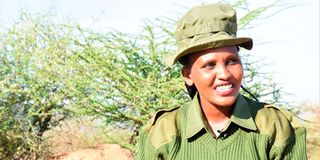
Lekumoisa Antonela, the first female ranger at Meibae Community Wildlife Conservancy in Samburu East, in a picture taken on March 5, 2021.

What you need to know:
- Kenya appointed its first female deputy director for wildlife security in 2019, reshaping conservation and breaking gender barriers in leadership.
- Despite past exclusion, women now thrive in wildlife conservation, overcoming stereotypes, advocating policies, and securing leadership roles.
In 2019, a seismic moment for gender equality in wildlife conservation and management in Kenya passed unnoticed when a woman was appointed Kenya Wildlife Service (KWS) deputy director for wildlife security.
It was an exciting, though shocking, appointment. For the first time since 1946, when the country’s first national park was established, the gruelling task of protecting Kenya’s wild flora and fauna, including endangered elephants and black rhinos, on both land and sea and the leadership of 1,500-plus armed rangers rested in a woman’s hands.
This feat was unthinkable 30 years ago when the UN Fourth World Conference on Women was held in Beijing, China. At the time, the top-ranking KWS female uniformed officer, a highly respected and capable leader, was an education officer at the Lake Nakuru National Park.


In contrast, her male peers were protecting wildlife on the frontlines. They guarded sensitive wildlife protection desks during the poaching wars of the late 1980s and the early 1990s, which exposed them to national-level visibility and responsibilities, international training, and professional networks within and outside the country. They were quickly rising in the ranks. That their colleague was cloistered in a small education office was, in part, rooted in a long history of patriarchy and exclusion within Kenya’s disciplined forces.
But the reality was that while her peers soared in their careers, the equally competent education warden was compelled time and again to plead against promotions and transfers to stations where her seniority and capabilities could be better exploited. A different, more compelling duty called: She was a wife, mother, and homemaker.
Difficulties in recruiting women rangers
Even though the late KWS Director Richard Leakey resolutely set out to recruit more women into the uniformed ranks, the harsh arena of wildlife management made their inclusion and career progression difficult. You could not, for instance, deploy a young female officer or ranger to a remote, desolate outpost with rudimentary and communal housing, where she would be the only woman among men because women have needs that are unique to their gender. They require privacy and safety. Their posting was, therefore, limited to a handful of safe urban spaces where social amenities such as housing, water, hospitals and schooling, for those who were mothers, were available. This severely curtailed their inclusion and career growth.
Gender and development expert Eva Komba, however, argues that while wildlife conservation was male-dominated because of the harsh environment in remote national parks, it was also aided by patriarchy and the absence of inclusive workplace policies. “Allocating women wardens ‘soft’ roles like education was both an assumption and a stereotype,” says Eva, who is also a board member of the Pastoralist Child Foundation. “Fortunately, attitudes and mindsets are shifting, policy is changing practice, and advocacy efforts are pushing women to challenge myths and stereotypes. Young women in conservation now have strong role models. They are scaling barriers.”
This mindset appears to have emerged after the ground-breaking Beijing Women’s Conference, which sought to eliminate discrimination, address inequalities, and empower women. Indeed, the first woman appointed as KWS deputy director in charge of wildlife security 24 years after the historic conference stood on the shoulders of giants – women like the imposing Ann Kahihia, a brilliant officer who became the first female game warden to manage a major national park.
By then, gender equality had become mainstream, and women were allocated a set quota during ranger and officer cadet recruitment. In recent years, some county governments have also improved social amenities in marginalised areas, making it easier for women officers to serve – a big win for conservation, according to Eva.
“Women leaders bring significant benefits to conservation because they are often adept at building relationships and fostering trust with the communities neighbouring national parks,” she explains. “They are effective communicators and advocates who raise awareness and mobilise support for conservation initiatives.”
While gender equality, as enshrined in the 2010 Constitution, remains a challenge — only 150 KWS women rangers were recruited in 2024, compared to 1,350 men — the journey from the education centre to the conservation corner office is no longer an impossible dream for capable women officers.
James Isiche is the Director of Africa at the International Fund for Animal Welfare (IFAW) based in Nairobi. He previously worked as the Assistant Director for Tsavo, Kenya Wildlife Service (KWS); [email protected].


