The sociopath next door: 'How Donald Trump became a danger to the world'
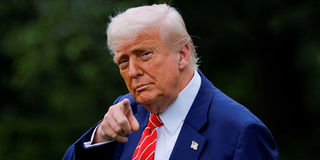
US President Donald Trump gestures, as he departs for Pennsylvania, on the South Lawn of the White House in Washington, DC on May 30, 2025.

What you need to know:
- Mary Trump details how childhood neglect, sociopathic parenting, and privilege forged Donald Trump’s damaged, dangerous personality.
- Denied empathy and love, Donald Trump adopted aggression, lies, and ego to mask deep psychological deficits.
Mary Lea Trump has a PhD in clinical psychology from New York's Derner Institute of Advanced Psychological Studies. While completing her dissertation, she spent a year working at the admissions ward of Manhattan Psychiatric Center, a state facility where she diagnosed, evaluated and treated New York’s patients.
She taught graduate psychology, including sophisticated trauma, psychopathology and developmental psychology, for several years as an adjunct professor. Mary is President Donald Trump’s only niece and the daughter of his late older brother, Frederick 'Freddy' Trump Jr.
In her memoir, Too Much is Never Enough: How My Family Created the World’s Most Dangerous Man, she talks about the emergence of Donald’s mental disorders. She says Donald meets the criteria for severe antisocial personality disorder, a medical condition called sociopathy.


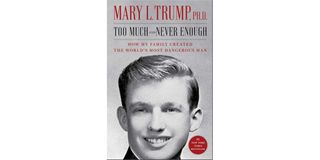
The cover of Mary Lea Trump's memoir, Too Much is Never Enough: How My Family Created the World’s Most Dangerous Man.
On August 26, 1948, shortly after giving birth to her last-born son, Robert, at Jamaica Hospital in Queens New York, Donald's mother, Mary, underwent an emergency hysterectomy. Doctors discovered that serious postpartum complications had been undiagnosed after Donald’s birth nine months earlier. She developed repressive osteoporosis from sudden loss of estrogen, leading to the removal of her ovaries and uterus. As a result, Mary was often in excruciating pain from fractures due to her thinning bones.
Mary Lea Trump defines mirroring as the process through which a parent reflects, processes, and reciprocates the baby’s own feelings. A smile is supposed to elicit a smile; tears are aimed at prompting a hug. It’s the root of empathy and a crucial part of a child’s development. Without mirroring, children are denied crucial information about how their minds work and how to understand the world.
Fortunate infants and toddlers have at least one emotionally available parent who consistently meets their emotional needs and responds to their desires for attention. The extension of being held and comforted, having feelings acknowledged and upsets soothed are all critical for the healthy mental development for children.
Donald’s needs weren’t sufficiently met when he was young. His mother’s physical health worsened and she became emotionally unavailable for her children. She attended to them only when it was convenient for her and not when they needed her. As hard as it was for Donald's older siblings, Maryanne, Freddy, and Elizabeth, the impact was dire for Donald and Robert who were the most vulnerable.
His alternative parent, Fred Trump, was a high-functioning sociopath. Sociopathy afflicts 3 per cent of the American population and 75 per cent of those diagnosed are men. Its symptoms include a lack of empathy, pathological lying, an indifference to right and wrong, abusive physical and emotional behaviour, and a deficiency of interest in the rights of others.
Having a sociopath as a parent, especially if there is no one else around to minimise its effects guarantees severe disruption in how children understand themselves and engage with their environs, and regulate their emotions. Fred’s self-interest skewed his priorities. The care for his children reflected his own needs, not theirs. Love meant nothing to him, and he could not empathise with their plight.
Fred believed that dealing with young children was not his duty and magnified his focus on round-the-clock work at Trump Management for six days a week, having no parental concern for his children. He focused on what was important to him, which were his enterprises: Shore Haven and Beach Haven. These two residential projects in Brooklyn, New York, were the most significant of his Real Estate Empire.
Fred would be annoyed when his children expressed neediness. The greater their distress, the more Fred rebuffed them. Behaviours that triggered soothing responses from him provoked his rage and indifference.
Fred didn’t want to be disturbed when he was at home and this affected Donald, who ended up equating ‘needing’ to humiliation, despair, and hopelessness. His cravings weren’t met and his insecurities and longings went unsoothed. These deprivations scarred him permanently. As he grew older, his personality traits started displaying narcissism, bullying and grandiosity.
To cope, Donald developed powerful but primitive defences, marked by increasing hostility to others and seeming indifference to his mother’s absence and father’s neglect. In place of those absent needs grew character traits that included pathological lying, disrespect, and aggressiveness.
By the time he was 18, Donald had developed the same sociopathic traits as his father towards children and he exerted them with vitriol and vengeance. He didn't operate on principle, or under ethics and morals. His ego was fragile and inadequate. He had a long and undiagnosed learning disability, which, for decades, interfered with his ability to process information.
He began perpetuating the myth his father later had of being strong, smart, and extraordinary. Contemplating the truth that he is none of those things was psychologically terrifying. Thanks to his father’s wealth and influence, Donald never had to navigate the real world by himself. Although he had the reasoning disability of an eighth-grader, he used his white privilege and family name to acquire loans for his real estate business, which he grossly mismanaged. By the late 1990s, he had filed for five bankruptcies, with his companies becoming extensions of his dysfunctional family.
The writer is a novelist, Big Brother Africa 2 Kenyan representative and founder of Jeff's Fitness Centre (@jeffbigbrother).