The sweet truth: One woman's mission to rescue honey from fraudsters
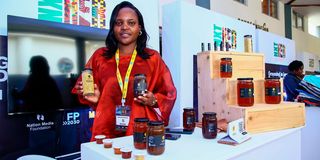
Damaris Chebet showcases her products at her exhibition tent during the NXT HER Summit held at Mövenpick Hotel, Nairobi, on August 22, 2025. She travels from Nairobi to Baringo and West Pokot to source authentic honey straight from the hive.

What you need to know:
- Damaris Jebet, a computer science graduate, launched Asali By Chebet in 2022 with Sh20,000 from her student loan.
- She travels to Baringo and West Pokot counties to personally inspect hives, working with 30 farmers to guarantee quality whilst creating sustainable rural income.
The next time you drizzle honey into your tea or spread it on toast, pause for a moment. That golden liquid you've just purchased from a reputable shop might not be what it claims to be. Across Kenya, adulterated honey—diluted with sugar syrup, corn syrup, or water—masquerades as the pure, natural product we expect. The fake versions often crystallise differently, taste artificially sweet, and lack the complex floral notes that make authentic honey so distinctive.
For many Kenyans, discovering they've purchased fake honey feels like a betrayal—money wasted, trust broken. But when Damaris Jebet noticed how difficult it was for people to find authentic, unadulterated honey, she didn't just complain. She built a solution.
In 2022, armed with Sh20,000 from her Higher Education Loans Board loan and the curiosity of a computer scientist, Jebet launched Asali by Chebet, a business now redefining what honey means on Kenyan tables.


Jebet holds a degree in Computer Science from Egerton University, but her entrepreneurial journey began during the first semester of her fourth and final year. Three years later, she reflects on lessons that extend far beyond anything taught in lecture halls.
"The biggest lesson has been that business is more than jars on a shelf—it's about trust, relationships, and understanding nature itself," she says.
From the beginning, Jebet realised that sourcing honey wasn't as simple as buying from any supplier. The honey industry's reputation for adulteration meant she had to approach things differently.
"Honey is a product that has been tampered with a lot," she explains. "To earn customer trust, you must guarantee quality."
The quest for purity
Determined to deliver only the best, she embarked on a journey that would take her far from university corridors. She travelled to Baringo and West Pokot counties, where she met farmers in their homes and personally inspected their hives—a hands-on approach that sets her apart in an industry plagued by middlemen and questionable practices.
Today, Jebet who is based in Nairobi, works with 10 farmers in Baringo — all men — and 20 in West Pokot, where there's an equal mix of men and women. By integrating them into her value chain, she has helped boost their earnings, creating sustainable income sources for rural households whilst ensuring she can trace every drop of honey back to its source.
Asali by Chebet started with a simple promise: pure organic honey, "from hive to jar," as she puts it. In a market where consumers have grown sceptical of honey claims, this transparency became her strongest selling point.
"We first started with pure organic honey. We harvest it straight from the hive and package it in jars," she explains.
"Farmers send us the honeycombs, and we use a machine to extract the honey ourselves. That way, it remains natural and unprocessed. But for the infused honey, it goes through processing."
Also read: Life lessons from the bee lady of Machakos
Over time, responding to customer needs, she diversified into value-added products. Her range now includes ginger, lemon, and chilli-infused honey, stingless bee honey, bee pollen, and a honey-based lip balm enriched with shea butter.
One of Jebet's greatest lessons came from discovering that honey follows the seasons—sometimes abundant, other times scarce—and learning to adapt her business around nature's rhythms rather than fighting them.
"When it rains, bees remain in their hives and consume the honey, leaving little to harvest," she explains.
"But during hot spells, they leave the hives, meaning the honey is preserved and there's more to collect."
By studying these patterns, she has learned to manage supply, set customer expectations, and prepare for shortages. In some months, clients even pre-pay to secure their jars—a testament to the trust she has built in a market where authentic honey has become increasingly rare.
Today, Jebet employs three staff members and supplies honey to hundreds of customers who know they're getting the real thing. But she's not stopping there.
"I want to place our Kenyan honey on international shelves and diversify into skincare and haircare products made from honey and beeswax," she says.


