The women trapped behind Samburu's walls of silence
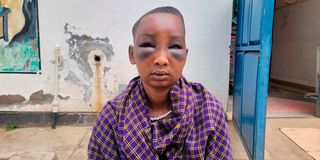
Priscilla Lolonyekie, a 24-year-old survivor of gender-based violence, at Samburu County Referral Hospital in Maralal town on May 19, 2025.

What you need to know:
- Domestic violence thrives as an "open secret" in Samburu County, where 48 per cent of women face gender-based violence.
- Most cases go unreported due to cultural stigma and fear of family dishonour.
When night falls in Samburu, the silence of the arid plains is often broken by the cries of women and girls muffled behind manyatta walls. They are the cries of wives and daughters facing domestic violence in their own homes—acts that are rarely reported to authorities, seldom discussed, and almost never punished.
In Samburu's patriarchal society, domestic violence is an open secret—seen and felt but seldom named. Survivors of gender-based violence remain trapped in the shadows of stigma and fear, bound by cultural expectations and silenced by the dread of retaliation. In most villages, a woman who dares to speak out risks shame, rejection, and in some cases, being disowned by her family.
"I was told to endure it, that a woman must be strong," whispers Naitoti*, a survivor in Treetop village, Wamba, Samburu East. "If I report, my family says I will bring dishonour. Wife battering is normalised here. Where can I go?"


The story of 24-year-old Priscilla Lolonyekie illustrates just how quickly misunderstanding can spiral into violence in this community. In May, the mother of one, who makes her living knitting beaded belts and bracelets, became the victim of a vicious attack that nearly cost her life.
It began with something as simple as an unfinished beaded belt. Priscilla had given the belt to her neighbour to complete—a minor act that would trigger a near-fatal chain of events. When the neighbour’s husband discovered the belt, his mind jumped to a devastating conclusion.
Mistakenly assuming his wife was making the belt for "a moran boyfriend," the man's rage exploded. He first attacked his own wife before turning his fury on Priscilla, accusing her of facilitating his wife's supposed infidelity by introducing her to other men.
"He knocked on my door that evening," Priscilla recalls. "When I opened it, he immediately flashed a torch into my eyes, and I could not see again. He hit me with a wooden club on my head and descended on me mercilessly."
The suspect reportedly picked up a wooden club and struck Priscilla repeatedly on the head and back, subjecting her to a near-fatal beating before fleeing. He remains on the run.
Since then, little action has been taken to secure justice for Priscilla because of entrenched patriarchal norms in Seren village, Samburu North.
Traditional gender roles in Samburu often collide with Kenya's modern legal protections, such as the Protection against Domestic Violence Act. Bride price cements a woman's place in her husband's home, and leaving a marriage is regarded as rebellion against the social order. Likewise, reporting abuse is equated with betraying family honor, and survivors are quickly branded troublemakers.
Weight of silence
"Victims of defilement, sexual assault and other forms of gender-based violence are always afraid to come forward to report the incidents for fear of retaliation by the offenders and families," says Temba Sitati, the Senior Principal Magistrate at Maralal Law Courts.
This pattern of silence has created a widespread crisis. The situation in the region prompted the Samburu Court Users' Committee to roll out a capacity-building program aimed at strengthening the fight against sexual and gender-based violence. Magistrate Sitati led the training in Maralal town, which brought together a wide range of stakeholders, including law enforcement officers, healthcare workers, chiefs, clerics, non-governmental organizations, and local administrators.
Participants were taken through legal frameworks, survivor-centred approaches, and effective referral pathways designed to ensure timely access to justice for victims. The initiative sought to close critical gaps in the handling of sexual and gender-based violence cases in Samburu.
According to the Samburu County Gender Office, reports of sexual and gender-based violence remain high in the past three years, with 48 percent of cases documented between 2022 and 2024. Many of these involve defilement, female genital mutilation, and intimate partner violence, though only a fraction makes it to court due to stigma, cultural norms, and fear of retaliation.
Albert Wanjohi, Samburu County Gender Officer, notes that child marriage and female genital mutilation remain strong drivers of sexual and gender-based violence, often trapping girls in cycles of abuse.
"Gender-based violence rates are at 48 per cent, and that is why we thought of engaging the magistrate to train the duty bearers," Albert said. "By training the duty bearers, they are able to file protection orders for the survivors."
Lydia Maina, the Samburu County Red Cross Coordinator, said there is a need to strengthen partnerships with grassroots organizations to enhance awareness campaigns in villages and schools, where most cases remain hidden by silence and stigma.
"We really need to create awareness at the community level to debunk misconceptions around gender-based violence and tell the community that justice should never be out of reach," she said.
Policy change
Samburu is banking on the recently passed Gender Policy to mainstream gender in the county's policies and programs. The policy was unanimously passed by members of the county assembly in a move hailed as a game-changer in tackling entrenched gender disparities in this patriarchal society.
The county's Director of Gender and Social Services, Nasieku Letipila, said the adoption of the policy means Samburu commits to addressing all forms of historical gender concerns in all spheres of life—from leadership and education to healthcare access and economic empowerment.
"We are committed to eliminating all forms of gender discrimination and creating an environment where both men and women can reach their full potential," she said.
The comprehensive policy sets out clear guidelines to mainstream gender considerations in county planning, budgeting, and service delivery while addressing harmful cultural practices that disproportionately harm women and girls. It outlines actionable strategies to close the gender gap in education, curb gender-based violence, increase women's representation in leadership and decision-making, and ensure equitable access to resources. It also mandates gender-responsive budgeting in all county departments.
The passing of the Gender Policy places Samburu among a growing number of counties aligning with national and international commitments to gender equality, including the Constitution and the Sustainable Development Goals.
To tackle the root causes of female genital mutilation and other forms of gender discrimination in Samburu, the policy requires officials to hold intergenerational dialogues to debunk misconceptions around gender violence. It seeks to bring together elders, Moran, religious leaders, and women in structured conversations to challenge deep-rooted cultural practices that continue to affect thousands of girls.
The Anti-FGM Board had already announced its collaboration with county governments, local leaders and youth groups to engage the Moran directly to become champions of change against the cultural practice.
"We are seeking to tackle the root causes of FGM because we realized that unless we bring the Moran into the conversation, we are only addressing the problem by half," says Ipato Korema Surum, Anti-FGM Board Chairperson, in May.
The engagement initiatives will involve workshops, dialogue forums, and cultural education sessions where moran are encouraged to reflect on the impacts of FGM on girls and women, with educators debunking traditional myths and misconceptions.
*Name changed to protect identity of the violence survivor.


