Trapped by dreams: The stories of Kenyan women caught in international drug trafficking

An estimated 1,300 Kenyans are currently serving sentences in foreign prisons, with many women discovering hidden drugs in luggage only after arrest, facing death sentences or life imprisonment thousands of kilometres from home.

What you need to know:
- International drug cartels are systematically targeting desperate Kenyan women, using them as unwitting mules to transport drugs across borders.
- An estimated 1,300 Kenyans are currently serving sentences in foreign prisons.
- The crisis has devastated families, whilst experts warn that poverty and unemployment make vulnerable women perfect targets for traffickers.
The suitcase looked perfectly ordinary—sleek, stylish, exactly the kind of luggage a successful woman might carry on an international business trip. But hidden within its lining lay 2kg of cocaine that would transform Margaret Nduta Macharia from a hopeful job-seeker into a woman facing death row, 8,000 kilometres from home.
It was July 2023 when the 37-year-old from Murang'a County clutched that fateful bag, unaware that her dreams of escaping poverty would lead her straight into the hands of Vietnamese authorities. Today, she sits behind bars, her death sentence recently commuted to life imprisonment—a small mercy that has done little to ease her family's devastation.
Nduta's story begins in the rolling hills of Weithaga, Kiharu Constituency, where life had become increasingly difficult.


"Life within Weithaga was not easy, securing a job had become more difficult and the only option for Nduta was to seek a job abroad," recalls her journey. When an agent based in Ethiopia promised her work in Vietnam, it seemed like the answer to her prayers.
The trap was expertly laid. After travelling from Kenya to Addis Ababa, the agent handed her a replacement bag, claiming her own luggage wasn't "classy enough" for the trip to Vietnam. Little did she know that this seemingly innocent gesture would seal her fate.
A family's silent anguish
Back in Murang'a, the news of Nduta's arrest and subsequent death sentence in March 2025 sent shockwaves through her family. Her mother, overwhelmed by the devastating news, was admitted to hospital. The family's matriarch remains unaware of the recent development that saw her daughter's sentence reduced from death to life imprisonment.
"She fell ill when the story of my sister broke. She is not even aware of the new development and we would not like to comment on it," says Rosemary Macharia, Nduta's sister, who now cares for their ailing mother. The family has made the painful decision to shield their matriarch from any updates, fearing it would worsen her medical condition.
Nduta's case initially proceeded without legal representation, and she was prosecuted in a court in Ho Chi Minh City that decided she would face death by lethal injection. However, intervention by the Kenyan government helped spare her life.
"She is safe and negotiations are still ongoing. The quick move to see the matter settled in another way saw her life spared early this year," Foreign Affairs Principal Secretary Korir Sing'oei told the Nation.africa.
Pattern of desperation
Nduta's story, whilst recent and particularly harrowing, is far from unique. Kenyan women have increasingly found themselves ensnared in international drug trafficking networks, often as unwitting pawns in a dangerous game orchestrated by more powerful players.
The numbers paint a sobering picture. Although there are no official confirmed statistics, the government estimates that 1,300 Kenyans are currently serving jail terms abroad, including women traffickers. In 2020, Monica Juma, who was serving as Cabinet Secretary for Foreign Affairs, revealed that 76 Kenyans were jailed in China—the last time Kenya publicly addressed such figures.
Many Kenyan nationals incarcerated abroad remain unidentified, with some believed to use fake documents due to the nature of their work or failing to register with embassies. The arrests have exposed Kenya as both a marketplace and transit hub for drug trafficking.
Perhaps no case better illustrates the seductive yet destructive nature of this world than that of Penninah Lema Munyithya, better known as Pesh Lema. During her heyday, she became a social media sensation, famous for sharing provocative photos and living a flashy lifestyle that any socialite would admire.
"For years before she was nabbed in 2015, Pesh had become famous for sharing her photos," the story of her rise recalls. Within months of gaining online notoriety, she was rubbing shoulders with top celebrities and announcing glamorous trips abroad.
Her downfall came swiftly. After announcing a holiday trip to Dubai, she travelled to West Africa to meet her partner for the first time. From there, she was meant to head to South Africa, but those plans never materialised. Instead, she was arrested in Ghana and sentenced to ten years in prison in Kumasi.
Released in February 2023, Pesh has kept a remarkably low profile since returning to Kenya. These days, her social media posts speak of God and prayers—a dramatic transformation from her former life.
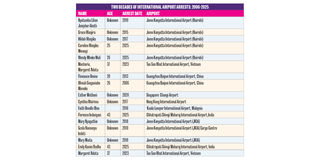
The stakes in this dangerous game couldn't be higher, as Rose Achieng’ Ojala discovered in August 2018. She was arrested and sentenced to death by a Malaysian court after being found in possession of methamphetamine that she was attempting to smuggle into the country.
Rose had concealed three capsules of the drug in her underwear and ingested another 68 capsules, totalling 400 grams. Airport staff at Kuala Lumpur noticed her suspicious behaviour during a routine search, which led to the discovery of more than 20 grams of methamphetamine in her underwear.
Rose claimed it was her boyfriend who had stashed the drugs in her underwear before she travelled, denying knowledge that she was in possession of the substances. Her court appearances were particularly tragic—she was sickly, fainted whilst in court, and attended all her sessions in a wheelchair.
Also read: Why do people become drug mules?
What drives women into such perilous circumstances? According to experts, the answer lies in a complex web of poverty, desperation, and manipulation.
"It is not abnormal—one's engagement in crime is mostly dependent on the environment, gender notwithstanding," explains Gad Aguko, an advocate in Kenya. He adds that those involved in drug trafficking are most likely tricked by men, with some even faking their nationalities.
Duncan Okatch, also an advocate of the High Court, provides further insight into this exploitation, arguing that the women in prison are there for being used by the real drug traffickers. He explains that since most of the established traffickers have criminal track records, they prefer using people who are less known and, if they are well known, are not linked to any criminal activities.
"Since the drug traffickers do understand their past records, they take advantage of people who tend to appear innocent," says Duncan.
Margaret Ruto, a US-based human rights activist and current head of Voices for Justice, a community-based organisation in Kericho, identifies poverty as the primary driver. She points to Kenya's worrying employment rate, with many graduates unable to find work.
"It is easier to arrest a Kenyan woman who is in possession of drugs because such business is taboo. The values instilled in Kenyan women, plus religious teachings, makes it harder for one to succeed in drug trafficking as they cannot keep calm body language when being scrutinised, as they grow knowing that it is wrong," Margaret observes.
She argues that the current Kenyan economy, where putting food on the table is increasingly difficult, creates conditions ripe for exploitation. Social media exacerbates the problem, with women following celebrities and influencers living lavish lifestyles whilst lacking opportunities to apply their own skills.

International drug cartels are systematically targeting desperate Kenyan women with false job promises abroad, using them as unwitting mules to transport drugs across borders.
A report titled Understanding the role of women in organised crime reveals that females are present in organised crime in significant numbers. "According to available arrest data concerning criminal activities associated with organised crime, women are involved across all organised crime markets, with a notable presence in economic crimes and participation in human trafficking crimes," the report notes.
"Female traits and gender roles contribute to women largely being seen as victims of crime, rather than as active members of organised criminal groups. Evidence shows, however, that women can and do play a variety of active roles in such groups," it adds.
Data from the United Nations Office on Drugs and Crime, published as part of the 2022 World Drug Report, shows interesting patterns in drug use between men and women. For cocaine, just 27 per cent of users are estimated to be women. However, for other drug types, the gap appears to be narrowing, with drugs such as amphetamines and recreational sedatives showing an almost 50-50 split between men and women.
Vulnerability and exploitation
Jackline Mwongela, a gender specialist who works with Loreto Neema—an organisation addressing challenges women face in Kenyan slums including Mathare, Kariobangi, and Kibra—identifies poverty and vulnerability as the main reasons women engage in such risky endeavours.
"Poverty levels are very high, and in most cases, women feel vulnerable as they want to feed their families. The difficulties they face make them end up engaging in risky business," she explains.
She wonders why, despite extensive news coverage showing how women end up behind bars due to such activities, many females continue to engage in drug trafficking. The responsibilities that come when a woman realises she is the sole breadwinner, she notes, are overwhelming.
Legal trap
In most cases where Kenyan women are arrested in foreign countries, they lack proper legal representation because they cannot afford it. This typically works against them, as they lack advocates who can enlighten them about the law in those countries, resulting in harsh sentences.
However, the Kenyan government sometimes intervenes in these cases. Nduta's case exemplifies this, where her sentencing was reduced from death to life imprisonment after the Ministry of Foreign Affairs held conversations with Vietnam's government.
Despite the concerning trend, experts emphasise the need for prevention strategies. Margaret Ruto stresses the importance of community sensitisation and education about the consequences of engaging in such business, ensuring people understand both local and international laws.
She also highlights a critical gap in support systems: "Imagine if a woman leaves prison after finishing their jail terms—if they won't seek help at a personal level and engage with psychiatrists, then getting back to their former selves is hard."
Jackline echoes this concern, noting that women leaving prison struggle to reintegrate into society as people tend to view them differently. "Currently, I don't know of any organisation that assists women when they leave prisons. With such facilities, the women can be assisted to stand back on their feet," she says.
Seeds of hope
However, there are initiatives working to address the root causes. The Centre for Rights Education and Awareness (Creaw) leads a consortium that includes the Collaborative Centre for Gender and Development and Groots Kenya. Together, they have established the Jasiri Fund (Swahili for "bold"), a women's fund designed to support women.
"The overall objective is to support access to finance for 1,000 survivors of gender-based violence (GBV) as a means to strengthen survivors' recovery and resilience in a sustainable manner," Creaw states.
The Jasiri Fund is a Sh45.2 million ($350,000) guarantee fund held by Kenya Women Micro-Finance Bank (KWFT), being implemented in ten counties across Kenya: Kajiado, Kakamega, Kiambu, Kilifi, Tana River, Nairobi, Mombasa, Kwale, Mandera, and Busia. The fund supports women, youth, and people with disabilities who are survivors of GBV by building their socio-economic resilience against economic shocks.
As authorities grapple with this rising trend, calls for increased awareness and stricter border controls persist. The women caught in these networks often start as victims of circumstance—driven by poverty, deceived by promises of legitimate work, and manipulated by criminal organisations that exploit their desperation.
Margaret's prescription is clear: "The Kenyan government needs to get alternatives and ensure that there is an increase in job opportunities to help these women who are being used in trafficking drugs."
Mexican cartels to Malaysian courts: Some cases that made headlines
- Priscilla Chemutai Kolongei (2002-2015)
The former air hostess was convicted and jailed in 2002 for drug trafficking after being found in possession of 27kg of heroin. She was sentenced to 18 years in prison and fined Sh10 million, with the alternative of serving an additional year if unable to pay. Imprisoned at Lang'ata Women's Maximum Prison, she was released in July 2015—five years early for good conduct.
- Penninah Lema Munyithya (Pesh Lema)(2015-2023)
The social media sensation was arrested in Kumasi, Ghana, in 2015 with a significant drug haul. She was part of a cartel trafficking drugs between Nigeria, Ghana, Kenya, and other countries. After serving ten years in prison, she was released in February 2023.
- Rose Achieng’ Ojala (2018)
The mother of three was sentenced to death in Malaysia in August 2018 after being found in possession of methamphetamine.
- Mary Mukami Mwangi (2018)
In 2018, she was sentenced to 20 years in prison after being found guilty of drug trafficking. The specific details of her case and location of imprisonment were not disclosed in available records.
- Nancy Kizungu (alias Mathe wa Ngara) (2023-2024)
Currently held at Lang'ata Women's Prison after being denied bond by the court. In August 2023, police raided her business premises and seized cannabis worth Sh18.3 million and cash amounting to Sh13,474,520. In August 2024, she faced additional charges alongside David Ochieng Okoth and Christopher Odipo Ochieng for possession of 189,300gm of cannabis with a street value of Sh5.6 million. The case has not been concluded and she is still entitled to the presumption of innocence pending conclusion of the trial.
- Mary Mweke (2024)
She was arrested in New Delhi, India, in 2024 with 2.5kg of heroin. Investigations revealed she was part of an extensive cartel that had smuggled over 120kg of heroin into India using various methods including drug mules and concealment in carry bags.
- Mariam Mweke (2024)
Also arrested in New Delhi, India, in 2024 with 2.5kg of heroin. She confessed to being part of the same cartel as Mary Mweke, which had smuggled over 120kg of heroin into India using capsules hidden in carry bags and through drug mules.
- Betty Mukami Micheni (2024)
Arrested in September 2024 in connection with a makeshift large-scale methamphetamine production laboratory located in Namanga, near the Tanzanian border. US authorities allege the laboratory was linked to the Cártel de Jalisco Nueva Generación (CJNG), one of Mexico's most notorious drug cartels.
- Caroline Wambui Muchira (2024)
Also arrested in September 2024 for her connection to the same makeshift methamphetamine production laboratory in Namanga near the Tanzanian border. Like Betty Mukami Micheni, US authorities allege her involvement with the Cártel de Jalisco Nueva Generación (CJNG).
- Joyce Akinyi Ochieng’ (2025)
After years of investigation into drug trafficking allegations, she was sentenced to 25 years in prison in January 2025. Her conviction was linked to heroin trafficking activities that had been under scrutiny by authorities for an extended period.
- Deborah Donde (2006)
Deborah was arrested in Malaysia on allegations of marijuana trafficking. She was apprehended alongside Emily Gathoni with 4kg of marijuana in their possession. Unlike many others on this list, she was subsequently released and set free.


