UN report warns sexual violence and exclusion are defining the world’s deadliest conflicts
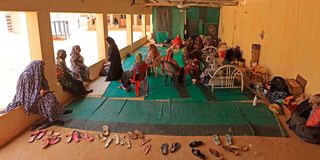
Women displaced by conflict sit at a mosque in Sudan's northern border town of Wadi Halfa near Egypt.

What you need to know:
- The UN says 676 million women live in war zones, with sexual violence up 87 per cent and humanitarian support for women’s groups at just 0.4 per cent of aid spending.
- The 25th anniversary of UN Resolution 1325 finds women still excluded from peace tables and vulnerable to conflict-related sexual violence.
In the dim light of a November afternoon, a 46-year-old woman sat before a team from UNFPA and began to speak. Her name is Asifiwe, and the story she carried from the Democratic Republic of Congo was one that tens of millions of women across the world could recognise—a story written in violence, displacement, and survival.
The memory was still fresh: January 2023, when conflict swallowed her hometown of Kitchanga whole. Asifiwe fled with her family, searching for safety in Lushagala. But displacement, as she would learn, offers no sanctuary from the horrors of war.
"The rebels entered our house, tied up my father. Then took me and my two older sisters and raped us all. It was such a painful experience that I will never forget," she said.


The attack left her body broken—chronic abdominal and back pain became her constant companions. But the wounds that cut deepest were the ones no one could see. In a culture where survivors of sexual violence face stigma and discrimination, Asifiwe lived with a fear that shadowed her every day: abandonment by her husband, alienation from her community.
Her story is not singular. In the DRC alone, an estimated 48 women are raped every hour. Across the globe, sexual violence has become a weapon of war, and women and girls have borne its sharpest edge.
A world aflame
The 2025 UN Secretary-General's report on Women, Peace and Security delivers a stark assessment: the world is experiencing the highest number of active conflicts since 1946, creating unprecedented risks and suffering for women and girls.
The numbers tell a story of escalation. An estimated 676 million women now live within deadly conflict zones—the highest level since the 1990s. Civilian casualties among women and children have quadrupled compared to the previous two-year period. Conflict-related sexual violence has surged by 87 per cent in just two years.
The report arrived during the 25th anniversary of Security Council resolution 1325, which once committed the international community to women's full participation and protection in peace and security. A quarter-century later, that promise remains largely unfulfilled.
"Women and girls are being killed in record numbers, shut out of peace tables, and left unprotected as wars multiply. Women do not need more promises—they need power, protection, and equal participation," said Sima Bahous, UN Under-Secretary-General and UN Women Executive Director.
Despite overwhelming evidence that women's participation makes peace more durable, they remain systematically excluded from decision-making. In 2024, nine out of 10 peace processes had no women negotiators. Women made up just 7 per cent of negotiators and 14 per cent of mediators globally.
The price of exclusion
While an increasing number of countries have developed national action plans to implement resolution 1325, tangible change for women remains elusive.
The report exposes a dangerous imbalance that reveals where priorities truly lie. Global military spending surpassed USD 2.7 trillion in 2024. Women's organizations in conflict zones—the very groups on the front lines of survival and peacebuilding—received only 0.4 per cent of aid. Many are facing imminent closure due to financial constraints.
"These are not isolated data points—they are symptoms of a world that is choosing to invest in war instead of peace, and one that continues to exclude women from shaping solutions," Ms Bahous noted.
She added that the report underscores the urgent need for a gender data revolution. Without disaggregated data, women's realities in war zones remain invisible and unaccounted for. Closing these gaps is vital for accountability and for placing women's experiences at the centre of decision-making.
"UN Women is calling for concrete, measurable results: conflicts resolved through inclusive political solutions, more women leading security reforms and recovery efforts, and greater accountability for violations, including access to justice and reparations for survivors," Bahous concluded.
Violence as strategy
In 2024, more than 4,600 cases of conflict-related sexual violence—including as a tactic of war, torture, terror, and political repression—were documented. This represents an 87 per cent increase between 2022 and 2024, according to UN data.
Gender-based violence was assessed as severe or extreme in 22 of 25 countries that experienced humanitarian crises.
The scale of displacement tells its own story. At the end of 2024, an estimated 123.2 million people were forcibly displaced, representing a decade of year-on-year increases in the number of refugees and others forced to flee their homes. Over 60 million forcibly displaced and stateless women and girls face elevated risks of gender-based violence.
When hunger becomes a weapon
Conflict drives hunger in most of the world's food crises—from Gaza and Sudan to Yemen and Mali—pushing food and nutrition insecurity to unprecedented levels.
In 2024, more than 295 million people faced high levels of acute food insecurity. Nearly half of them—139.8 million people, or 47 per cent—lived in conflict or insecurity zones.
The crisis hits pregnant and breastfeeding women with particular cruelty. In 2024, 10.9 million pregnant and breastfeeding women faced malnutrition in 21 countries with nutrition crises. A third of them were in the Democratic Republic of the Congo, while Afghanistan, Ethiopia, South Sudan, and Sudan each had over one million.
The war on education
Conflicts have also put girls' education under fire. Over 85 million children affected by crises are out of school, of which 51.9 per cent are girls—including five million girls in Sudan alone.
Four years after the Taliban takeover, eight out of 10 young Afghan women are excluded from education, jobs, or training.
UN Women estimates that more than 28,000 women and girls have been killed in Gaza by May this year since the beginning of the war in October 2023. That is one woman and one girl, on average, killed every hour in attacks by Israeli forces. Among those killed, thousands were mothers, leaving behind devastated children, families, and communities.
In Ukraine, the toll continues to mount. More than 4,000 women and 300 girls have been killed, and 9,596 women and 750 girls have been injured, since the war with Russia started in 2022.
In Sudan, out of the 12 million people displaced by the ongoing war, about 5.8 million are women. Reports show that at least 412 children and 400 women have faced sexual and gender-based violence since the beginning of the conflict. However, the volume of first-hand accounts suggests that this is a vast underestimation.
The estimated 6.9 million women and girls at risk of sexual and gender-based violence in Sudan are often affected by unwanted pregnancies, unsafe abortions, and untreated sexually transmitted infections.
Issued on the 25th anniversary of Security Council resolution 1325, the report warns that two decades of progress are unravelling. Somewhere, as these words are read, another woman like Asifiwe is facing what she faced. The question is no longer whether the world knows what is happening. The question is what it will choose to do about it.
Follow our WhatsApp channel for breaking news updates and more stories like this.