Voices from the margins: Women in Kajiado, Narok rewrite empowerment on their own terms
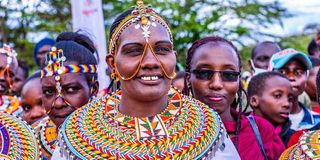
Women wear beaded necklaces during a ceremony.

What you need to know:
- Women in Kajiado and Narok dream of independence, but face financial, cultural, and environmental barriers to empowerment.
- Economic empowerment for women means health, freedom, and opportunity, but access to resources and support remains limited.
Every morning, Mary, a mother of three, starts the day in her grass-thatched house in Kajiado County before dawn.
As she routinely tends her small chicken coop, she wears a distant look, immersed in a simple yet profound dream: “I hope to one day own a small poultry farm that can feed my family and provide a decent income.”
But the path to that dream is fraught with challenges. “I need financial support to achieve my dream,” she says, louder this time, with her voice tinged with determination and hope.
Just a few kilometres from Mary’s homestead, Grace meticulously strings colourful beads into jewellery. A skilled artisan, she faces a different challenge.


“There are no markets for my beads,” she laments. “Sometimes I sell them for almost nothing, just to buy food for my children.”
Her story echoes those of countless women across Kajiado and Narok counties, struggling to translate their skills and hard work into financial independence. Mary and Grace are not alone. Their stories are part of a larger story of women striving to rewrite the narrative of economic empowerment. This narrative has been highlighted through a recent campaign report called What Women Want for Economic Empowerment. In this report, more than 7,000 women and girls from Kajiado and Narok share their dreams, barriers, and suggest solutions to their economic woes.
For these women, economic empowerment transcends financial gain. It represents ownership, independence, and the freedom to pursue their aspirations. Asked to define economic empowerment, Naserian, one of the respondents, says, “This is where women can generate resources for themselves and use them for their personal gain.”
Women's economic empowerment, as defined by UN Women, encompasses a wide range of factors that contribute to their ability to participate fully and equally in the economy. This includes not only their ability to participate in existing markets, but also their access to and control over productive resources, such as land, capital, and technology. It includes their access to decent work – one that provides fair wages, safe working conditions, and social protection.
Furthermore, women's economic empowerment involves control of their own time, lives, and bodies, having the freedom to make decisions about their own lives without fear of violence or discrimination. It also means having a voice and agency in economic decision-making at all levels, from the household to international institutions, and having the ability to influence policies and decisions that affect their lives and communities.
Women’s economic empowerment, by UN standards, is not only a matter of economic development but also a matter of human rights and gender equality. When they are economically empowered, they are able to realise their full potential and contribute to their families, communities, and societies. They are also able to challenge gender stereotypes and discrimination, and to advocate policies and programmes that promote equality.
According to Angela Nguku, the founder and executive director of White Ribbon Alliance Kenya, economic empowerment is closely linked to the ability to access quality healthcare. Women in Kajiado have expressed their need for affordable transport to healthcare facilities, menstrual products, family planning options, and a balanced diet, among others, all of which are tied to financial stability.
“The findings of our survey highlight the dreams and aspirations of women for economic power, as well as the challenges they face and the support they need to overcome the same. I call on all those who make decisions on behalf of women and girls to prioritise their self-articulated voices and needs, to ensure they have the economic power to take charge of their health and that of their families,” Angela intimates.
Economic empowerment, as defined in the report, centres on owning resources and making decisions on their use. For many, this means starting or expanding businesses. Poultry farming, beadwork, livestock production, and small-scale retail are the most frequently mentioned ventures. “I dream of having my own salon,” says a young woman. “With a salon, I can provide for my children and save for their future.”
Another woman in the focus group shares a similar vision: “I want to open a boutique. In this region, women hardly get access to good clothes at fair prices. That is the gap I have identified and I would love to be the one to fill it up by bringing trendy clothes at an affordable rate.”
A remarkable number of the respondents expressed their aspiration to gain education and skills to navigate economic spaces more effectively. “We need training in how to manage money and expand our businesses” was repeatedly mentioned by different women. Leadership skills also featured prominently, with a good number saying they would want to join public participation forums and speak for other women in their community.
Women also highlighted the connection between financial independence and healthcare. “When we earn our own money, we can pay for hospital visits, buy medicines, and take care of our children,” says a participant in her 30s. “This is not just about us—it’s about the well-being of our families.”
Despite their ambitions, these women face formidable barriers. Chief among these is access to capital. “The cost of starting a business is too high, and we don’t have enough resources,” explains Mary, the small-scale poultry farmer.
Many women noted that the lack of collateral prevents them from accessing loans or grants. Grace said, “Even when we form groups to apply for loans, the process is too complicated. We need training in how to navigate these systems.”
Infrastructure poses another significant challenge. Poor roads, limited access to water, and inadequate storage facilities hinder economic activities. “Sometimes, milk goes bad before we can find buyers,” said a dairy farmer.
Market access remains a critical issue for artisans like Grace, whose beautiful beadwork has few buyers. “We need markets that are not controlled by middlemen,” she says.
Cultural expectations often double the burden. Many women shoulder both domestic responsibilities and the financial weight of their households. “Most men have neglected their responsibilities, leaving us to bear the financial burden of our families,” shares one participant.
Psychological barriers, such as low self-esteem and lack of confidence, complicate matters. “We are told we cannot succeed because we are women. That needs to change,” says another.
Environmental challenges, such as droughts, also exacerbate the struggles of women in farming. “We walk long distances to fetch water. By the time we return, there is little energy left for anything else,” said a farmer.
A World Bank, Kenya Country Climate and Development Report (2024) shows that climate change poses a substantial risk to economic development, with projections indicating potential losses equivalent to 2.6 per cent of gross domestic product annually by 2030. Implementing climate-smart agricultural practices and investing in resilient infrastructure are critical to mitigating these impacts and promoting sustainable economic growth.
A different report by the UN Women and Food and Agriculture Organization (2024) indicates that empowering women in arid and semi-arid regions such as Kajiado and Narok counties through climate-smart agriculture is a multifaceted approach that yields a multitude of benefits. It enhances food security by providing families with a consistent and reliable source of nutritious foods, even in the face of challenging environmental conditions. This is achieved through the adoption of drought-resistant crops, which can thrive with minimal water input, and the implementation of efficient water management, such as rainwater harvesting and drip irrigation that optimise the use of available water resources.
Climate-smart farming
Further, climate-smart agriculture provides sustainable livelihoods for women and their families. By increasing crop yields and diversifying income streams, women farmers are able to generate a stable income, which can be used to support their families, invest in their businesses, and improve their overall quality of life. This economic empowerment also strengthens women's social standing within their communities and gives them a greater voice in decision-making.
Climate-smart agriculture contributes to environmental sustainability. By promoting soil conservation, such as agroforestry and cover cropping, and reducing the use of synthetic fertilisers and pesticides, women farmers protect and restore the fragile ecosystems in arid and semi-arid regions. This, in turn, enhances resilience to climate change and other environmental shocks.
Overall, empowering women in arid and semi-arid regions through climate-smart agriculture is a holistic strategy that addresses the interconnected challenges of food insecurity, poverty, and environmental degradation.
By equipping women with knowledge, skills, and resources to adapt to the changing climate, we build a more sustainable and equitable future for all. Economic disempowerment directly hurts health and wellbeing. Many women highlighted their inability to afford healthcare services. “I cannot get access to good health services because of high costs at health centres,” lamented a 24-year-old.
Others mentioned the difficulty of purchasing menstrual hygiene products and providing nutritious meals for their families. These struggles lead to malnutrition, poor maternal care, and limited access to family planning services. “Without money, you cannot make choices about your health,” one woman summarises.
Water scarcity and poor sanitation exacerbate these challenges, especially during droughts. According to findings by the International Centre for Research on Women, women who earn an income tend to prioritise expenditures on education, health, and nutrition, creating a ripple effect that benefits entire communities. This is why their economic empowerment should be the cornerstone of development strategies.
At the heart of the campaign is the Ask-Listen-Act methodology, a participatory approach that prioritises the voices of women. “It’s the first time we felt heard and we want our suggestions to solutions implemented, not just documented. Previously, we have heard our ideas sought, but never put to use. But we are hopeful that this will not be the case this time round,” said a participant.
This approach has revealed a shared vision for economic empowerment, with priorities such as financial literacy training, access to low-interest loans, and better market opportunities. “We need fair prices for our products,” another bead maker echoed Grace’s sentiments.
To navigate the financial barriers, a good number of women in Kajiado County have formed community groups or chamas to pool resources. The chamas help members with money whenever each of them wants to start an income-generating activity. While this format’s sustainability has not been tested, it is working for them.
“The majority of women are engaged in low-paying, informal work, often due to limited skills and educational opportunities. This limits their earning potential and traps them in a cycle of vulnerability. Compounding these challenges, access to formal credit from banks is severely limited for most women often due to a lack of understanding of credit processes and a fear of debt. This financial exclusion further hinders women's ability to start or grow businesses, limiting their economic independence,” says Dr Rhoune Ochako, the managing director (an advisory and social research consultancy) at Lagniappe.
“Moreover, economic disempowerment increases women's vulnerability to gender-based violence, including domestic abuse and sexual assault during daily activities. To address these challenges, county governments must create an inclusive environment by implementing policies and programmes that actively support women's economic empowerment and ensure the effective implementation of national policies aimed at advancing women's rights and opportunities.”


