When the rains fail, violence rises: New study warns of deepening gender risks
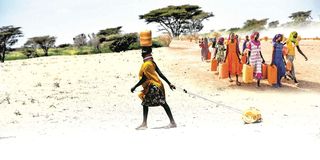
A woman pulls a jerrican of water in Kanamkuny village,Turkana County, on October 11, 2022. As climate change intensifies, women face higher rates of violence, displacement, and poverty.

What you need to know:
- A new study shows that climate shocks—including droughts and floods—are driving a surge in gender-based violence across Kenya’s arid and semi-arid counties.
- As women and girls walk long distances for water and firewood, they face heightened risks of assault, early marriage, and FGM.
- Climate change is intensifying inequalities and exposing women and girls to escalating violence in northern Kenya.
Every year, images of women and young girls in arid and semi-arid regions trekking in search of water during droughts have become familiar. Women and girls walk tens of kilometres to find the precious commodity for domestic use and for their livestock.
Arid and semi-arid parts of the country are experiencing their worst drought in 40 years, with 4.5 million people facing acute food insecurity. As men migrate with livestock, women and girls are left behind, forced to walk long distances to fetch water and firewood—journeys that expose them to harassment and assault.
Evidence from a survey by IDH and the UN Global Compact Network Kenya on gender-based violence (GBV) in the agricultural sector shows that domestic violence surges during climate shocks. The study, titled From Risk to Resilience: Building Safe, Inclusive and Climate-Resilient Value Chains, indicates that in drought-hit counties, GBV cases reported to support centres rose by 50 per cent between 2021 and 2022.

Civil society groups in Garissa and Turkana have linked early marriages and transactional sex to survival strategies during prolonged droughts. Floods create similar risks: displacement and overcrowded shelters increase exposure to sexual violence. Climate stressors such as droughts and floods, and resource scarcity deepen vulnerabilities and heighten GBV risks.
Read: Women on the frontline: Study warns GBV in agriculture is a growing business and economic risk
The National Gender and Climate Change Action Plan (2025–27) recognises these vulnerabilities, but implementation has been slow. According to the study, unless GBV prevention is integrated into climate adaptation strategies, Kenya risks undermining its own resilience agenda.
With failed rainy seasons and recurrent floods, the survey notes that climate stress is no longer a future threat—it is a daily reality. These shocks deepen women’s economic dependency, further fuelling vulnerability to violence. “Failing to address GBV carries immense economic and social consequences. GBV disrupts supply chains, weakens productivity, fuels poverty cycles, and threatens Kenya’s progress towards Vision 2030,” the study states.
For businesses, this translates into absenteeism, high turnover, and reputational damage. For communities, it means insecurity and declining food stability. Trini Ariztía, the global gender director at IDH, said during the release of the study in Nairobi that behind every incident, every statistic, every “case” is a person navigating a complicated landscape of power, silence and survival.
Trini added that research consistently shows that when climate stress rises, gender-based violence rises. “This is not a marginal or abstract issue. It is structural. It is happening every day across farms, factories, packhouses, transport routes and households. GBV is not invisible—it is simply unreported. But it shows up everywhere in the numbers,” she said.
She noted that in agricultural settings where supervisors are trained, grievance systems are functional and anonymous, men engage in sessions on respect and positive masculinity, women know their rights, and fear is replaced by trust, there is evidence of better business outcomes.
Domtila Chesang, founder of the I-Am Responsible Foundation, an organisation championing the fight against FGM and child marriage in West Pokot, told the Nation that drought often forces many girls out of school, placing them at heightened risk of undergoing the cut.
“The only escape for girls in the region from FGM is being in school, and with many institutions closed due to the ravaging drought and insecurity, they are now exposed and at risk. There is a need for the government to address insecurity even as we pray for rains,” Domtila said.
She added that cases of girls being married off for bride price to help families survive the drought have also become common. “With many animals dying from famine and others being stolen through cattle rustling, some families turn to marrying off their daughters—who sadly must undergo FGM first. The dowry paid helps them acquire more cattle, goats or money for food,” she said.
Gabriel Letukei, an elder in Samburu County, noted that the perennial drought crisis forces many young mothers and girls to trek long distances in search of water, making them vulnerable to sexual and gender-based violence and causing girls to miss school. “Having a regular water supply can be instrumental in the fight against sexual and gender-based violence. Many defilement and FGM cases occur early in the morning or late in the evening when girls have gone to fetch water,” Gabriel said.
The Gender Snapshot 2024 report indicates that by 2050, climate change may push up to 158 million more women and girls into poverty—16 million more than the number of men and boys affected. Even today, 47.8 million more women face food insecurity and hunger than men.
A 2025 UN Spotlight brief finds that climate change is intensifying social and economic pressures that are driving increased levels of violence against women and girls. One study cited in the brief found a 28 per cent increase in femicide during heatwaves. Without urgent action, climate change could be linked to one in every ten cases of intimate partner violence by the end of the century. The impacts will be felt most severely in communities where women already face entrenched inequalities.
In many regions, women bear a disproportionate responsibility for securing food, water and fuel for their families. When these resources become scarce due to the changing climate, women must work harder and travel farther. This increased burden is also placed on girls, who are often forced to leave school to help their mothers manage household responsibilities.
Research shows that the instability and poverty that follow climate-fuelled conflicts lead to more instances of conflict-related sexual violence, human trafficking and child marriage. Climate change also affects maternal and neonatal health, especially where disasters and conflict disrupt access to healthcare and essential services.
In northern Kenya, girls and women have been severely affected, with drought disproportionately impacting them as they spend long hours searching for water—walking great distances to reach boreholes and queuing at water kiosks, often competing with large herds of livestock. Water scarcity also compromises hygiene, especially for girls and women, as the little water available is prioritised for drinking and cooking.
According to the 2021 food and water assessment report for Samburu County, conflicts triggered by competition for rangeland resources have resulted in the loss of lives and livelihoods, alongside an increase in climate-related cases of domestic violence.


