When women lead, oceans thrive: Kenya’s coastal transformation
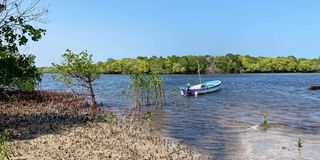
A mangrove project spearheaded by women in Gazi, Kwale County.

What you need to know:
- Women are reclaiming their place in the blue economy. Once confined to the shores, they now sit at the decision-making table in Beach Management Units, reshaping the future of marine conservation and community resilience.
From Mkwiro to Vanga, they are rising to leadership roles in fisheries. Advocates say their inclusion not only promotes gender equality but also boosts accountability, trust, and access to global funding for marine conservation.
The sun is barely up over the Indian Ocean when boats begin their journey out to sea. For generations, this scene has played out the same way—men heading into the waters while women wait on the shore, their hands ready to process whatever catch the tide brings. But something is shifting along Kenya's coastline, and it has nothing to do with the changing tides.
In the meeting halls of Beach Management Units (BMUs) across the region, a quiet revolution is taking place. Where once only male voices echoed off the walls, women are now taking their seats—not at the back, not in silence, but at the front, leading the conversation.
Just a few years ago, seeing a woman in leadership within BMUs was almost unheard of. For decades, fisheries and marine conservation spaces were dominated by men, with women relegated to the margins of decision-making despite being key players in the sector.

BMUs are community-based organisations formed to manage and conserve fisheries by promoting sustainable use of ocean resources. They are legally recognised and bring together fishers, fish traders, and other stakeholders. Their activities go far beyond fishing. Members engage in coral reef restoration, seaweed farming, seagrass conservation, mangrove rehabilitation, and octopus enclosures—initiatives that require strong community cooperation and leadership.
Yet, cultural and religious norms have been among the key barriers, often forcing women to take a backseat in the fishing sector despite their critical roles in processing, value addition, and marketing. But the tide is turning. More women are now being encouraged to take up leadership and committee positions in BMUs.
Gender advocates say women’s inclusion in marine management is not only a matter of equality but also essential for building community resilience amid growing threats such as climate change and pollution, which continue to endanger the blue economy.
Magdalene Were, the regional coordinator for gender equality at Mission Inclusion, said maximum impact in marine conservation can only be achieved when women are fully involved.
“In 2023, we conducted a gender-based analysis on governance structure that showed only 15 per cent of committee positions are held by women within BMUs in Kenya, and this is still a small number,” said Magdalene, whose organisation works closely with women in the blue economy across the Coast region.
She said cultural barriers remain a major challenge, as traditionally women do not go into the sea and only engage in shoreline activities, which limits their economic opportunities. “Cultural barriers have lowered women's confidence, discouraging them from vying for leadership positions and participating in meaningful decision-making,” she said.
Domestic chores
Magdalene added that most meetings are held during hours when women are engaged in care work, forcing them to prioritise domestic responsibilities. “This limits the economic benefits women gain from the ocean and the influence they have,” she said, urging the government to ensure that policies such as the two-thirds gender rule are fully implemented.
According to her, having women in key offices would enable them to access better benefits, such as owning boats or fishing equipment, to increase their harvests and sales.
As advocacy continues, Kwale County stands out for embracing women's leadership in BMUs. In an interview with the Nation, County BMU Network chairperson Mtengo Omari confirmed that more women are being encouraged to take up leadership positions, with Vanga and Mkwiro BMUs leading the way.
“This year, we elected a woman to chair the Mkwiro BMU, while Vanga has previously had a female chairperson. Through their leadership, we've seen a significant positive impact,” he said.
Mr Omari noted that women’s inclusion in community structures is already yielding meaningful results, with many BMUs showing improvement in accountability. He said women have always been instrumental in the fisheries sector, which is the backbone of the Coast’s economy, but they have not always been visible.
“In the past, we had different cultures within us. Women were not allowed to get into the water to fish, and that is why it was not important for them to be in decision-making positions.”
He added that in predominantly Muslim communities, religious norms sometimes make it difficult for women to speak before men. “Currently, women are given chances to speak and are empowered with more information about the ocean,” he said.
“We have a special committee that only has women in it. This is a chance for them to have their issues better represented and they can competitively vie for leadership positions in the community.”
Mr Omari explained that the few women at the forefront of conservation have helped BMUs gain trust and attract more support to enhance their operations. As the ocean faces growing threats such as acidification due to rising global temperatures, adaptation and mitigation initiatives have become more urgent.
Communities believe that having women in key committees when seeking funding attracts more attention, increasing their chances of success. “When we write proposals, it is usually hard to get support without the women's numbers, as it is a requirement for most donors. So when a woman speaks, they are believed to be honest,” said Mr Omari, adding that women’s inclusion enhances trust in leadership.
Partnerships
Many BMUs are now collaborating to mitigate the effects of climate change through conservation efforts supported by international organisations. Units such as Kuruwitu, Wasini, and Mkwiro have set aside specific areas within the ocean, known as locally managed marine areas, where communities restrict fishing to promote breeding and protect marine ecosystems.
Vatosoa Rakotondrazafy, the regional coastal and ocean governance manager at the International Union for Conservation of Nature, said that beyond local achievements, international collaboration remains crucial. “When you have a coalition, you are able to strengthen your voice. This means it is easier to access funding and even build capacity for more women getting into leadership positions,” she said.
She added that, just like other countries with locally managed marine areas, cross-border alliances can improve representation and resilience against climate change. “Such an alliance would be part of a global movement that helps achieve the sustainable use of ocean resources by building community capacity while creating harmonised regulations across countries, given that the Indian Ocean is a shared resource,” she noted.


