Whistle, sweat and soil: How one woman is changing Kenyan rugby
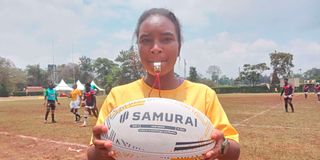
Esther Nyambura poses for a photo on the sidelines of the 2025 Federation of Africa University Sports (FASU) Rugby Sevens Championship held in Nairobi on October 4-5, 2025.

What you need to know:
- Nyambura belongs to a rare breed. In a country where rugby is played with religious fervour, there are only about eight active female rugby referees in Kenya.
- They navigate a world where whistles and authority have long been symbols of male dominance, where a woman in the middle of the pitch still raises eyebrows.
The whistle cuts through the heat like a blade.
Under the scorching sun at the 2025 Federation of Africa University Sports (Fasu) Rugby Sevens Championship at KCB Ruaraka Sports Club in Nairobi, bodies freeze mid-stride.
Heads turn. At the centre of the field stands a composed figure, whistle poised, eyes steady and unwavering.


Twenty-five-year-old Esther Nyawira Nyambura commands the pitch—not with size or volume, but with something quieter and far more powerful: presence.
"It feels good when you are there commanding, especially men," she says with a grin after the match. "You are the one giving them the commands—no, yes, or yes."
Nyambura belongs to a rare breed. In a country where rugby is played with religious fervour, there are only about eight active female rugby referees in Kenya. They navigate a world where whistles and authority have long been symbols of male dominance, where a woman in the middle of the pitch still raises eyebrows.
Yet her journey to this moment began far from any stadium, in a quiet corner of Dagoretti, Nairobi.

Esther Nyambura poses for a photo on the sidelines of the 2025 Federation of Africa University Sports (FASU) Rugby Sevens Championship held in Nairobi on October 4-5, 2025.
"My journey began way back while in high school at Hidden Talent in Dagoretti," she recalls. "It is a children's home kind of setting. That is where I joined rugby, though I didn't play it professionally."
At the institution, Nyambura played scrum-half, the lively number nine position where quick thinking and sharp communication rule the day. But after school, she stepped away from rugby. She tried baseball first, until the Covid-19 pandemic slowed everything down.
"After Covid, baseball was a bit slow," she says. "That is when I fully transitioned to rugby. I loved rugby from high school. That school exposed us to sports so much. I just loved the unity, the discipline, the commitment. I felt like that's where I belong."
In rugby, she found more than sport. She found structure, integrity, something that resonated in her bones.
"There is a lot of discipline in rugby," she says. "And even fairness. You just feel happy, like you are doing the right thing."
The day everything nearly fell apart
Nyambura's officiating journey began in 2022. Her first match as a centre referee was a Women's Kenya Cup game—a match that nearly broke her spirit.
"It was my first ever game as a centre referee," she remembers. "The players decided to walk off the pitch while the game wasn't over. They said they wanted another referee. That broke my heart."
It would have been easy to quit. To hand back the whistle and walk away, convinced that this world was not meant for her.
But she didn't.
"I decided to be courageous and trust myself," she says. "The support from my Coaches of Match Officials (CMOs) and fellow referees kept me going. You like a place where you are growing, and that's why I'm still here."
Two years later, she has officiated more than 30 matches—from Women's Kenya Cup games to Nationwide Men's fixtures, and on to the National Sevens Circuit, where she handled her first-ever finals in Nakuru during the Prinsloo Sevens. In 2025, she took charge of the bronze final at the Dala Sevens in Kisumu.
"That was huge for me," she says proudly.
Her consistency paid off when she was named Most Promising Lady Referee at the end of the 2024-2025 season—an award she didn't see coming.
"That award came as a surprise," she says. "But I had put in a lot of work. From training with clubs, reviewing my games every Tuesday, and setting clear objectives with my CMO. It all led to that moment."
Esther Nyambura poses for a photo on the sidelines of the 2025 Federation of Africa University Sports (FASU) Rugby Sevens Championship held in Nairobi on October 4-5, 2025.
Making history on home soil
Her eyes light up when she recalls another milestone—officiating the Nationwide play-offs final between Nation Youth Service (NYS) and Administration Police (AP), the first-ever all-lady officiated final in Kenyan rugby.
"I didn't believe it at first," she laughs. "It was my best moment because it was history—an all-lady team, from the centre referee to the in-goal."
Balancing the books and the whistle
Away from the pitch, Nyambura wears another hat: accountant at Power Governors Limited, a company dealing in vehicle telematics.
"I'm an accountant by profession," she says. "I have a degree in finance from KCA University, and I'm planning to pursue a second one, maybe even a master's later."
Her employer, she says, has been incredibly supportive.
"They know I engage in rugby, so they always give me time to go do what I love."
Refereeing mostly happens on weekends, allowing her to juggle her professional life, family, and another passion that has become her mission: environmental conservation.
Tries for trees: Where rugby meets reforestation
"I love nature," Nyambura says, her face softening. "I love the environment. I love plants. I just love everything to do with making the environment better."
Her love for nature inspired the creation of 'Tries for Trees', an initiative that merges rugby and reforestation in a way that is as simple as it is brilliant.
"Sports is like a community. People come together with unity of purpose," she explains. "So we decided to plant trees equivalent to the tries made during a tournament."
The initiative has already seen trees planted with Kenyatta University, Kabras Sugar RFC, Jomo Kenyatta University of Agriculture and Technology (JKUAT), Zetech University and Lenana School.
"Our goal is to plant more than 50,000 trees by 2026," she says. "We've partnered with Ngong Forest, and the Kenya Forest Service even donates seedlings when we explain what we're doing."
She emphasises that it's not just about planting, but about education too.
"We teach players why we've planted certain trees like Jacaranda for shade or indigenous species that support life. We don't just want to plant; we want to sustain."
Dreams beyond borders
Nyambura's dream stretches far beyond Kenya's borders.
"My dream is to one day officiate outside Kenya, Africa, in world rugby," she says. "And also to have this environmental aspect recognised globally. Imagine having an award for the club that supports the environment—a Sports Trees Award!"
She lights up at the thought.
"It would motivate clubs to plant more trees, to give back to the earth that gives us the air we breathe."
The weight of breaking barriers
Her path, however, has not been easy.
"In officiating, there are a lot of challenges," she admits. "This is a male-dominated field. You have to be at par with men. Your fitness level has to be high. You have to be consistent."
And then there is the stigma.
"Sometimes people see you and say, 'Oh, you're the one officiating?' They still doubt when they see it's a lady," she says. "But things are changing. People are beginning to see that even ladies can officiate the game."
Tree planting, too, has its hurdles.
"We lack enough space," she says. "That's why we work with schools and universities. And of course, funding. When you say you are planting trees, you have to facilitate everything yourself."
A day in her boots
At the 2025 Fasu Africa Sevens Championship in Nairobi, her day begins early.
"I packed my bag the night before—boots, three pairs of kit, socks—because you never know when teams might clash in colours," she says.
She wakes at dawn, hydrates, eats a heavy breakfast, and arrives at the venue an hour before kick-off.
"Games are back-to-back, so timing is everything. Afterwards, I stretch and rest for the next day."
Keeping fit is non-negotiable.
"We train with teams, and our strength and conditioning coach gives us endurance drills. You have to keep your body ready."
The people who keep her going
Behind her determination stands a strong support system.
"My family's support is huge," she says. "They always ask me, 'You don't have a game today?' That pushes me."
Although her family is not deeply rooted in sports, Nyambura believes she is starting a new sporting generation.
"I know my generation will be sporty people," she says proudly.
She also dreams of starting her own family.
"I'm planning to," she says softly.
Her inspiration to be a referee came from another woman in the middle of the pitch.
"I remember seeing Faith Mulongo officiate a game," she says. "I was inspired just seeing her inside the pitch."
Her current role models are Precious Pazani of Zimbabwe and Aimee Barrett-Theron of South Africa.
"They've broken barriers," Nyambura says. "Even if I don't reach where they are, I'll try my best to align my goals and work toward them."
When sport and climate collide
For Nyambura, climate change is not just a buzzword. It is a visible, physical concern for athletes.
"Climate affects sportspeople," she explains. "Some fields are so hot you can't even breathe. Trees help us get fresh air and shade. Look at Iten—full of trees, fresh air, and top athletes."
She hopes Kenya's sports community will take the environment seriously.
"If we cut a tree, let's plant five more," she says firmly. "It's about the generations to come."
The worst and the best
Her worst moment remains that first game—when the players walked off.
"I even told my supervisor, 'I don't want to officiate anymore,'" she says. "But then I decided—this will not be my last moment."
Her best?
"Being told I was officiating the nationwide finals—and realising it was an all-lady team. That was history. That was pride."
Words for those who will follow
"To anyone looking up to me," she says, "understand what you want to do, and align yourself with the right people. Nothing comes easy. You have to study, train, and plan."
Her message to women is powerful and unequivocal:
"Ladies, the sky is the limit. Don't shy off from what makes you happy. Be courageous and believe in yourself. Have a role model who knows you and an accountability partner who walks with you. And don't procrastinate—plan."
As the sun dips over the field, Nyambura's whistle echoes one last time before the players walk off, sweat and mud on their faces. Later, she will trade her boots for a shovel, planting another tree in honour of every try scored, every new beginning.
For her, rugby and the environment are not separate worlds. They are two sides of the same fight—for fair play and a future worth breathing for.
"My dream," she says, "is to see trees grow and to know that I have made the world a little better."


