Why Kenya's 'inward decolonisation' matters for women’s access to AI-powered health solutions
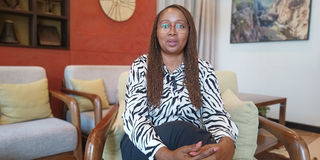
Angela Wamola, Head of Sub-Saharan Africa at GSMA, during the interview on African Population and Health Research Centre campus in Nairobi on November 19, 2025.

What you need to know:
- Experts at the 2nd Africa Health and Development Research Symposium warned that despite rapid advances in AI-driven health technologies, women remain the most excluded.
- Structural inequalities, restrictive social norms and poor access to devices continue to prevent women from benefitting from digital innovations.
- The symposium highlighted that decolonising global health requires confronting power imbalances both globally and within African societies.
At a time when Africa’s research institutions are rolling out new artificial intelligence (AI) tools to transform healthcare, women remain the most excluded from these advances, according to experts speaking at the 2nd Africa Health and Development Annual Research Symposium held at the African Population and Health Research Centre (APHRC) campus in Nairobi.
The two-day forum, held on November 19–20, 2025, and co-organised by the Science for Africa Foundation, GSMA and the East, Central and Southern Africa Health Community, brought together scientists and technology leaders to examine how to decolonise global health in the age of digital transformation. The gathering explored how to rethink aid and partnerships as Africa leads its future, and how digital innovations can advance health on the continent.
But as new solutions emerge, concerns are growing about women’s unequal access to digital technologies and the underlying gendered norms that continue to hold them back. Dr Anthony Mveyange, director of programmes at the APHRC, said the discussion on decolonising global health cannot be separated from questions of power and privilege, including gendered power.


He described decolonisation as an effort to expose and dismantle “epistemic injustices, power imbalances, patriarchy, and coloniality” that continue to elevate the Global North as superior to the Global South. Even within that hierarchy, he added, a white woman scholar would have more privileges than a male African scholar, illustrating how multiple layers of inequity intersect.
The goal of the symposium, he said, was to make such hidden power structures visible. This included questioning internal inequalities within Africa. Dr Mveyange argued that while Africans challenge the Global North’s dominance, they must also confront inequalities within families, workplaces and communities, including the “superiority complex” that still positions men above women.
“If we want to engage with the world, we must also introspect,” he said. “How do you treat our women? How do you treat our men? Are there balances there?”

Dr Anthony Mveyange, Director of Programmes at the African Population and Health Research Centre, during the interview on APHRC campus in Nairobi on November 19, 2025.
He described this process as “inward decolonisation,” noting that harmful norms within African societies often prevent women from accessing knowledge and digital tools even where infrastructure exists. Despite these inequities, APHRC is increasingly developing digital and AI-based innovations designed to improve health access, especially for vulnerable populations.
Dr Mveyange cited two recent AI-powered mobile applications: Faraja, a mental health app, and Amina, a Swahili-language diagnostic tool capable of differentiating male and female voices and identifying health conditions. He said these tools aim to reach populations typically excluded from health interventions, particularly women in rural communities.
Beyond these, APHRC has developed apps that scan food barcodes in supermarkets, innovations in oxygen systems, and is engaged in upcoming work building large language models in major African languages such as Swahili, Amharic, Hausa, Fulani and Zulu.
Dr Mveyange, however, emphasised that gender inequalities persist not because knowledge is inaccessible but because social norms restrict women’s access to the technologies needed to benefit from these advances. Angela Wamola, head of Sub-Saharan Africa at GSMA, underscored the scale of the problem.
She noted that although 91 per cent of Africa’s population is covered by a 3G, 4G or 5G signal, only 30 per cent have ever been online. The rural–urban divide is stark: people living in rural areas are 48 per cent more likely to be offline, she said. The gender gap is even wider, with women 35 per cent less likely than men to use the internet.
She explained that this exclusion is driven by a combination of factors that continue to shut women and marginalised communities out of the digital space. These include unaffordable smartphones, high data costs, and restrictive social and cultural norms that limit women’s access to technology.
“The majority of our population is offline despite being near a broadband signal,” Angela said. “We must understand what is driving those barriers, including those affecting women.”
Angela pointed to examples showing that digital health can improve outcomes for women when systems are well-designed.
A GSMA-supported pilot in Kumasi, Ghana, connected local patients to health workers in Ghana and specialists in Singapore using existing 4G infrastructure, she said. It demonstrated how digital tools can enhance diagnosis, care and knowledge exchange, with clear potential benefits for women and underserved groups.
But Angela stressed that scaling such innovations requires addressing structural challenges, particularly women’s limited access to devices, data and electricity. “One of the most critical interventions is access to energy. Many households, especially in rural areas, cannot charge or use digital devices consistently, rendering digital health tools ineffective,” she said.