Why migrant jobseekers need protection against exploitation risks in the Middle East
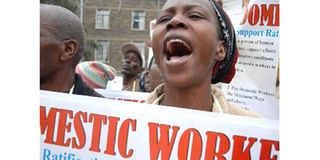
Domestic workers demonstrate outside Parliament in Nairobi to agitate for the passing of laws that protect their labour rights.

What you need to know:
- New UAE protections for domestic workers offer hope, but enforcement remains critical for Kenyan women working in private homes.
- Unpaid wages, excessive working hours and abuse continue to expose Kenyan domestic workers to serious risks in the Middle East.
The combination of unemployment, the government policy of exporting labour and the allure of better life abroad pushes Kenyan women to the Middle East in search of mainly domestic work. But this trend is also associated with tribulation.
Just recently, a former worker was reunited with her child after two years of separation. There have also been women brought back in coffins, having died under unexplained circumstances tacitly understood to be persecution in their new environments.
The stories highlight systematic exploitation and abuse where the female domestic workers are: not paid their wages; subjected to long and laborious working hours; exposed to servitude and modern day slavery; and debt-bonded to the recruitment agencies. They are also targets of sexual violence in the households, with hardly any redress mechanisms.


These abuses are accompanied by psycho-physical mistreatment in the form of battery, intimidation, confinement, poor medical services and denial of rest, which have deleterious effects on their health.
The practice of confiscating their identity and travel documents worsens the situation because it limits their ability to leave those countries even when they escape from their employers. Those who try this route often get arrested and consigned to concentration camps where the treatment is even worse.
As captured by Katie McQue in The Guardian of October 12, 2023, workers “who do leave without their employers’ permission face criminal charges for ‘absconding’, punishable by fines, arrest, detention and deportation”. These gendered tribulations illustrate how feminisation of migration intersects with gender inequalities.
A report by Amnesty International on August 6, 2026, notes that many women are pushed to seek employment in the Middle East because of social and economic reasons. “For many women, the decision to migrate is driven not by choice alone but by necessity. Financial hardship, unemployment, medical expenses and the responsibility of supporting their families leaves many feeling they have little alternative”.
The treatment once they arrive is tantamount to jumping from the frying pan into the fire. “Rather than being treated as workers, they are treated as possessions by their employers”.
Also read: After escaping abuse in the Middle East, domestic workers’ woes are far from over in this pandemic
The report categorises this deceptive arrangement as a form of human trafficking. “In reality, trafficking can also occur when people initially consent to travel but that consent is obtained through deception, false promises or abuse of vulnerability, and is followed by exploitation”.
It notes that “these abuses violate a range of internationally recognised human rights, including the right to just and favourable conditions of work, freedom from forced labour, freedom of movement, and the right to dignity and security of the person”.
In an earlier report on June 10, 2025, Amnesty International documented cases of over 70 Kenyan women who previously worked in Saudi homes. Apart from exploitative working conditions, they were also subjected to racial and dehumanising slurs, being referred to as “black animals” and equated with monkeys.
This is all due to the “kafala sponsorship system, which gives employers excessive control over migrant workers”. It is widespread in the Middle East countries, including the United Arab Emirates (UAE).
It is from this perspective that news that the UAE has listed the legal entitlements of domestic workers comes as good news. One is the entitlement to their wages within 10 days of the due date. Two is the right to at least one day of paid rest per week, and a minimum of 12 hours of rest daily, eight of which must be consecutive.
Related to this is 30 days of paid annual leave, giving the worker time to attend to personal matters and reconnect with family, especially in the context of a return air ticket every two years. Capping the list is entitlement to 30 days of sick leave annually and the right to retain their identity and travel documents.
The big question is whether these provisions will be respected by the domestic employers and enforced by the UAE government. It therefore behooves the Kenyan government to develop a comprehensive database of the Kenyan domestic workers in UAE and liaise with the UAE counterpart on enforcement and compliance.
But it must also demand more since the steps outlined do not address egregious violations such as physical battery, intimidation, poor living conditions and sexual exploitation and abuse. As a report by Amnesty International indicates, “exploitation is difficult to detect because it mostly occurs in private homes rather than public workplaces”.
Moreover, “victims are often isolated and unable to speak the local language, making it difficult to seek help or report abuse.” Moreover, “the fear of deportation, retaliation, and financial loss discourages many victims from coming forward.” Without addressing these matters, the listed entitlements may end up being fala to use the Sheng word for “dubious”.
The writer is a lecturer in Gender and Development Studies at South Eastern Kenya University ([email protected]).