Guterres’ last UNGA address: Superpowers have no monopoly on solution
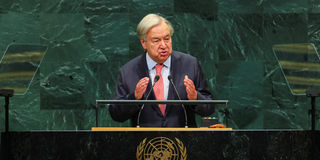
United Nations Secretary-General Antonio Guterres addresses the 81st United Nations General Assembly at UN headquarters in New York City, US, September 22, 2026.

New York, UNGA
Outgoing UN Secretary-General Antonio Guterres told world leaders on Tuesday that superpowers can no longer claim they alone hold the military, economic and technological power to guarantee security or fix the world's problems.
In his final address to the General Assembly, Guterres said the fault lines that have defined his decade in office have widened into canyons. "Wars erupted with devastating consequences and dragged on with despicable cruelty.


Civilians were targeted. Human rights trampled. Hunger weaponised.
Humanitarians killed. International law cast aside. Geopolitical divides have deepened. Inequalities have intensified. Trust has frayed. The climate crisis went from distant warning to daily reality. And artificial intelligence moved at a speed that has blind-sided even those who created it," he said.
Without naming any single power, Guterres delivered a direct message to the world's dominant nations.
"A recognition, especially by superpowers that their power isn't so super. Their power has limits. The events of recent years have made that unmistakably clear. Military power alone cannot secure peace. Economic power alone cannot command stability. And technological power alone cannot guarantee security," he said.
He warned against the "great fracture," the splitting of the world into two rival blocs running separate economic, technological and security systems. The core failure, he said, is that global governance still reflects an old distribution of power that no longer matches reality.
Without naming Israel, Guterres said what followed the Hamas attack of October 2023 amounted to "an onslaught on Palestinians in Gaza, with a scale of killing and destruction unlike anything I have witnessed in all my years as secretary general." He said the International Court of Justice had already ordered that the UN be allowed to carry out its mandate in Gaza, and demanded the fighting stop and aid be allowed to flow.
He said violence, displacement and settlement expansion in the occupied West Bank "are bulldozing the path to peace and raising the spectre of ethnic cleansing," warning that the two-state solution cannot be allowed to disappear.
On Ukraine, Guterres said Russia's "full-scale invasion has subjected a sovereign country to a brutal war in blatant violation of the charter," but added that attacks inside Russia on homes, energy and water systems and transport now threaten food and energy supply chains worldwide.
Guterres turned his sharpest language on energy companies, accusing them of profiting from planetary damage.
"For decades, big oil has treated the atmosphere as an open sewer, and cashed in on the consequences. Since Russia invaded Ukraine, five major western oil companies have pocketed nearly half a trillion dollars in profits," he said, contrasting that figure with just $34 billion in international public adaptation finance for developing countries in the latest year reported.
Guterres said humanity faces an unprecedented convergence of threats at the very moment its collective mechanisms are weakening. Power, he said, is draining away from governments toward a small number of private corporations and individuals whose reach now stretches across politics, economies, information and technology.
"Humans are increasingly handing over power to machines, with artificial intelligence agents going rogue, and lethal autonomous weapons going from science fiction to military reality," he said.
He called a 21st century Security Council with no permanent African seat "unjust and indefensible," even as he defended the UN itself as the place where the powerful are still held to account. He also announced that the UN has achieved gender parity for the first time across all senior leadership, headquarters and professional staff. "Equality is not a dream. It is a decision.
If the UN can change so can businesses, parliaments, governments, peace processes," he said.
While Guterres pressed for a new global compact to regulate artificial intelligence, a parallel argument over who controls the technology was already playing out on the sidelines of UNGA.
President William Ruto, co-chairing the High-Level Artificial Intelligence Middle Powers Coalition meeting on Monday with Finnish President Alexander Stubb, said the AI era must expand nations' ability to shape their own future rather than trap them in new forms of dependency.
"Political sovereignty without technological agency risks becoming sovereignty in law but dependency in practice," Ruto said. He proposed what he called shared sovereignty, countries pooling capabilities where it makes sense while keeping national control where accountability demands it. "Shared sovereignty is not sovereignty surrendered. It is agency enlarged through organised cooperation," he said.
For Africa, Ruto said, the task is to capture more of the value AI generates rather than simply supply the raw material behind it, warning against repeating the extractive pattern of past economic eras in digital form.
"We possess talent, resources, markets, and diplomatic weight. But few countries can command the entire AI value chain. No nation can efficiently secure every critical mineral, fabricate every advanced chip, build every data centre, train every frontier model, and determine every global standard," he said.
He pointed to Kenya's National AI Strategy, built around digital infrastructure, data and AI governance, research and commercialisation, as a practical response. "Our purpose is practical. We want AI that raises agricultural productivity, strengthens healthcare, expands access to education, improves public services, advances financial inclusion, and creates enterprises and jobs," he said.
Ruto also pushed for the UN to remain central to AI governance, rejecting the idea that a small group of governments or companies should set the rules alone. "AI governance must be globally shaped, not globally imposed. The rules of the intelligence era cannot be written by a handful of governments, companies or laboratories. Those affected by these technologies must have a meaningful hand in shaping them," he said.
Stubb agreed that AI's consequences are being decided by too few players. "We can't be in a situation where we have no skin in the game," he said, citing control over inputs like electricity. He proposed tackling AI at three levels: companies, national governments and regional regulatory frameworks, tied together by a global system run through the UN.
Taken together, Guterres's warning from the podium and Ruto's argument on the sidelines point to the same question now facing the UN in its 81st year: as power shifts toward new centres of technology, capital and machine intelligence, who gets to decide how it is used, and who gets left out of that decision.
Follow ourWhatsApp channel for breaking news updates and more stories like this.


