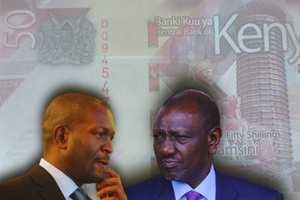
The reinstatement of Chege Kirundi as chairman of Kenya Tea Development Agency (KTDA) Holdings on Monday has marked yet another twist in the agency’s ongoing boardroom battles.
The High Court confirmed Mr Kirundi, a Nairobi-based lawyer, as the substantive chairman overturning an earlier decision that had blocked him from assuming office.
His return comes barely a month after a petition by former chairman Enos Njeru sought to bar him from taking over following a boardroom coup on January 23, 2025.
With the ruling, Mr Kirundi now officially assumes control of the board overseeing an agency that represents 680,000 smallholder tea farmers across the country.
In the leadership shake-up, Mr Erick Chepkwony was retained as board vice-chairman, a move expected to provide continuity and institutional memory.
KTDA issued a statement dollowing the reinstatement, reassuring stakeholders that operations remain uninterrupted.
“We assure our stakeholders that KTDA’s operations continue seamlessly and our focus remains on delivering value, enhancing efficiency and promoting the welfare of our farmers,” read a statement from the agency’s corporate communications department.
The latest developments highlight the ongoing power struggles at KTDA where the chairmanship has been a revolving door, attracting both industry and political interests.
Mr Njeru himself had taken office through a similar boardroom coup on July 17, 2023 when he ousted former chairman David Ichohi.
Mr Ichohi is said to have fallen out of favour with political powers at the time, just 10 days after former Deputy President Rigathi Gachagua held a two-day tea reforms conference in Kericho.
During his tenure, Mr Ichohi had questioned the government’s increasing interference in KTDA affairs despite it being a private entity governed by the Companies Act, 2015.
His stance reportedly irked Mr Gachagua, who had been tasked by President William Ruto to spearhead agricultural reforms in the tea, coffee and dairy sectors.
However, with Prof Kithure Kindiki succeeding Mr Gachagua as Deputy President, questions remain about whether agricultural reforms will still be anchored in the DP’s office.
Mr Kirundi is an advocate of the High Court of Kenya, a Fellow of the Chartered Institute of Arbitrators (FCIP)and a Certified Public Secretary.
He previously served as a State Counsel in the Attorney General’s Chambers and was instrumental in the tea sector reforms that led to the enactment of the Tea Act, 2020. But his ascension to the chairmanship has not been without controversy.
On August 23, 2024, he and other board members ncluding John Wasusana, James Omweno, Mwangi Githinji, and Gatundu South MP Gabriel Kagombe boycotted elections in Mombasa.
They accused the Ministry of Agriculture of interfering in the process and backing a preferred candidate, Mr Njeru.
Following his reinstatement, Mr Kirundi has vowed to put farmers' interests first.
“My mantra is farmers first. KTDA is a farmers’ organization, and it should serve them well. They should make profits from their investments. That is what will drive our agenda,” he said in a recent interview.
He emphasised that for decades, small-scale tea growers have not reaped meaningful returns from the industry, an issue he intends to address as a priority.
“Farmers should be at the center of operations under the Environmental, Social, and Governance (ESG) pillars planet, people, and profits,” he added.
Traditional export markets in the Arab world and Europe have been disrupted by political turmoil and wars, leading to sluggish demand.
At the same time, the Mombasa Tea Auction has seen slow uptake of tea by exporters due to overproduction and the reserve price policy set by the government under the Tea Act, 2020.