Despite decades of reforms, policy reviews and recommendations aimed at preventing such tragedies, the implementation of safety safeguards remains lacking.
While the cause of the fire at the Gilgil-based institution is under investigation, the incident has rekindled memories of previous school tragedies that revealed glaring gaps in safety measures and emergency response systems.
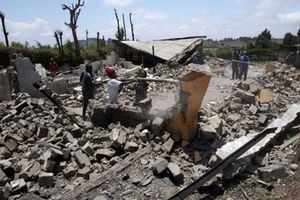
A burnt dormitory at Utumishi Girls Senior School in Gilgil, Nakuru County on May 28, 2026.
Photo credit: Boniface Mwangi | Nation Media Group
Early accounts suggest the Utumishi Girls Academy fire may have been exacerbated by dormitory doors locked from the outside and inadequately sized windows that hindered emergency escape.
This is despite safety guidelines clearly stating that all dormitory doorways be at least 5 feet wide, open outwards and must not at any time be locked from outside when learners are inside.
The Kenya Union of Post Primary Education Teachers (KUPPET) has called for accountability from concerned authorities following the fire tragedy that left 79 girls injured.
“The county Education Board, quality assurance officers, the Public Health Department, the school board and management and the local police command in charge of the school security have serious questions to answer,” said KUPPET secretary general Akelo Misori in a statement.
Kenya Union of Post-Primary Education Teachers (Kuppet) Secretary-General Akelo Misori.
Photo credit: File | Nation Media Group
Pictures of the 21 children who died in the dormitory fire at Hillside Endarasha Academy.
Photo credit: Pool
Other school fires that have scarred the country's education sector include an arson attack in 1991 at St Kizito Mixed Secondary School dormitory that claimed the lives of 19 students.
Seven years later, an electrical fault at Bombolulu Girls Secondary School in Kwale County claimed 26 lives. In 2001, Kenya witnessed its deadliest school fire when 67 students died at Kyanguli Secondary School in Machakos after two students set a dormitory ablaze.
Over the years, the government has constituted several commissions, committees and task forces to investigate school fires and unrest and recommend measures to enhance the safety of learners.
Among them are the Kirima Commission of 1994, the Wangai Task Force of 2001 and the Koech Committee of 2008.
Following a wave of student unrest and dormitory fires in 2016, then Education Cabinet Secretary Fred Matiang’i appointed a Special Investigation Team to probe the incidents, review recommendations from previous inquiries and assess the effectiveness of existing safety regulations in schools.
Students of Moi Girls School hold pictures of the deceased schoolmates during a requiem Mass at the school on September 14, 2017. PHOTO | KANYIRI WAHITO | NATION MEDIA GROUP
The team's findings, released in 2017, suggested that many schools were still ill-prepared to respond to fire emergencies.
It found that only a few institutions had adequate fire-fighting equipment, while some had empty fire extinguishers or equipment placed in locations that would be difficult to access during an emergency.
The investigators also established that many schools lacked designated fire assembly points and that there was little evidence that learners and staff regularly participated in fire drills.
Equally worrying were findings relating to dormitory design and occupancy with the report noting that emergency exits were either lacking or blocked in many dormitories, while narrow doorways could hamper evacuation during a fire outbreak.
Parents take photographs of the ruins of the dormitory following an overnight fire at the Utumishi Girls' Academy Senior School in Gilgil, Nakuru county, Kenya May 28, 2026.
Photo credit: REUTERS/Thomas Mukoya
In some schools, overcrowding had forced learners to sleep on triple-decker beds or share beds, increasing congestion and reducing mobility in emergencies.
The team further reported instances where dormitories were locked from the outside at night to prevent students from sneaking out of school compounds, a practice that could prove disastrous when rapid evacuation is required.
Many of these concerns had already been addressed in the Safety Standards Manual for Schools in Kenya, published in 2008.
The manual requires dormitory doors to be at least five feet wide and to open outwards, and explicitly states that doors should never be locked from the outside when learners are inside.
Principal Assistant to the DIG Masoud Mwinyi gives update on the fire tragedy at Utumishi Girls
The guidelines also require each dormitory to have a door at either end and an additional emergency exit located in the middle and clearly marked for easy identification during emergencies.
To facilitate quick evacuation, the standards require a minimum spacing of 1.2 metres between beds and corridors of at least two metres.
Schools are further required to maintain functional fire extinguishers and install fire alarms at strategic and easily accessible points.
Learners and staff are expected to participate in fire drills at least twice every term, while local fire departments should be invited to conduct demonstrations and educate students on fire prevention and emergency response.
The recurrence of such incidents despite existing regulations and repeated warnings from investigators suggests that school safety remains a challenge that extends beyond policy formulation.