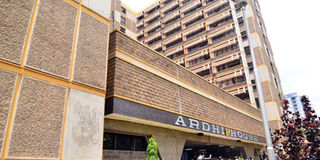
Ardhi House which houses the Lands ministry.
In the leafy suburb of Loresho where some of Nairobi’s elite reside in mansions behind high walls, a brazen land scam unfolded.
It was a plot so audacious that it involved not shadowy cartels, but the very government office meant to protect property rights.
For more than a decade, four property owners Young Moon Choi, Bharat Ramnji, Allotrope Trust Company Limited and Masai Roses Limited—fought a legal battle against a company that had obtained title deeds to their land, merged the parcels into one and even used the fraudulent documents to secure a Sh62 million bank loan.
At the centre of the dispute were three parcels—LR No 21075, 21103 and 21104—each mysteriously bearing two sets of title deeds issued years apart, with different claimants insisting they were the legitimate owners.
A fortnight ago, the Environment and Land Court delivered a scathing 50-page judgment exposing shocking dysfunction within the Ministry of Lands. The ruling painted a picture of an institution riddled with negligence or worse, complicity so severe that it had become a factory for duplicate titles.
The court found that the Ministry of Lands had, in a baffling display of ineptitude or collusion, registered the same properties under different names, creating a legal nightmare that took more than a decade to untangle.
The judgment reads like a detective novel, complete with forged documents, backdated titles, and a trail of bureaucratic negligence that allowed prime property to exist under two different owners simultaneously.
“This judgment concerns three ambitious parcels of land. Ambitious because they seem to have acquired several owners, each bearing a certificate of title from the same Ministry of Lands…Like a well-meaning but forgetful scribe, the Ministry of Lands appears to have rewritten its own story several times, bestowing ownership of land upon more than one deserving soul,” said the judge.
The plaintiffs maintained they had acquired their titles lawfully—some through government allotments in the 1990s, others through purchases—and had diligently paid land rates and rent for years.
The saga began in 2013 when Bharat Ramnji, one of the plaintiffs, received a call from a real estate agent. A prime 14-acre parcel of land in Loresho was on the market for Sh45 million per acre, though a witness told the court that the prevailing price was Sh85 million per acre—valuing the land at Sh1.19 billion.
He was shown a copy of the title deed and, upon inspecting the deed plan, realised there was a problem: part of the land being sold already belonged to him.
Alarmed, he checked the property’s records—including obtaining a Survey Plan—and discovered that someone had not only obtained a title deed for his land but had merged it with two adjacent parcels, LR No. 21103 and 21104, to create a new property, LR No. 29945.
Noticed irregularities
The new title had been issued to Goldstein Group Services Limited, which then used it to secure a Sh62 million loan from Jamii Bora Bank.
Mr Ramnji also noticed irregularities in the land rent and rates accounts, including a mysterious charge entry.
When he and the other owners attempted to obtain an official search from the Lands Department, they were told the file was missing. Through a letter dated March 2014, they were advised to request the National Land Commission to open a temporary file.
But he was not alone.
As the case progressed, a disturbing pattern emerged: the Ministry of Lands had issued multiple title deeds for the same parcels with no coherent explanation.
For LR No. 21075 (9.4 acres), Allotrope Trust Company held a 1996 title, yet Goldstein Group had another title dated 2013.
In relation to LR No. 21103 (2.47 acres), Masai Roses had owned it since 1997, but Goldstein Group again appeared with a 2013 competing title.
For LR No. 21104 (2.49 acres), which Bharat Ramnji and Young Moon Choi acquired in 2010, Goldstein Group held a duplicate title.
Even more bizarre, some of Goldstein’s titles bore a date of 1913—something the plaintiffs cited as evidence of forgery.
“Upon examining the document in its entirety, the court is satisfied that the reference to 1913 is most likely a typographical error, as the instrument is indicated to have been registered on August 5, 2013,” said the judge.
The plaintiffs argued that the amalgamation was unlawful, as none of them had requested it or sold their land to Goldstein Group.
“The amalgamation could only be explained as part of a corrupt scheme facilitated by the third defendant (the Chief Land Registrar), being the statutory custodian of land administration,” testified Mr Ramnji.
The fraud reached its peak when Goldstein Group applied to merge the three parcels into one —and the Ministry of Lands approved it.
However, key documents were missing. The Chief Land Registrar admitted in court that critical files had “disappeared.”
How land ownership that it continues to determine the country’s political economy six decades after independence.
A Nairobi County official testified that a crucial planning approval form (PPA2) bore a forged signature. He noted that the survey process contained stamps for “subdivision” rather than “amalgamation”—a basic error that should have raised alarms. Yet the process sailed through, creating a title out of thin air.
Another witness, a land registrar, testified that land fraud had become increasingly sophisticated, often involving insiders within the registry. He stressed that the sanctity of the title must be protected.
The bank’s role also came under scrutiny. The court found that in advancing the Sh62 million loan against the fraudulent title, the lender failed to conduct basic due diligence.
“The admission by the Bank’s Legal Manager that certain documents may have been forged, coupled with the Bank’s failure to produce essential documentation, including the borrower’s Board Resolution and valuation report, gravely undermines its claim of having exercised due diligence,” the court noted.
Bank officials admitted they had relied solely on registry records, ignoring glaring discrepancies that should have prompted further investigation.
In its verdict, the court declared the bank’s charge invalid—though the loan had already been repaid.
The judge criticised the Ministry of Lands for acting like a “forgetful scribe,” rewriting its records without care.
“The amalgamation was a fraud from start to finish. A title deed is only as good as the integrity of the system that issues it,” the judge said.
The court concluded that the plaintiffs’ titles bore the hallmarks of authenticity, while those relied upon by Goldstein Group lacked the administrative trail expected of genuine titles.
The court ordered the cancellation of Goldstein Group’s titles, reinstatement of the original owners’ deeds, and scrapping of the amalgamation deed plan by the Director of Surveys.
“The amalgamation of LR Nos. 21075, 21103 and 21104 to LR No. 29945 (IR 152312) by the first defendant (Goldstein) and the resultant registration in its name are declared fraudulent and illegal," the court ruled.
Sh90 million bank loan
The Loresho case is not an isolated incident. Just a month earlier, the Court of Appeal upheld a High Court decision cancelling an irregularly acquired title held by Frank Logistics Limited for prime property on Argwings Kodhek Road—a title used to secure a Sh90 million bank loan.
The court found that Golden Lion Real Estate Company was the lawful owner of the property, known as Blacky’z Lounge in Kilimani.
Similar cases have emerged nationwide. In Kajiado, Phillip Mutiso successfully reclaimed land in September 2025 that had been unlawfully transferred to an educational trust. In Runda, Nesclay Limited in April 2025 regained family land lost through a fraudulent 1998 subdivision. At the Coast, Degan Ali recovered his Kwale property after the court ruled that a competing title was irregularly issued.
Collectively, these cases paint a troubling picture of Kenya’s land administration system—one where duplicate titles can surface decades after legitimate ownership is established, critical documents routinely disappear from ministry files, and basic verification systems fail.
A land registrar who testified in the Loresho case warned that land fraud has become increasingly sophisticated and is often perpetrated with insider assistance.
A fortnight before the judgment, the Directorate of Criminal Investigations arrested 14 people—including two land registrars and a ministry clerk—suspected of facilitating land fraud. Nineteen vehicles were seized in coordinated raids, signalling a possible renewed effort to clean up the system.
For ordinary Kenyans, these cases are both cautionary tales and rallying cries. They underscore the importance of safeguarding every land document—from allotment letters to payment receipts—and remaining vigilant against potential fraud.
They also highlight systemic vulnerabilities that demand urgent reform: proper record-keeping, stricter verification processes and stronger safeguards against insider manipulation.
As the Loresho judgment made clear, the sanctity of property rights depends entirely on the integrity of the systems meant to protect them.
Follow our WhatsApp channel for breaking news updates and more stories like this.