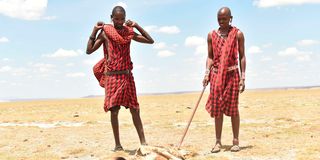
In January 1970, an op-ed article in The New York Times said that "one of the great experiences for the visitor in East Africa is seeing the Maasai, the warrior herdsmen who inhabit the dry plains of southern Kenya and northern Tanzania."
Unfortunately, the article by two-time Pulitzer winner Anthony Lewis was not a compliment. Instead, it portrayed the tourism industry's continued abuse and commodification of the Maasai community — a topic we have been shy to address to safeguard the dollars.
As a result, over the years, there was little effort to disturb the community; thus, they were marginalised, and the spaces they occupied remained undeveloped. As I will show, this matter has been raised in Parliament, but interestingly, it has never formed part of our national discourse.
Since colonial times, part of the multi-billion dollar tourism industry has been built around what we can call the Maasai gaze.
This commodification ultimately led to their marginalisation to continue offering tourists some indigenous cultural spectacle.
This exploitation of the Maasai culture by the tourism sector would allow us to ask the bitter question: how much have the Maasai earned from the tourism industry from this unwarranted public spectacle and the appropriation of their culture by global brands and tourism industry?
Unfortunately, if you traverse the Maasai counties, you won't see the benefits of this cultural appropriation.
Yet, to date, the Maasai are the most photographed community in Kenya: They appear in coffee-table books, postcards, paintings, documentaries, films, billboards, and souvenirs – and to perpetuate their perceived “otherness”, their religious elders are usually invited to the state opening of Parliament to say traditional prayers.
To understand the thinking behind the deliberate neglect of the Maasai, one has to look at how the travel industry had always looked at both the Maasai and "their cousins, the Samburu" – as syndicated travel writer Robert Ruark would call them.
Writing in 1961, Ruark, then one of the most celebrated syndicated columnists and author of several books — including the famous Horn of the Hunter — asked Americans not to try to interfere with these “under-developed” communities.
He hoped that any Peace Corps sent there to, ostensibly, civilise the community would be speared to death. Ruark's was the most racist insult I have encountered by a journalist recently.
He wrote, outrageously: “I love the Samburu ... because he is hopelessly un-emerged, completely under-developed.
He is like the elephant and rhino among whom he dwells. He belongs to another age, and you will no more be able to remake him more than you can put a girdle on a rhino or convince an African bull elephant that he is a pet.
He is utterly useless to anybody or anything but himself and would not have it otherwise ... I hope we will have the Peace Corps in here someday ... and I hope that the first Samburu the Peace Corps runs onto whips a spear into the peerless leader.
Here is one place on earth that progress should avoid. These un-emerged savages are doing just fine.”
I have decided to paraphrase Ruark's column because he represented the thinking in the tourism sector – and even today, tourists are still being taken to see the Maasai as depicted by Ruark and his disciples.
Safari packages were only complete in the colonial era with the Maasai culture component. Today, a body of literature suggests that this informed the community's continued marginalisation to sustain the tourism industry.
If that is still the thinking, and I am praying I am wrong, then we fell into a colonial trap, and we have a significant problem.
Following Ruark's thinking, Lewis, The New York Times writer, also hoped that nobody would try to lift the Maasai into mainstream economies: “A visitor of any sensitivity finds himself hoping that the Maasai – and really all the remote people of the earth – will not seek comforts of civilization.”
On attempts to change the Maasai lifestyle – riding bicycles or inseminating their cows with better breeds – Lewis argued that this was “corrupting” Maasai culture, and he said: "Any country dependent on tourism risks (with) that kind of corruption.”
The deliberate transfer of all Maa-speaking people into the dry Southern Maasai Reserve, which blocked them from accessing the various water points, not only marginalised them, but turned them into objects of gaze as they struggled to make sense of the new territories.
Here, they would acquire a unique identity ideal for those who wanted to see exotic Africa – or see the “war-like” tribe depicted in Joseph Thomson's 1895 book Through Maasai Land. Thomson is the man who lied to the world about discovering Thomson Falls in Nyahururu.
The hospitality industry would later have its own set of dancers – or a “Maasai village” where they would take their guests.
For instance, one Kedong settler decided to put up a Maasai camp in his Mayers Ranch. Here, he would have his own colony of English gardens, something close to what Elspeth Huxley would call 'White Man's Country,' and with some traditional Maasai villages.
He used this ranch to showcase Maasai to the tourists and have them photographed at close range. This objectification of the Maasai has been studied by two scholars, Edward M Bruner and Barbara Kirshenblatt-Gimblett, who conclude that the Maasai are victims of a vicious tourist industry that “insists on recidivism, atavism, and anachronism. It insists on true tribesmen and archetypal colonialism."
Thus, the Maasai and their cattle emerged as tourism symbols, and there was little effort made to decolonise the tourism industry after independence.
This matter was first raised in Parliament in June 1964 when Narok North MP, Justus ole Tipis, sought the prioritisation of the Maasai region for water development since it had been neglected by the colonial government.
During the debate, Busia North MP, Oduya Oprong, contextualised the problem: "It is very shameful for an independent Kenya government to continue using the Maasai as an attraction for the people who come to Kenya ... it is time to correct the colonial mistake which has been imposed on the Maasai without their wishing."
Oprong went on: "The previous (colonial) government thought the Maasai should be hidden from the regions of development and that (the community) would make a lot of money for tourism.”
What Parliament was being urged to do was to abandon the colonial marginalisation of the Maasai community in order to feed the appetite of tourists seeking to see “virgin” African cultures.
In 1961, Kajiado MP John Keen complained to the Legislative Council (then Parliament) that “the whole of the Maasai Reserve has been turned into a museum piece where the tourists come for sightseeing.”
The same was said of the Samburu district in September 1964 when Yatta MP Gideon Mutiso lamented that the "[The Samburu] were used by the colonial powers as museums for those who came here to go and see naked people in this country. It is a great shame, to continue to live this sort of life whereby the tourists in this country will always want to visit Kenya because they want to see the naked Samburu."
One of the proposals by Maasai leaders was that part of the tourism revenue should be used to uplift the status of the Maasai. That was the 1965 argument by Stanley Oloitiptip, who said the Maasai “bring a lot of tourists to this country and must receive a bigger share in the money which is brought”.
Scholars of cultural tourism argue that when communities do not derive significant benefits from those tours – then they are no more than a “human zoo” as Van den Berge observed in 1992: “Ethnic tourism has created a situation akin to a human zoo, in which many locals feel that their privacy is invaded, they are frequently stared at, and they are photographed against their will ... ”
Fast-forward to 1982, and Vice President Mwai Kibaki accused tour operators of demeaning and degrading the Maasai. He also lamented that the tourism industry was projecting Kenya negatively: "If you read the brochures that the tour operators are publishing, you will see that they are continuing to degrade the image of this nation ... it is terrible that people who live in Kenya, some of whom are Kenyans, and others who claim to be Kenya's permanent residents – but truly their hearts are not here except for the money that they make – continue to project that people should come to Kenya to see a naked Maasai jumping and his 'gadget' swinging around ... There are tremendous ways of publicising the tourist attractions of this nation without continuing to project an image that we are a primitive society.”
Fast-forward to 2004, Shinyalu MP Daniel Khamasi decried the poverty around Maasailand despite the billions it had generated over the years from tourism: “These people have been turned into tourist attractions. If you go to Europe and ask one of them who is coming to Africa what he is coming to see, he will tell you he wants to see the Big Five ... the lion, the elephant, and also the Maasai. Definitely, these people have been turned into tourist attractions. This is a shame.”
He suggested that 30 per cent of all the investments in the camps and other tourist attraction areas must be vested in people who lived around those game reserves and national parks.
I hope that somebody will not say that the Maasai were given Maasai Mara Game Reserve to manage – and that it is the Maasai elite to blame. This will require a national conversation because it is not only the Maasai who face similar problems. We also have issues at the Coast, where young girls are lured into dancing for tourists.
As Narok North MP Moses ole Marima said in 1971, “It has become apparent that no tourist would find his ticket well paid for, worth coming here for unless when he lands at Embakasi Airport or gets into the tourist buses, he sees a naked Maasai.”
The time has come for us to decolonise the tourism sector – and I hope the new Cabinet secretary will have the guts to right the wrongs.