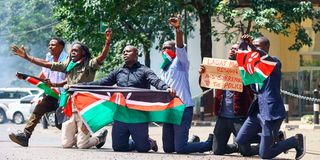
A new report by Civicus, an online platform that tracks threats to civil society globally, has rated Kenya’s civic space as “repressed.”
The platform, run by a global civil society alliance, categorises countries as open, narrowed, obstructed, repressed, or closed. Kenya now falls into the second-most severe category.
The latest report on Kenya, titled “Police Bullets, Digital Chains: State-Sanctioned Brutality in Kenya’s Peaceful Youth-Led Uprising,” was released on the first anniversary of the peak of the 2024 protests.
It documents a sustained government crackdown that includes killings, enforced disappearances, arrests, abductions, censorship, online surveillance and harassment of journalists.
“The Kenyan state first reacted to mass protests with mass violence, leaving dozens dead and more than one hundred missing. Since then, it has aggressively pushed to tighten control over all forms of civic space and free expression from peaceful protesters in the streets to critics on social media and everywhere in between,” said Civicus Secretary General Mandeep Tiwana.
“This year-long crackdown shows how Kenya’s security apparatus deeply rooted in a broken, brutal, colonial legacy does not serve the public. Instead, it is a tool of repression to silence people demanding justice and accountability,” it adds.
Kenya’s youth-led protests erupted in June 2024 in opposition to a Finance Bill that proposed steep tax hikes amid a struggling economy. The demonstrations quickly grew into a broader movement denouncing government incompetence, police brutality and corruption.
Protests peaked on June 25 when demonstrators stormed Parliament, and the government responded with brutal force during and after the protests.
The Kenya National Commission on Human Rights reported at least 60 deaths by October 31, and 82 cases of enforced or involuntary disappearances by December 26, 2024. Many bodies were later found in forests, rivers, quarries, and morgues, some bearing signs of torture and dismemberment..
“Authorities have disrupted internet access during protests, issued onerous regulations to social media companies, and threatened to prosecute or shut down platforms,” the report states.
Parliamentarians also introduced a bill seeking to authorise real-time monitoring of internet users, giving the state sweeping surveillance powers without sufficient checks or safeguards. Legislators also proposed a significant budget increase for police to surveil online activity. Both proposals are still under consideration.
Meanwhile, police have reportedly targeted online activists directly. In May 2025, software developer and civic activist Rose Njeri was arrested after creating a platform allowing Kenyans to email their MPs about the Finance Bill. She was detained for 90 hours before appearing in court on alleged violations of the Computer Misuse and Cybercrimes Act.
A week later, police abducted political commentator Albert Ojwang in western Kenya. He was later found tortured and murdered in a Nairobi police cell.
“The deadly clampdown on online activism is a major attack on digital rights in one of the world’s most tech-savvy nations,” said Tiwana.
Traditional media has also come under fire. The Kenya Television Network (KTN), part of the Standard Media Group, accused the state of threatening to shut it down over its live protest coverage.
Subsequently, the government terminated a contract with the media house, moved to revoke its licences, and barred some of its journalists from covering presidential events.
Authorities also reportedly pressured the BBC into cancelling the screening of a documentary in Nairobi that identified uniformed officers allegedly responsible for shootings. Police detained a group of Kenyan filmmakers—none of whom worked on the documentary—during the fallout.
In another incident, the government banned a girls’ high school from performing a play about the protests during a national drama festival. Although the courts overturned the ban, police lobbed tear gas and assaulted journalists during the performance.
Civil society organisations (CSOs) have also been accused, without evidence, of financing the protests. Some church leaders have alleged that state agents infiltrated services to question worshippers and monitor sermons.
“From journalists to students to churches to civil society groups, anyone suspected of criticising the government faces repression. This unrelenting attack on civic space is unacceptable and extremely worrying in a country with a long tradition of robust public debate,” said Martin Mavenjina, Senior Advisor at the Kenya Human Rights Commission.
Despite the crackdown, the report identifies Kenya’s judiciary as a beacon of hope. Throughout the crisis, courts have issued rulings protecting protest rights, demanding police accountability, and overturning government restrictions.
“Kenya’s independent judiciary remains the last bastion of hope for protesters, activists, and ordinary citizens facing an unconstitutional assault on civic space,” said Mr Mavenjina.