If you type “Africans fighting for Russia” or “Africans captured by the Ukrainian military” into a search engine, you will be flooded with stories.
A troubling pattern emerges across the headlines: young Africans, lured by the prospect of lucrative employment or scholarships, find themselves trapped in a war they never signed up for.
What seemed like legitimate opportunities — a high-paying job, a fully funded education, or a chance to live abroad — often turns into grim reality of exploitation and danger.
In the digital age, opportunities abound. A simple search for “jobs in Russia” or “scholarships in Russia” yields thousands of results, each promising a brighter future.
Recently, Ukraine’s military released a video of Evans Kibet, a Kenyan athlete, 36, who surrendered to Kyiv troops after being deployed to the front-line by Russia.
He was captured by Ukraine’s 57th Motorised Infantry Brigade in the Kharkiv Oblast, near the town of Vovchansk.
In a video interview after his capture, Kibet said that he had gone to Russia as a tourist before being tricked by a contact person into joining the Russian army.
“I was recruited to the Russian military without knowing. I have never been in the military. I have never wanted a job in the military. I went to Russia as a tourist and spent two weeks. On the day before I was due to leave, my contact person asked me what I thought of Russia. And I said it was good. He asked if I would like to stay. I said yes, but my visa had expired,” he said.
Kibet stated that the contact person offered to help with his visa situation and that he had a job ready for him.
“In the evening, he came with documents written in Russian. I didn’t realise it was a military job. He told me to sign, took my passport and phone, and that’s when everything went wrong.”
According to British online newspaper The Independent , between 35,000 and 37,000 African men and women are studying in Russia through various scholarship schemes.
In May 2024, Indian authorities arrested and prosecuted four men believed to be brokers who were using scholarships and job placements to lure desperate people into fighting for Russia in its invasion of Ukraine.
One year later, the Government of Togo issued a warning to its citizens about scholarships and job opportunities in Russia that were being advertised at the time.
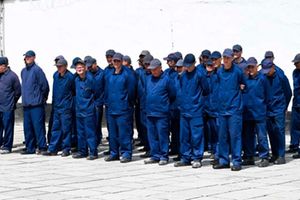
Prisoners of war stand in formation inside a Ukrainian detention facility where foreign fighters are held under strict supervision as part of wartime operations linked to the ongoing Russia-Ukraine conflict.
Photo credit: MFA Ukraine
This followed an alert from civil society indicating that a Togolese national had been flown to Russia under the guise of a full scholarship, only to be deployed to the front lines.
In June 2024, the Ministry of Education posted an advertisement calling for people interested in studying in Russia to apply for scholarships.
However, there are currently no confirmed cases of Kenyans joining the Russian military through this scheme.
According to Kibet, after signing the documents, people he had not met before came and picked him up from the place he was staying. They drove about seven hours away to a military camp.
“You already signed the documents, you cannot go back. You either serve of get killed,” he was reportedly told.
What starts as ambition and hope — whether for education, a high-paying job, or a chance to live abroad — often turns into exploitation, danger, and, for some, a fight for survival.
A video circulating on social media shows three men — who provide the names Gitau Peter Njenga, 32; Mutai Felix, 28; and Martin Njenga, 36— among other foreigners ready to fight for Russia.
In May 2025, the Global Initiative Against Transnational Organised Crime, an independent policy research institute, released a report showing that tens of young women from Kenya, Uganda, Tanzania, Malawi, South Africa, Ethiopia and Zambia were working in dangerous conditions in Russia producing arms.
Many young Kenyan women are among the more than 200 recruits from East and West African countries who have been enlisted to assemble weapons in wartime Russia while searching for better opportunities abroad.
Enticed by social media ads promising free plane tickets, cash, and accommodation, along with the thrill of a European adventure, many young women unknowingly find themselves entangled in supporting Russia’s involvement in the Ukraine conflict.
Ukrainian soldiers ride a top of infantry fighting vehicles in Novoselivka, on September 17, 2022, as the Russia-Ukraine war entered its 206th day.
Photo credit: Juan Barreto | AFP
With minimal entry requirements—such as only completing a computer game or passing a brief Russian vocabulary test—their dream opportunity swiftly turns into a grim experience.
In a report titled, Who is Making Russia’s Drones? The research institute details how hundreds of youth from Africa have been duped and shipped out to work in drone-making factories in Russia. The majority were recruited by agencies, ostensibly to attend training in Russia.
The report focuses on the Alabuga Special Economic Zone (Alabuga SEZ), a major industrial and engineering complex located in the Tatarstan region of southwestern Russia.
Due to a significant labour shortage (partly caused by Russia’s military mobilisation), the Alabuga SEZ management has reportedly been recruiting students from Alabuga Polytech, a college based at the site, to work in the drone production facilities.
Maksym Subkh, Ukraine’s special representative for the Middle East, told African journalists visiting Ukraine that a number of African nationals are among the foreign prisoners of war. He added that diplomatic efforts are underway to secure their release.
According to the POW report, migrant workers are recruited through an international programme called Alabuga Start. This drive targets young women aged between 18-22, primarily from Africa, but also Latin America, South Asia and former Soviet countries.
The report says the employers prefer young women as they are easier to control compared to their male counterparts.
Mohamed Hussein, 29, from Somalia, saw living abroad as his only escape from the hunger and hardship his family endured. Friends told him of job opportunities in Russia, promising $2,000 a month and $2 million upon signing. He followed them, unaware the job would put him near the frontline in Ukraine. By then, it was too late to turn back.
“I am not a fighter by nature. But I am a father. I want my children to eat, go to school, to live without fear. That is why I will stay in Russia. Even at this cost, I can build something,” he told the Nation earlier this year at the Ukraine Prisoners of War.
Hussein had tried every option Schengen visas, the USA, Europe but faced constant rejection.
For many young Africans and Asians, offers like these seem like a path to a better life. Yet beneath the surface, many are lured into situations that exploit their labour and, in some cases, their lives. The speed of his Russian visa approval—just one week—convinced him it might be his only chance.
In the prisons of war, Richard Mensah, 37, Ghanaian, a father of two, sat on a narrow bench inside a prisoners-of-war camp in Ukraine, his hands tightly folded in his lap. He looked worn older than his years —his face heavy with regret.
He never imagined he would one day find himself in such a place: detained, disoriented, and caught in conflict thousands of kilometres away from home.
“I didn’t come to fight. I didn’t even know there was a war when I left Ghana. I was caught on the first day by the Ukrainians. I was at the front line,” he said.
Back home, Richard had started looking beyond Ghana’s borders for a better life. He asked friends who had travelled abroad, joined online forums, and even visited travel agents. Then someone mentioned Russia. He applied for a visa, half-expecting never to hear back. But two weeks later, it arrived.
Then he met someone a Nigerian man who became his ‘agent.’ The contract was in Russian. Within days, Richard was taken to a remote location. Military gear was issued. Weapons were handed out.
“He told me I’d get paid in dollars. You just need to sign this contract.’ I asked what the job was, and he said, ‘Logistics and support.’ It sounded official.” He said.
While in Visiting the Prisoners of War, we encountered Citizens of Somalia, Ghana, Egypt, Sierra Leone, Togo, South Africa, Cuba and Sri Lanka.
For many young individuals across Africa and Asia, these opportunities seem like gateways to better lives. However, beneath the surface of these enticing offers lies a darker reality: many are being lured into situations that exploit their labour and, in some cases, their lives.
Ahmed El-Sayed, 23 from Egypt, never imagined his pursuit of education would lead him to the frontlines of a war he didn’t understand.
He arrived in Russia on a student visa, eager to study information technology. But things quickly fell apart. Struggling with language barriers and rising expenses, Ahmed was arrested after being found with a small amount of drugs. And he was sentenced to seven years in a Russian prison.
Then came the offer: sign a contract and go to war—or stay in prison. Ahmed El-Sayed didn’t make it in a courtroom. He made it inside a cold Russian prison cell, clutching a pen with trembling fingers, faced with two impossible choices: spend seven years behind bars for a drug offense or sign a contract that would send him to the frontlines of a brutal war.
“They said, ‘If you go to the front, you’ll be free in six months. If not, rot here for seven years.’ I didn’t even think, I just signed. I was shaking the whole time. I didn’t even know who we were fighting. I just kept thinking, ‘I came to study. How did I end up here? And remember I am 23,’” he said.
Captured by Ukrainian forces shortly after deployment, he now waits in detention haunted by the choice no one should have to make.
At the time of the visit, the Nation learned that in the ongoing negotiations, Russia appears primarily focused on securing the release of its own citizens. This narrow approach leaves foreign fighters, including Africans, in a precarious position, often detained with little hope of immediate negotiation.
Maksym Subkh, the special representative of Ukraine for Middle East told African Journalist visiting Ukraine that a number of nationals from the continent are among foreign prisoners of war (POW), raising new questions about how and why these individuals ended up in the conflict zone.
“We were informed by the armed forces headquarters, or by the President’s military intelligence service of Ukraine that some people were captured. They had foreign passports, including African passports. We informed the relevant countries that these people were captured,” he said.
He noted that some are believed to have arrived in Ukraine as migrant workers or students but were caught up in the conflict under unclear circumstances.
Subkh noted that diplomatic efforts are underway to secure their release through formal legal procedures involving the United States, which has been working closely with Ukraine on POW matters.
“We filed the negotiations with the other side, based on the legal framework that we had with the United States, Sometimes, some additional memoranda are required to be signed to hand over those captives to your country,” he said.