On a bright June morning in 1963, on the steps of what is today Harambee House, Jomo Kenyatta was ceremoniously sworn in as Kenya’s first Prime Minister by Governor Malcolm MacDonald. Draped in a vividly beaded cap - matching that of his key ally, Oginga Odinga - and holding a symbolic flywhisk, Mzee Kenyatta was the face of a new dawn, blending tradition, authority and the fierce hope of a nation finally breaking free.
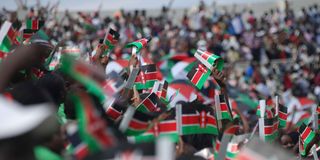
The former Ministry of Works building had been transformed into the office of the Prime Minister. Along Coronation Street, now Harambee Avenue, an ecstatic crowd of nearly 30,000 danced and chanted, caught in the whirlwind of a long-awaited freedom. On that day, the man once vilified by the British as “the leader unto darkness and death” stood at the threshold of power, moments away from inheriting the mantle from his former oppressors.
But the challenges of governing a fragmented country were only just beginning - not only for Mzee Kenyatta but also for the civil service and political class. The challenge of nationhood was only starting. Some 62 years later, successive administrations have experimented with various formulas to hold together the diverse fabric of the Kenyan nation. From Kenyatta and Daniel Moi’s one-party rule to coalition governments, the handshake, and now President William Ruto’s “broad-based government,” each regime has borrowed from its predecessors in the delicate art of nation management.
Beginning of collective dream
Madaraka, as the day was christened, was a turning point in Kenya’s history. It marked the inception of internal self-governance - a milestone after the Lancaster House negotiations - and the beginning of an imagined collective dream: an audacious hope that Kenya would chart its destiny free of colonial subjugation. “This is one of the happiest moments in my life,” Kenyatta declared, moments after Governor MacDonald pronounced Madaraka a “grand hour in Kenya’s history.” Then, as if choreographed by history itself, Kenyatta, Jaramogi Oginga Odinga, Tom Mboya, and James Gichuru - the vanguard of Kanu - mounted an open vehicle, waving to jubilant crowds as the spirit of a nation-in-waiting danced through the streets of Nairobi.
Everybody was measured in their hope that this political friendship would hold. “I trust all will work together and play their part in building a happy and united nation,” wrote Duncan Sandys, Britain’s Secretary for the Colonies and steward of Kenya’s transition. But it was Britain that played behind the scenes to stop the camaraderie, driven by fears that communists influenced the internal workings of the new Kenyatta government.
During the pre-Madaraka coalition government between Kanu and Kadu, Jaramogi accused Britain of meddling and forcing Kenyatta to exclude him from government. As he later recalled in Not Yet Uhuru, “The country was angry. It felt that my exclusion was a betrayal of the struggle.” Kenyatta explained that Jaramogi would oversee the party, but as he found out, “obstacles (were) put in my way by the elements within Kanu who had always feared a strongly centralised party organisation.”
It is that quest for personal power that drove Paul Ngei in 1963 to register an ethnic-based party - the African People’s Party - in a bid to solidify his control over Ukambani politics. His move set a precedent that continues to shape Kenya’s political landscape, where leaders often craft parties rooted in ethnic loyalty rather than national ideology.
After the election that preceded self-rule, Kenyatta was invited to form the government following Kanu’s decisive victory on May 19, 1963, with 58 seats in the House of Representatives against Kadu’s 28. In the Senate, the balance stood at 11 for Kanu and 9 for Kadu. It was another winner-takes-all - or simply, cripples the opposition - the same predicament facing our politics.
Leading a nation fragmented by tribal loyalties and historical grievances, Kenyatta’s Kanu projected a unifying manifesto. At its heart lay a pledge to heal the wounds of colonialism, to forge national unity, and to dismantle the inequities entrenched over six decades of British rule - a task still central to Kenya’s political discourse. “Kenya is not going to be another Congo,” Kenyatta declared, reassuring the anxious white settler community - 55,000 among 8 million Africans - that they would be granted full protection under the new government. “He will have the right to own property. He will be equal to every other citizen,” he affirmed, pledging a future built on equality, stability, and rule of law.
The chaos of the 2007 post-election violence, largely blamed on deeply tribalised political parties, revived an old question first posed by Jomo Kenyatta in the 1960s: Could a cohesive Kenyan nation truly emerge from a divisive multi-party democracy? Kenyatta’s main obstacle then was Kanu, which championed federalism - popularly known as Majimboism - widely perceived as advancing settler interests. During the Lancaster House negotiations, Kadu’s push was backed by settler representatives like Michael Blundell, RS Alexander, and Wilfred Havelock. To Kenyatta and his allies, Majimboism was a veiled attempt to delay independence and obstruct a strong, centralised African government.
Under the proposed framework, Kadu envisioned powerful regional governments - especially in the Rift Valley, Coast, and Western regions - where it held sway. This setup was designed to thwart Kenyatta’s ascent to national leadership. But after Madaraka, these regional governments struggled with financial instability and lacked competent administrators. Denied real power or resources, they provided Kenyatta justification for centralisation - a classic postcolonial tactic to dismantle federalist structures.
Tom Mboya, Kenyatta’s ally and Minister of Constitutional Affairs, engineered defections from Kadu through co-optation - offering positions to defectors while branding the opposition as retrogressive or tribalist. Eventually, the last member, Martin Shikuku, gave in, and Kenya became a de facto one-party state in 1964. This strategy would be perfected later to suppress opposition parties, especially by Kanu.
The other strategy targeted dissent within Kanu itself. Jaramogi’s leftist and populist stance, aligned with socialist movements, was viewed as a threat to Kenyatta’s pro-Western, capitalist agenda. Using both soft and hard power, Kenyatta moved to weaken Jaramogi and ensure the party reflected conservative, elite interests. State media branded Jaramogi and his allies as radicals - a tactic that served the domestic goal of silencing dissent and reassured Western powers of Kenya’s Cold War alignment.
Kenya did not formally outlaw opposition until 1982, but Kenyatta’s post-Madaraka strategy created one-party dominance without constitutional amendment - a clever form of legal authoritarianism. Former President Mwai Kibaki, too, faced similar headwinds after dislodging Kanu’s 40-year grip on power. By then, Kanu under Moi had presided over economic stagnation and widespread cronyism, transforming public institutions into vehicles for elite enrichment.
Some 63 years later, the Kenyan nation is still under construction - facing the same challenges that confronted its forefathers.