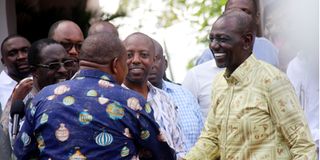
President William Ruto has persuaded transport stakeholders to call off the strike, which was set to resume early next week.
The nationwide strike on Monday and Tuesday this week crippled operations in major towns and cities across the country, with Nairobi being the worst hit.
President Ruto promised at the meeting that the price of diesel will come down by at least Sh10 in the next review cycle.
The President said the government has employed direct stabilisation measures and tax reliefs to protect Kenyans, saying there would be no more tax cuts on fuel since the government needs funds to run other sectors and projects.
The directive targets the Insurance Act (Cap 487), which regulates the insurance industry, and the Auctioneers Act (Cap 526), which governs the licensing and conduct of auctioneers. Together, the two frameworks aim to protect financial consumers and set compliance standards for debt and collateral recovery.
"There is a big issue with transport operators who, despite having insurance cover for their vehicles, find that their passengers end up paying the bills when incidents occur, while the insurance companies go free," Dr Ruto said.
President Ruto directs Sh10 reduction in diesel prices June/July pricing cycle
The President said the review of insurance regulations and the Auctioneers Act within the next three months will save transport stakeholders from heavy financial burdens caused by accident claims and asset seizures.
The meeting brought together public transport operators, oil marketers, financial institutions and government officials, who discussed the impact of global fuel price shocks and measures being taken to cushion Kenyans from further economic hardship.
Government officials explained that the increase in fuel prices was largely linked to instability in the Middle East, where tensions have disrupted global oil supply chains.
According to the government, nearly 20 percent of the world’s oil passes through the Gulf region daily, making any disruption a major threat to global fuel distribution and pricing.
President Ruto noted that the crisis was not unique to Kenya, saying countries such as the United States and those in Europe were also experiencing rising energy costs due to global supply disruptions.
"Within just weeks, global fuel prices rose sharply, with prices increasing by 54.4 per cent for Super Petrol, 118.5 per cent for Diesel, and 126.4 percent for Kerosene," said the President.
President William Ruto State House briefing
During a press conference in Mombasa State House, President Ruto said in the last two pricing cycles alone, April–May and May–June 2026, the government utilised Sh13.74 billion to cushion consumers and during the Parliament, we have reduced VAT on petroleum products from 16 per cent to 8 per cent, foregoing Sh14.43 billion in tax revenue in order to reduce pressure on Kenyan families and businesses.
"Without government intervention during this cycle, Super Petrol would today have retailed at Sh230.12 per litre instead of Sh214.25; Diesel would have retailed at Sh277.75 instead of Sh232.86; and kerosene would have retailed at Sh270.00 instead of Sh191.38. 23. Taken together, across the April–May and May–June 2026 pricing cycles, the Government has committed a total of Sh28.19 billion in fuel price support through direct stabilisation measures and tax relief interventions," said Head of State.
He added, "These interventions have protected millions of Kenyans from even more severe economic hardship. I have directed that the cost of diesel be further reduced by Sh10 in the June–July cycle to help stabilise pump prices and provide additional relief to consumers."
The President dismissed those asking the government to remove all taxes and levies on fuel immediately.
"We must ask ourselves honestly, if we stop collecting this revenue entirely, what public services shall we stop funding? Do we go back to the spectacle of stalled road projects that had become a hallmark across the country? Do we stop the fertiliser subsidy programme? Surely our hospitals and schools must continue to function and be funded," said the President.
As part of long-term solutions, Kenya and other East African Community states are exploring ways to develop regional oil reserves, including resources in Turkana, and invest in regional refineries to reduce dependency on imported fuel.
The government also announced plans to accelerate renewable energy adoption and electric vehicle programmes, revealing that the first 100,000 electric vehicles imported into the country will be duty-free.
More than 3,000 electric vehicles are also expected to be rolled out through government-supported programmes through the Ministry of International Security.
Transport stakeholders welcomed the dialogue and extensive consultations, saying the discussions addressed sustainability challenges facing the industry.
Transport sector officials call off matatu strike
Among the resolutions reached was engagement with financial institutions to provide temporary relief to transport operators struggling with loan repayments due to rising operational costs.
Public transport operators further pushed for urgent regulations to streamline digital taxi platforms and improve operations within the ride-hailing sector.
Federation of Public Transport Sector chairman Edwin Mukabana confirmed that the strike had been suspended with immediate effect after productive engagements with the government.
“We are going to support the government after the consultations and agreements reached today. Following the meeting, the planned nationwide transport strike was officially called off,” he said.
Transport leaders condemned hooliganism during recent protests, saying violence had led to loss of lives and undermined economic activities.
Operators also welcomed the government’s decision to exempt buses from mandatory weighbridge inspections and support the introduction of new 14-seater vehicles in Mombasa.
Public transport representatives additionally raised concerns over the influx of vehicles from Somalia and Tanzania into the local market.
Concerns were also raised over National Transport and Safety Authority (NTSA) regulations affecting matatu branding and graffiti art on public service vehicles.