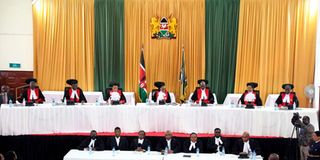
Four more Supreme Court judges have secured court orders stopping their ouster even as the Judicial Service Commission (JSC) reconvenes today to discuss their fate.
Deputy Chief Justice Philomena Mwilu together with Justices Mohammed Ibrahim, Isaac Lenaola and William Ouko secured the orders from High Court judge Lawrence Mugambi, where they attributed the ongoing disciplinary process to disparaging social media posts by two prominent lawyers: Nelson Havi and Ahmednassir Abdullahi.
They joined Chief Justice Martha Koome and Judge Njoki Ndung'u who obtained similar orders last wee k suspending the JSC from proceeding with the ouster process as proposed by three Kenyans.
Nation could not independently confirm whether Justice Smokin Wanjala has filed a case against the JSC by press time.
The Commission is set to reconvene today at it's offices in a meeting that is to be chaired by vice-chairperson Isaac Rutto, with the ouster petitions top of the agenda.
Pleading with the High Court to halt the disciplinary proceedings , DCJ Mwilu together with Justices Ibrahim, Lenaola and Ouko told justice Mugambi that the conduct of the JSC proceedings is questionable and that the Commission is exposing them to public scrutiny without due process.
This is because the Commission's decision to develop the Draft Judicial Service (Processing of Petitions and Complaints Procedures) Regulations 2024 is surrounded by veracity questions.
They added that the JSC is subjecting the entire seven-judge bench to targeted persecution and a deliberate effort to demean and discredit the Supreme Court along with its judges.
"In my view, JSC cannot claim to be protector of judges and the entire Judiciary while simultaneously exposing them to public condemnations without due process. By singling out Supreme Court judges for this kind of public treatment, JSC engaged in discriminatory conduct," said Justice Ouko in his court papers.
He questioned why the JSC issued a press release on January 16, 2025, informing members of the public that it had received a petition against the seven Supreme Court judges.
"Even more disturbing, the JSC press release was issued before the judges of the Supreme Court were officially notified of the petition, meaning the judges learned about the petition through the media rather than formal communication. This public ambush subjected the judges to trial by public opinion, damaging their dignity, integrity and professional standing before they even had the opportunity to respond to the claims against them," said Justice Ouko.
For Deputy Chief Justice Mwilu, she said the ouster petitions concern decisions made collectively by all judges of the Supreme Court in their official roles and that JSC failed to perform its mandate of preliminary evaluation of the complaints.
She explained that the Constitution does not entertain removal of a judge based on collegial decisions of the entire Supreme Court.
"The architecture of article 168 of the Constitution only gives the JSC the mandate to initiate the removal of a judge from office on account of individual and personal culpability," she said.
Ms Mwilu said the petitions stemmed from general and unsubstantiated claims by lawyers Havi and Abdullahi on social media.
"I have personal knowledge that Mr Havi and Mr Abdullahi have also over the years and even currently made clear their contempt for me and the other Supreme Court judges through their numerous social media posts, mostly on the X platform," she said.
She has attached copies of social media posts made between 2021 and 2025 in respect to the Supreme Court and individual judges.
For Justices Lenaola and Ibrahim, they argued that the JSC has failed to protect judicial officers from persistent vilifying speeches and commentaries made in disguise of freedom of expression.
"The campaigns of vilification of the judges and the Judiciary constitute a serious attack of the independence of the Judiciary and the integrity of judicial process. The actions threaten to abolish the Supreme Court established by law by seeking the removal of the entire bench of seven judges through unconstitutional means," said Justice Lenaola.
Judge Ibrahim said there is no collective or joint gross misconduct of judges as alleged by the petitioners, hence the joint complaint filed against all the seven judges is an affront to the Constitution.
The cases will be mentioned on March 6, 2025, for further directions.