Kenya's Financial Reporting Centre (FRC) has complied with a United Nations Security Council directive to delist Kuwaiti cleric Hajjaj bin Al-Ajmi as a terrorism sponsor.
Previously flagged by both the UN and the US for financing Syrian insurgents, Al-Ajmi was recently removed from the list of terror masterminds.
The Syrian group Hay’at Tahrir al-Sham (HTS), a major Islamist faction that evolved from Al-Qaeda’s former affiliate Jabhat al-Nusra, was also delisted after transitioning into a governing body and dissolving its insurgent identity.
In a notice titled Targeted Financial Sanctions Notice No. 4 of 2025, the FRC confirmed the removal of Hajjaj Bin Fahd Al Ajmi, formerly listed under QDi.328, from Kenya's local terror sanctions enforcement list.
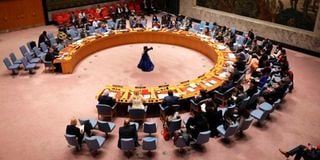
The action follows a UN Security Council update on its sanctions list related to ISIL (Da’esh) and Al-Qaeda on June 9, 2025.
Kenya will also comply with the decision to lift Al Ajmi’s travel ban and unfreeze any of his linked assets.
The UN's decision falls under Resolutions 1267 (1999), 1989 (2011) and 2253 (2015), which guide global action against terrorism financing.
These frameworks support asset freezes, travel bans, and arms embargoes for individuals and entities associated with terrorism.
According to the FRC, these measures will no longer apply to the delisted individual.
“Respect the delisting and unfreeze, without delay, all targeted funds or other assets of the delisted person(s) that you or your institution hold,” the notice stated.
The FRC, through its Counter Financing of Terrorism Inter-Ministerial Committee, said that the delisting aligns with the Prevention of Terrorism Act (2012) and the newly gazetted Prevention of Terrorism (Implementation of the United Nations Security Council Resolutions on Suppression of Terrorism) Regulations, 2024 (POT-TFR).
In Kenya, the FRC monitors compliance with global financial sanctions and tracks suspicious financial activity potentially tied to terrorism or organised crime.
The delisting notice has been sent to all reporting institutions, including banks, financial firms and any entity that may have held assets linked to Al Ajmi.
The centre instructed these institutions to file reports on the unfreezing of any such assets and submit details via email to [email protected] .
It warned that non-compliance or any attempt to circumvent these obligations would constitute an offence under Kenyan anti-terrorism financing laws.
“Respect the delisting and unfreeze, without delay, all targeted funds or other assets of the delisted person(s) that you or your institution hold,” said FRC Director General Saitori Maika.
Al Ajmi had been sanctioned due to his alleged role in raising and funnelling funds to extremist groups in Syria during the civil war.
Although he denied direct involvement in violence, his fundraising—often conducted via social media and Gulf-based networks—attracted international scrutiny.
In 2014, the US Treasury blacklisted Al Ajmi, accusing him of using donation campaigns to finance al-Nusra Front, then an Al-Qaeda affiliate in Syria.
He reportedly leveraged his clerical influence to raise millions of dollars ostensibly for humanitarian aid, which intelligence agencies believed was diverted to militants.
His removal from the UN sanctions list reflects shifting geopolitical dynamics in Syria and among jihadist factions. HTS, which previously embraced global jihad, has since focused on local governance and distanced itself from Al-Qaeda’s transnational agenda.
The FRC reminded institutions and the public that the updated list of sanctioned individuals and entities linked to ISIL and Al-Qaeda is available on the FRC website and the UN Security Council portal.