The government’s much-hyped plan to plant 15 billion trees in 10 years faces major logistical and operational challenges, with the country’s tree-planting drive having reached 1.7 billion trees in the last four years despite the rise in afforestation programmes aimed at restoring degraded ecosystems.
The country has fallen short of its initial target of planting 1.5 billion trees annually and increasing forest cover from the current 8.8 per cent to 30 per cent by 2032 by growing trees in degraded public forests and securing crucial water catchment areas.
Environmentalists have decried the shortage of quality seedlings, inadequate manpower, poor coordination, and lack of proper monitoring to track the survival rates of planted trees.
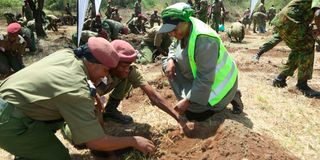
The head of the Anglican Church of Kenya Jackson Ole Sapit (left) and students plant tree seedlings at ACK Guest House in Makueni County on October 10, 2022.
Photo credit: Pius Maundu I Nation Media Group
“The government needs to shift its focus to addressing the bottlenecks affecting this programme. Going by its own projections, more than four billion trees should have been planted by now,” said Eldoret-based environmentalist Mathew Koech.
To achieve the 15 billion target by 2032, Kenya would need to consistently plant and sustain an estimated 4.11 million trees daily from the launch of the initiative.
The concerns come as the Kenya Forest Service (KFS) intensifies efforts to restore degraded ecosystems and protect critical water towers through fencing and enhanced conservation programmes.
KFS has rolled out a three-year post-care programme aimed at monitoring the survival rate of planted trees and replacing dead or damaged seedlings.
“The National Tree Growing Campaign is responsible for monitoring and replacing dead or damaged plants as part of tracking the progress of the 15 billion trees initiative,” KFS said in a report.
The agency has established a resource mobilisation unit to support restoration programmes in gazetted forests, community land, private farms, parks and public institutions.
According to Cabinet Secretary for Environment, Climate Change and Forestry Dr Deborah Barasa, the plan to grow 15 billion trees by 2032 and restore 10.6 million hectares of degraded forest land is attainable.
“Stringent measures have been put in place to contain further destruction of forests and water catchments, and intensify afforestation programmes to realise the target of planting 15 billion trees and restoring 10.6 million hectares of degraded forest,” Dr Barasa said in an earlier interview.
Environmentalists and professionals in Nandi County have launched a community-led forest afforestation programme aimed at restoring degraded ecosystems in a bid to help attain the 15 billion-tree target.
As part of the initiative, they planted more than 200,000 indigenous trees at the Chepkiep/Kiptangus Forest on the Nandi Escarpment.
The community-led conservation programme, led by Dr Henry Rotich, Abraham Koech and the forum’s patron, Dr Hosea Kili, has restored about 74 hectares of degraded forest.
Dr Henry Rotich (second right), Nandi Integrated Forum for Conservation chairperson Lorna Sang, and other participants take part in a tree-planting exercise during the launch of the Nandi Integrated Forum for Conservation in Chepkiep/Cheptangus Forest, Mosop, Nandi County, on June 26, 2026. The initiative aims to restore 74,000 hectares of forest. Head of Public Service Felix Koskei was the chief guest.
Photo credit: Jared Nyataya | Nation Media Group
The initiative brought together several partners, including the National Industrial Training Authority (NITA), Kenya Bureau of Standards (KEBS), County Pension Fund (CPF), Teachers Retirement Benefits Authority (TRA), KASNEB Foundation, Kenya Forest Service (KFS), North Nandi Community Forest Association (CFA), Kenya Seed Company, Eastern Produce Tea Company, Nandi Tea Company, Chepkiep community members and other stakeholders.
“Communities living around the forest need to be empowered to take ownership of the conservation efforts and benefit from the programme,” said Dr Rotich.
The restoration initiative was attended by senior government officials, including Head of Public Service Felix Koskei and Cabinet Secretary Dr Deborah Barasa.
Principal Secretary for the State Department for Forestry Gitonga Mugambi said every county has been assigned a role in achieving the national target, adding that Nandi County has already made significant progress.
“Every county has a target that contributes to the 15 billion-tree programme. Nandi County is already halfway towards achieving its target, but more community initiatives like this are needed to accelerate restoration efforts,” Mr Mugambi said.
The Global Environment Facility Council has approved the release of Sh196.6 billion to address the pressing issues of climate change, biodiversity loss and pollution
Photo credit: EVANS HABIL| NATION MEDIA GROUP
As part of the conservation drive, KFS has embarked on fencing key forest ecosystems to curb illegal logging, charcoal burning and human encroachment, which continue to threaten fragile ecosystems.
According to Chief Conservator of Forests Alex Lemarkoko, the move is expected to enhance biodiversity conservation and promote natural regeneration.
“The fencing is expected to safeguard critical forest functions, including water catchment protection, carbon sequestration and soil conservation,” Mr Lemarkoko said.
The fencing exercise covers 273 kilometres across the Kessup, Sabor, Penon, Kaptagat and Kipkabus forest blocks.
Mr Lemarkoko called on communities living near forests to complement government efforts by acting as “social fences” against illegal activities that degrade forests.