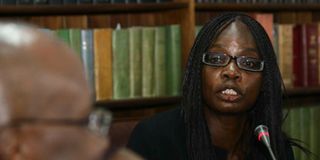
Kenyan law professor Phoebe Okowa was on Friday elected to sit on the International Law Commission, becoming the African woman to sit on a legal advisory body for the United Nations.
Professor Okowa scored 162 votes in a secret ballot conducted by the UN General Assembly, winning the required two-thirds majority vote in the first round.
And Kenya’s Permanent Representative to the UN, Dr Martin Kimani, promptly congratulated her as a qualified legal expert.
He said Prof Okowa was “an eminent scholar and practitioner” whose “brilliance will illuminate that body.”
Prof Okowa, an international law academic, had looked likely to clinch the seat after the United Kingdom supported her as well as an endorsement from the African Union.
She is currently a professor of Public International Law at Queen Mary University in London, and will now be among 34 members of the Commission who draft, research and expand on international law for the UN.
Prof Okowa has been a Member of the Permanent Court of Arbitration at The Hague and had been drafted to be part of the legal team for Kenya at the maritime case at the International Court of Justice against Somalia. An Advocate of the High Court in Kenya, she has also lectured on international law for the United Nations as well as published articles and books on emerging issues of international law.
She has promised to help build a body of law “rooted in political reality and of practical use to Member States.”
“My work will be informed by my dual experience as an academic and a practitioner of international law, which gives me a strong grasp of both the technical and the practical elements.”
Thirteen candidates from across the continent had filed their candidature with the UN, according to a listing published by the UN last month. Africa was allowed nine seats but as long as each seat comes from a different country.
Kenya had said Prof Okowa’s election will signal “an important step towards making the equality ideal in the Charter of the United Nations a manifest reality.”
Created in 1947, the Commission chooses its members from among candidates of the UN member states and serves for five years once elected by majority votes through a secret ballot. The new team will start their term in January 2023.
Africa’s other candidates included Yacouba Cisse of Cote d’Ivoire, Aly Fall of Mauritania, Ahmed Amin Fathalla of Egypt, Charles C Jalloh (Sierra Leone and endorsed by Chile and New Zealand), Kalaluka Likando of Zambia, Ahmed Laraba (Algeria), Clement Julius Mashamba (Tanzania), Ivon Mingashang (DRC) and Hassan Chahdi Ouazzani of Morocco. Others are Allioune Sall of Senegal, Louis Savadogo (Burkina Faso) and Mohamed Muaz Ahmed Tungo of Sudan.
Other regions were entitled to specified numbers of seats. The Asia-Pacific was due to elect seven, three from Eastern Europe, six from Latin America and Caribbean, Eight from Western Europe.