Premium
Kenyans to witness the longest lunar eclipse of 21st century
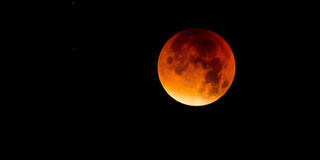
The "supermoon" rises on September 28, 2015 in Godewaersvelde. Kenyans and other East Africans will today experience total phase of the ‘blood moon’ eclipse. PHOTO | PHILIPPE HUGUEN | AFP
What you need to know:
The moon will pass by the Earth’s shadow and become completely ‘bloody’ for almost two hours.
CNN has reported that the Friday eclipse will turn the light colour of the moon to deep red.
Scientists call this kind of moon a “blood moon.
Kenyans and other East Africans will on Friday experience total phase of the ‘blood moon’ eclipse, which will last for one hour and 43 minutes— making it the longest Lunar eclipse in the 21stcentury.
In particular, Kenyans in Omenyangamong, Turkana County, will experience a total eclipse that will last for 103 minutes, beginning 8.14pm.
DARKEST MINUTE
According to a schedule published by www.timeanddate.com, the eclipse will end on Saturday, July 28, 2018, at 2.28am— with the darkest time estimated to be 11.21pm.
American space agency, Nasa, says the moon will move into the Earth’s shadow on Friday night.
For four hours, it will be partly in the Earth’s shadow.
The moon will pass by the Earth’s shadow and become completely ‘bloody’ for almost two hours.
CNN has reported that the Friday eclipse will turn the light colour of the moon to deep red.
Scientists call this kind of moon a “blood moon.
Andrew Fabian, a professor at the Institute of Astronomy at the University of Cambridge, told the Reuters that the phenomenon is called a ‘blood moon’ because as light from the sun goes through the Earth’s atmosphere, it turns red.
LENGHT
But the eclipse’s impressive length, the professor said, also means that the moon itself will actually look a little smaller and dimmer than usual.
That’s because the moon will be as far away as it gets from the Earth on its elliptical orbit, making it appear smaller, he added.
But, the moon also moves more slowly when it is that far away, according to Frederick Walter, a professor of physics and astronomy at Stony Brook University.
That lets it linger for longer in the Earth’s shadow and stretches out the length of the eclipse, added Walter.
According to Nasa, this event will be seen from almost any place on the planet.
The eclipse will be visible to people in Europe, Africa and the Middle East on July 27 between sunset and midnight.
Those who live in Asia and Australia will be able to see the eclipse between midnight and sunrise on July 28.
Unlike solar eclipse, people can look at a lunar eclipse directly with their own eyes.
The eclipse, however, will not be visible from North America or most of the Pacific.
MARS WONDER
The next lunar eclipse of such length will happen in 2123. But that is not all.
At the same time, an incredible Mars at opposition is going to happen too—a full moon, and great view of Mars, which will be directly opposite the sun. Mars will come so close to Earth that it can be seen with the naked eye.
The planet will appear brightest between July 27 and August 3.
Viewers will be able to see it higher in the evening sky.
This is “a once-in-two-years treat called ‘Mars in opposition, and it’s going to be an incredible show,’” said Walter.
This happens once every 15-17 years.
According to Space.com, this year’s Mars opposition is the closest since 2003.
During the Mars opposition in 2003, the Red Planet was only 34.6 million miles (55.8 million kilometers) from Earth.
This was the closest the two planets had come to each other in almost 60,000 years, and this record won't be broken until in August 28, 2287, according to Nasa.


