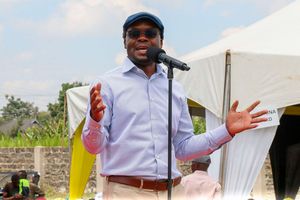
Don’t limit yourselves to one foreign partner, DP Kindiki urges African countries
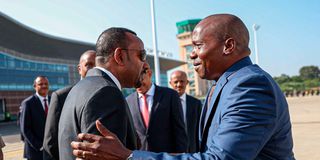
Deputy President Kithure Kindiki is welcomed by Ethiopian Prime Minister Dr Abiy Ahmed at the Bahir Dar Dejazmach Belay Zeleke International Airport. Prof Kindiki is in Ethiopia to attend the 12th Tana High Level Forum on Security in Africa in Bahir Dar.

What you need to know:
- Prof Kindiki said that, like Kenya, African countries should seek to have a constructive engagement with all partners.
- Such an attitude, he noted, can protect Africa from exploitative tendencies that have caused under-development.
Deputy President Kithure Kindiki has shared with Africa the approach that the Kenya Kwanza administration is taking in its foreign policy – which is engaging with as many partners as possible without having favourites.
Addressing a forum in Ethiopia on Saturday, Prof Kindiki said that, like Kenya, African countries should seek to have a constructive engagement with all partners.
“Africa must engage all partners constructively, without isolation or automatic alignment, guided by its interests and collective priorities. Africa should be a partner to all, a satellite of none, and an equal participant in shaping the international order,” Prof Kindiki said.


Such an attitude, he noted, can protect Africa from exploitative tendencies that have caused under-development.
It is a policy that has appeared active under President William Ruto, as he has often engaged with partners that have competing interests.
Since taking office, President Ruto has aggressively pursued a policy of “strategic autonomy”, positioning Kenya as a bridge between competing global powers.
A prime illustration of this balancing act occurred in March this year when the US State Department reported a phone call between Secretary of State Marco Rubio and President Ruto to discuss commercial opportunities and regional security, just as Chinese Vice President Han Zheng was in Nairobi flagging off tariff-free Kenyan exports via the standard gauge railway.
The balancing act between Washington and Beijing has defined Ruto’s economic and security blueprints. Under Dr Ruto, Kenya secured a historic designation as a Major Non-NATO Ally by the United States in 2024.
Yet, Dr Ruto has simultaneously deepened economic ties with China, which is Kenya’s largest trading partner.
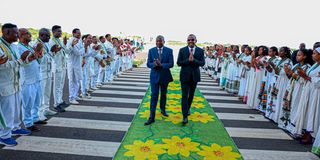
Deputy President Kithure is welcomed by Ethiopian Prime Minister Dr Abiy Ahmed. Prof Kindiki is in Ethiopia to attend the 12th Tana High Level Forum on Security in Africa in Bahir Dar.
During his visits to Beijing, Dr Ruto has co-chaired high-level forums on the Belt and Road Initiative. In April 2025, he hailed China as a “co-architect of a new world”, a stance that drew sharp rebukes from US lawmakers who threatened to review bilateral relations.
Dr Ruto’s multi-aligned diplomacy extends to other adversarial superpowers. While he openly condemned Moscow’s invasion of Ukraine at a peace summit in June 2024, his administration had, in May 2023, hosted Russian Foreign Minister Sergey Lavrov in Nairobi.
Back in Ethiopia, Prof Kindiki who was presenting Dr Ruto also asked African countries to explore ways of creating finished products for the global markets.
“Africa must move beyond exporting raw materials and importing finished products. We must capture greater value from our minerals including critical minerals, agriculture products, energy and human capital through investment in processing, manufacturing, technology and skills,” said Prof Kindiki.
He was speaking at the Tana High Level Forum on Security in Africa, which happened at the Ethiopian city of Bahir Dar.
He called on African countries to seek more ways of governing data in the age of evolving digital technologies.
“African countries must strengthen their capacity to govern data, protect critical digital infrastructure, develop technological capabilities and shape the rules governing emerging technologies,” said Prof Kindiki.
He noted that Kenya had a strong interest in championing the growth of African enterprise, drawing inspiration from Africa-grown successes such as Safaricom’s M-Pesa in digital finance, Ethiopian Airlines in aviation, and Dangote Industries in cement manufacturing and oil refining.
Prof Kindiki said President Ruto, as the Africa Union champion of reforms, remains committed to advancing more changes for a better continent.
“President William Ruto, as African Union Champion for Institutional Reform, is advancing Africa’s collective commitment to a more effective, accountable and financially sustainable Union that delivers on the continent’s priorities,” he said.
Prof Kindiki also asked African countries to explore local solutions to ensure lasting peace in Africa.
“An African model for peace must be built on prevention, dialogue, and African-led solutions. This demands strong, accountable institutions and inclusive political processes, supported by empowered and adequately resourced African Union, regional economic communities and regional mechanisms, working in accordance with the principle of subsidiarity and in constructive partnership with the international community,” he said.
Follow our WhatsApp channel for breaking news updates and more stories like this.