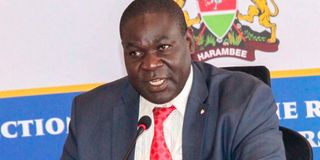
President William Ruto is in a fresh legal dispute following a petition filed by two civil society groups challenging his choice of Dr Duncan Oburu Ojwang as chairperson of the Kenya National Commission on Human Rights (KNCHR).
The groups, Katiba Institute and the Kenya Human Rights Commission (KHRC), want the High Court to nullify the nomination on grounds that both the President and the selection panel that recommended Dr Ojwang’s nomination failed to observe the gender parity rule. Dr Ojwang is set to replace Roseline Odede, who passed away in January this year.
The strength of the petition is premised on Article 250(11) of the Constitution, which prohibits the appointment of people of the same gender as chair and vice-chair of a constitutional commission.
In addition, Section 1(6) of the Second Schedule of the Kenya National Commission on Human Rights Act states that the chairperson and vice-chairperson should not be of the same gender.
In this case, both Dr Ojwang and the commission’s vice chairperson, Dr Raymond Nyeris, are male.
The petitioners have cited Article 250(11) of the Constitution, which states that “the chairperson and vice-chairperson of a commission shall not be of the same gender”.
“The President violated Article 250(11) of the Constitution and Clause 1(6) of the Second Schedule and Section 12(13) of the Kenya National Commission on Human Rights Act, by nominating and forwarding to National Assembly for vetting a male candidate namely Dr Duncan Oburu Ojwang despite the fact that the Vice Chairperson of the commission Dr Raymond Nyeris, PhD, is also a man” says the petitioners.
Dr Ojwang is awaiting vetting and approval by the National Assembly. The petitioners want the court to stop the intended vetting, arguing that the nomination is already in breach of the law, which demands gender parity.
“The National Assembly equally threatens violation of Article 250 (11) of the Constitution and Section 1(6) of the Second Schedule and Section 12(13) of the Kenya National Commission on Human Rights Act, unless stopped by an order of this court. On the face of it the nomination sent to them already violates the Constitution and Act, as the nominee is a male,” says the petitioners.
They have named the Attorney General, the Selection Panel and the National Assembly as the respondents in the suit. Members of the Selection panel for the recruitment of nominees for appointment as the Chairperson of the KNCHR are listed as interested parties.
The Panel chose Dr Ojwang after interviewing him alongside five other candidates, including Victor Okoth Ogwang, Selina Amsugut Iseme, Claris Awour Ogangah, Edward Katama Ngeywa and Michael Peter Otieno Okelloh.
The petitioners allege that allowing the nomination of Dr Ojwang to remain standing amounts to reducing “constitutional commands to ceremonial rhetoric”.
“The Respondents have violated the right of women to equal treatment, including the right to equal opportunities in political spheres, by inviting, shortlisting and recommending male applicants to the position of chairperson of the commission, which in the circumstances could only have been filled by women candidates, is contravention of Article 27 of the Constitution,” says the petitioners.
They want the court to examine the actions of the selection panel, the President and the National Assembly.
It is their case that the respondents needed to show justification for the non-compliance with Article 250 (11) of the Constitution.
If Dr Ojwang gets Parliament's approval and is appointed to the position, the petitioners want the court to declare that any actions he may take in consequence are invalid and of no legal effect.
The petition is awaiting hearing directions at the High Court. The AG, together with the Selection Panel and the National Assembly are yet to file their responses.