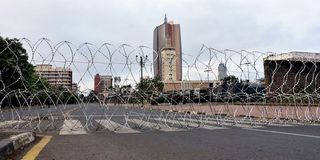
Police mounted extensive roadblocks across Nairobi on Thursday despite a High Court order barring security agencies from blocking access to the city's central business district without prior public notice.
The barricades, erected as Kenyans marked the second anniversary of the Gen-Z-led anti-Finance Bill protests, disrupted transport and prompted fresh claims that police had disregarded a subsisting conservatory order.
Rights group Katiba Institute said the operation raised serious questions about compliance with court orders and the rule of law.
A deserted Thika Superhighway June 25, 2026 during Genz as the nation marked the second anniversary of the Gen Z protests.
Photo credit: Sila Kiplagat | Nation Media Group
Major highways leading into the capital were sealed off from the early hours, with razor sharp barbed wire barriers and heavy police deployment reported along key entry points, including Mlolongo and Athi River. Roads allowed Parliament were also sealed off.
Thousands of commuters were forced to walk long distances after public transport was turned back or diverted, while many businesses remained closed and movement into the city centre was severely restricted.
The renewed road closures came despite court conservatory orders issued on July 9, 2025, restraining the Inspector-General of Police and officers under his command from mounting barricades or blocking access to Nairobi's central business district without issuing a timely public advisory.
The judge later extended the orders on October 2, 2025, pending the hearing and determination of Katiba Institute's constitutional petition.
In the ruling, the court said the orders were necessary to ensure the public was not inconvenienced whenever police decided to restrict access to roads. It directed that any emergency road barricades should be preceded by timely notice to allow members of the public to plan their activities.
"Today's barricades raise serious concerns about continued disregard for court orders and the constitutional principle that all public authorities are bound by the law," the organisation said.
"The rule of law requires compliance with court orders, especially by those entrusted with enforcing them," it added.
The petition, filed after similar road closures during the June 2025 Gen-Z anniversary protests, argues that police unlawfully used razor-sharp barbed wire and barricades to deny citizens access to the central business district without prior notice.
Police officers man a roadblock at Ruiru Bypass along Thika Road on June 25, 2026 as the nation marked the second anniversary of the Gen Z protests.
Photo credit: Wilfred Nyangaresi | Nation Media Group
It seeks declarations that such actions violate constitutional guarantees on freedom of movement and peaceful assembly and asks the court to permanently restrain police from imposing similar restrictions without due process.
The petition also seeks "a permanent order of prohibition prohibiting the respondents from unlawfully limiting the enjoyment of Constitutional human rights, the right to picket and demonstrate under Article 37 of the Constitution and the freedom of movement under Article 39 of the Constitution without issuing an advisory to the public."
The Motorists Association of Kenya also criticised Wednesday's roadblocks, saying they contradicted assurances issued a day earlier by Interior Cabinet Secretary Kipchumba Murkomen that the anniversary would proceed as a normal working day under adequate security.
The association said patients travelling for dialysis and emergency treatment, workers, traders and people attending court proceedings were among those stranded after police blocked major highways into Nairobi.
"The police have no legal basis to turn back law-abiding Kenyans who are exercising their fundamental rights," the association said, calling for the immediate removal of the roadblocks and accountability over the disruptions.
The National Police Service had not publicly responded to the allegations by the time of publishing this article.
Security agencies have previously defended road closures during major demonstrations as necessary public order measures.
Wednesday's operation unfolded as thousands of Kenyans commemorated the June 2024 anti-Finance Bill protests, which left dozens dead and triggered ongoing criminal investigations, constitutional petitions and civil claims over police conduct.
With Katiba Institute's petition still awaiting final determination, the latest barricades have added a fresh legal dimension to the continuing debate over the balance between public security and constitutional rights during protests.
The petition is scheduled for mention on September 28, 2026 before Justice Patricia Nyaundi.