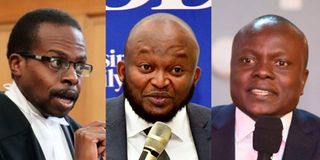
The race for the Law Society of Kenya (LSK) presidency to replace incumbent Faith Odhiambo has turned into a clash of generations, experience, and vision, with each candidate staking a claim to lead a profession at a crossroads.
With only two weeks to the elections, Senior Counsel Charles Kanjama, current Vice President Mwaura Kabata, and Peter Wanyama are locked in a high stakes contest that pits experience against continuity and fresh ideas against entrenched leadership.
Speaking at a debate organised by the Mombasa Law Society for contestants of various elective seats, each candidate presented themselves as the best choice to serve at a time when they say the Society will be tested by the upcoming general elections.
Mr Kanjama positioned himself as the seasoned insider who can navigate LSK through a critical period, emphasising the need for leadership with gravitas and respect.
“LSK is at a crossroads. We need a leader who can engage other leaders from a position of respect and seniority,” said Kanjama. He added that he was the steady hand the Society needed to navigate a period of critical decisions, from stalled infrastructure projects to safeguarding the welfare and dignity of members across the country.
By contrast, Peter Wanyama, an advocate with 18 years of experience, pitched energy and reform over experience. He took aim at his rivals, saying Kanjama’s seniority limits bold action, while Kabata’s tenure serving under the current president is enough for him to retire.
He acknowledged that despite holding leadership in LSK, he had fresh ideas and bold action which are exactly what the Society needs to reclaim its relevance and protect young lawyers.
“LSK is in a state of inertia. Some things are happening but the members are not feeling it. Mr Kabata has been there as a vice president, we celebrate him as he retires. Senior Counsel Kanjama has been here since 2014. I am new with fresh ideas,” said Mr Wanyama.
Mr Kabata positioned himself as the practical choice to lead the lawyers, emphasising efficiency and continuity. He said that, having served as Faith Odhiambo’s deputy, he has a proper understanding of the Society and would continue the fight against human rights abuses that he and his boss have long confronted.
Seniority and inexperience
He also took aim at his rivals, arguing that experience alone is not enough and that Kanjama’s seniority and Wanyama’s inexperience could hold back the Society.
“We require a leader who understands LSK’s systems and history. Fresh ideas are good, but without experience, you cannot make the machinery work efficiently. The Society cannot afford to learn on the job,” said Mr Kabata.
He added, “My contenders, one is a leader who has not served in LSK and the other one needs to be mentoring young advocates, not looking for an elective seat.”
The panel pressed the candidates on their campaign financing and whether there should be rules to regulate contributions. Mr Kanjama emphasised transparency and structural reforms, saying he had spent up to Sh2 million.
Mr Kabata highlighted a modest, low-cost approach, noting pledges of up to Sh4 million, while Mr Wanyama acknowledged spending over Sh10 million but stressed he had been professional and could account for every shilling.
“I have been practicing for 18 years, so it would not be modest of me to say that I cannot afford Sh5 to Sh10 million to run a campaign for the presidency. I have spent over Sh12 million on logistics, but I advise that even with regulations, we must remain professional. After campaigns, candidates should self-report and declare their sources of funds and how the money was used,” said Mr Wanyama.
Despite their attacks, the trio found common ground on cracking down on quack lawyers. They all emphasised the need to uphold professional standards and protect the integrity of the legal profession.
“We need to adopt technology to upskill our members and use the available digital platforms that now are struggling and make them use technology with ease; this way we will kick quacks out of the profession,” said Mr Kanjama.
The debate also touched on LSK’s role in monitoring laws. The candidates explained that the Society must act early to protect lawyers’ interests and prevent policies that could undermine their work.
Mr Kabata highlighted his work as vice president developing a legislative tracking tool that helped the Society intervene on laws that could have left lawyers without jobs.
“We developed a tool to monitor all bills sent to Parliament and see how they affect our members. This allowed us to intervene early and even recruit in-house counsel to advise on critical legislation,” he said.
Mr Kanjama added, “LSK needs to go beyond reacting to bills. We have members working in government as in-house lawyers, and we must influence laws from the drafting stage, not from the back foot.”
“A lot is happening at the central level that diminishes the role of lawyers. I have been at the centre of this and will ensure policies do not risk our livelihoods,” said Wanyama.
While much of the debate focused on the presidential race, contestants for other elective seats, including the vice presidency and General Council, also presented their visions. The candidates for vice president, Elizabeth Njeri, Teresiah Wavinya, and Deborah Ajwang’, outlined plans for improving member welfare and professional standards.
The vice president debate centred on strengthening the Society’s systems and ensuring effective oversight of legislation. Candidates also focused on member welfare, including health cover, support for young lawyers, and professional development.
Despite their differences, there was consensus that upholding professional standards and protecting member interests remain key priorities for the next leadership team.