The Kenya Railways has received court approval to reconstruct a concrete tunnel and soil embankment bridge in Maai Mahiu, the area where the 2024 flash flood emerged before killing 60 people.
This is after Judge Mary Oundo lifted interim orders issued on March 26, 2025, directing the Kenya Railways Corporation (KRC) to stop the construction of the tunnel along the Kenya-Uganda railway line, following a case lodged by 143 residents.
The judge dismissed their claims that the reconstruction of the concrete tunnel bridge and soil embankment bridge was outdated. They had also claimed that the reconstruction was not only a waste of public money but a death trap for the people living downstream.
"No evidence had been placed before the court that the petitioners’ representative one Bernard Ndungu Kamau, had experience in civil and structural engineering works or that he was a professional engineer for that matter," said the judge.
She added: "No affidavit had been filed from a professional to counter the disposition of Shimrone Munga, a representative of the first respondent (KRC) in as far as the structural engineering works of the railway and bridge were concerned".
The court allowed KRC's application to vacate the interim order on grounds that the project was being implemented by qualified engineers from both KRC and the Ministry of Transport and had also received an endorsement from the professionals of the National Environment Management Authority (Nema).
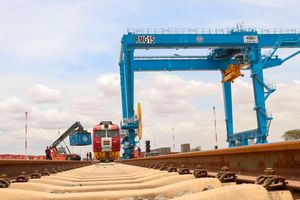
KRC argued that the Uplands-Longonot section of the metre-gauge railway line serve as a vital corridor for transporting goods and passengers between Nairobi and Western parts of Kenya and to Uganda.
The court heard that subsequently, the delay in completion of the restoration was threatening to cause diplomatic rows with the neighbouring country.
The court heard that a delegation from Uganda had also visited Kenya to implore the Government to fast-track the restoration of the railway line.
KRC, through Shimrone Munga, an engineer, said unless the orders were vacated, Kenya Railways Corporation stood to be highly prejudiced and the lives of many residents living on the lower sides risked another catastrophe.
It was the petitioners' case that without any form of remorse, precaution or participation of the people, the KRC "just like in the year 2020 was back at creating yet another outdated soil embankment bridge in the places that had been swept away by the 2024 floods".
They argued that KRC was undertaking the works without the environmental impact assessment from Nema and in particular, the sustainability and safety of the communities living down the gorges.
They told the court that the construction of the "outdated tunnel and soil embankment bridge" would be at the detriment of their lives, properties and livelihood.
The concrete tunnel and soil embankment bridge is to pass the gorge, through Kamuchira, Jerusalem, Githioro, Gorges and Ruiru villages.
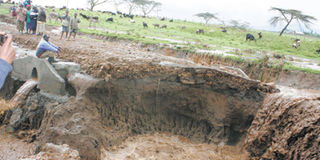
The reconstruction follows the April 2024 flash flood tragedy that resulted in 60 deaths, after a blocked railway tunnel burst at night and a speeding deluge swept away homes in the nearby villages.
The tunnel, which is near Old Kijabe Town, burst due to the accumulation of flood water in what was locally known as the dark tower, which was a 183-meter-long and 10 feet diameter concrete tunnel, built to carry soil embankment bridge for the Kenya-Uganda Railway track to pass the 100-meter gorge.
According to the petitioners, it was the responsibility of the Kenya Railways, together with its managing director and employees, to keep a 24-hour vigil at the said bridge, and observe water levels in the event of rains or floods, so as to take appropriate remedial steps to avert any disasters.
They said that had the appropriate measures been taken, they would have been spared of the worst avoidable catastrophe where as a result of the KRC's negligence, defiance and breach of duty of care, they had suffered loss of their loved ones, homes, properties and businesses.
They claimed that as a consequence of the breach of duty of care, the residents had been left vulnerable and exposed to the elements of nature and cruelty of loss of social protection, denial of access to their sources of income, identity and belonging.
However, the Environment and Lands court found that the petitioners failed to establish a strong case to warrant issuance of an injunction order stopping the works.
For example, the court found that the basis of filing the application for injunction order was overtaken by events upon the issuance of the Environmental Impact Assessment (EIA) licence by Nema.
This meant any complaints arising on issuance of EIA licenses fell within the jurisdiction of the National Environment Tribunal.
The petitioners had argued that the public participation meeting held on May 7, 2025 had been done clandestinely pursuant to a notice of a prescribed venue in Kamuchira village, which venue had been changed at the last minute to the site of the construction. They said that the venue was later moved to another place.
"The marginalised communities of the Maai Mahiu villages who had suffered a catastrophe were not accorded an opportunity to submit their views on the construction of the railway in contravention of Articles 10 and 118 (1) (b) of the Constitution," said the petitioners.
They further contended that the said public participation meeting had ended in unanimous rejection of the railway project by the residents.