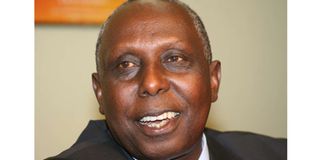
Former Co-operative Bank chairman and powerful politician Hosea Kiplagat, who died Saturday morning, was an influence peddler and a grassroots mobiliser for President Daniel Moi.
Those who knew Kiplagat eulogised him as a generous but shrewd man who used his connections – he was a nephew of the former president – to build a business empire spanning Nairobi and his rural Baringo backyard.
According to the family, Kiplagat died around 9.30am. He was 76.
“Mr Hosea Kiplagat fell ill in his house this morning. He was rushed to Karen hospital where he was pronounced dead on arrival,” family spokesman CK Mundui said, without disclose the cause of the death.
Kiplagat was born to Isaac Salgong and Zipporah Salgong in Tenges, Baringo county, in 1945.
President Moi made him a confidant, an aide and Baringo Kanu chairman.
Popularly known as HK by his associates, Kiplagat started off as a prison warder and made a fortune while managing some of Moi’s property.
When President Moi retired in 2002, Kiplagat went into a quiet life.
He contested the Baringo Central parliamentary seat in 2007 but lost to former Lands Commissioner Sammy Mwaita.
Kiplagat’s closeness with Moi saw him build a multimillion-shilling empire with property in Nakuru, Baringo and Uasin Gishu counties.
He held wide business interests, including banking and transport.
But Kiplagat’s fortunes appeared to plummet when his closeness to power waned. And off started trips from one court to another as he fought with auctioneers.
Last month, Kiplagat lost a petition seeking to bar a bank from auctioning several parcels of land in Eldoret, after defaulting on loans.
In 1996, Kiplagat was allocated 20 hectares when EATEC land in Eldoret was put up for sale. He also bought a large chunk of the vast wattle trees plantation, and established an electricity wood poles treatment plant.
To expand the business, Kiplagat took a Sh375 million loan from the Bank of India, a decision that would come to haunt him.
Court documents show Kiplagat, through his company, took a Sh275 million loan from the bank in 2017, charging 12 properties in Eldoret.
He took another Sh100 million in June 2018 to buy a tractor and other machines. He charged the same properties.
According to Kiplagat, his company defaulted on the loan due to hostile and unpredictable business environment coupled with the Covid-19 pandemic.
In 2019, he won temporary reprieve when the High Court stopped the sale of his property to recover a loan advanced to his company by Trade Bank, which is in liquidation.
The politician through Makatiat Ltd, a breadmaking company, was in court over a loan advanced to the company in 1992. He secured the loan using his home.
The home stood on an 82-acre- parcel and had house, servants quarters, a water tank and trees.
Kiplagat said he borrowed Sh5 million but the total amount he had taken from Trade Bank was about Sh170 million.
By the time the matter was in court, he said he had a balance of Sh8 million and “wondered” why the bank was claiming Sh400 million and keen on selling his property.
In 1994, Kiplagat through Sewenei Ltd was among 125 beneficiaries of the 990-acre ADC Kiswani farm bought at Sh20,000 an acre instead of the earlier agreed Sh250,000 to Sh300,000.
Government-sponsored livestock production, seed maize, seed grass, national Boran stud, potato seed production multiplication and horticultural projects collapsed following the division of the farm.
Kiplagat also defended the ownership of a 20-hectare parcel, saying despite it being part of the Mau water tower, he acquired it legally “like any other Kenyan”.
Reported by Anita Chepkoech, Sam Kiplagat and James Kariuki