Mounting pressure from the United Nations and the Kenyan government, direct family appeals, and fears over the health of Kenyan rights activists Bob Njagi and Nicholas Oyoo, forced Ugandan President Yoweri Museveni to order their release from military detention, the Nation can reveal.
Kenyan a ctivists Nicholas Oyoo (left) and Bob Njagi who were detained in Uganda during a press conference at Jomo Kenyatta International Airport in Nairobi on November 8, 2025 upon their return to the country.
Photo credit: Bonface Bogita | Nation Media Group
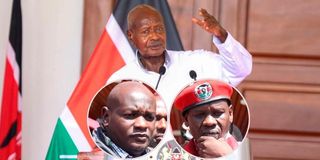
On Saturday, President Museveni, whose government and military had denied knowledge of the whereabouts of the abductees, admitted that he ordered their arrest and detention as he openly bragged about Uganda’s security intelligence.
“Here we have very good intelligence. We know them. They have been with us; I have their names. They came and they were working with Kyagulanyi’s group. They are experts in chaos,” he said during a press briefing at Mbale State Lodge.
Museveni confirms arrests of Kenyan activists Bob Njagi and Nicholas Oyoo
Without giving details, the Ugandan leader’s statement attempted to suggest that the Kenyans were part of the opposition’s plan to stage protests and cause chaos in his territory.
Major Jimmy Omara, the spokesperson of Special Forces Command, an elite force responsible for guarding the president and important national installations, said he had shared the release details with his bosses and would share details as soon as he gets a briefing.
Mr Njagi’s and Mr Oyoo’s walk to freedom followed sustained pressure from several quarters, including the United Nations, whose special rapporteur made calls and travelled to Kampala to push for their release.
Mary Lawlor, the UN Special Rapporteur on Human Rights Defenders (HRDs), told the Nation in an exclusive interview that the disappearance of the two Kenyans in Uganda had raised serious concerns globally about their safety and the need for the respect of human rights.
The UN Special Rapporteur, who is in Kenya on an unofficial tour, said that on November 3, she held a meeting with the Uganda Human Rights Commission (UHRC) and raised the case of the two Kenyans, and the commission pledged to look into it.”
“They (UHRC) said they had been unable to act prior because the matter was before the courts. But after the courts adjudged the two to be missing persons, the commission then had a mandate to investigate their whereabouts,” Ms Lawlor, who is in Nairobi, spoke just hours after the two Kenyans had been released.
She said she travelled to Uganda and on November 6, she met with UHRC in a bid to put pressure on the Ugandan authorities to release the two Kenyans.
Being on unofficial visit, Ms Lawlor was not scheduled for meetings with the Ugandan government officials.
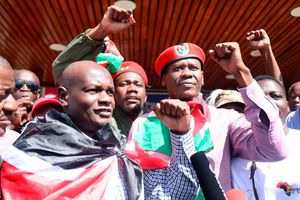
Activists Bob Njagi and Nicholas Oyoo who were held in Uganda for the last 38 days thank Kenyans for their support during their detention on November 8, 2025 at Kisumu International Airport.
Photo credit: Alex Odhiambo | Nation
However, the human rights-related Civil Society Organisations (CSOs) came in handy to pass the message to the Ugandan authorities.
“We wanted to establish what had happened to the two Kenyans held in Uganda,” said Ms Lawlor, noting that the killing of human rights defenders (HRDs’), which is becoming prevalent, “should be a red alert on the part of any government.”
“It should be the duty of the government to protect its people, including the HRDs and not the responsibility of the civil society organisations,” said Ms Lawlor as she castigated the coordinated attacks on the Kenya Human Rights Commission (KHRC) offices in Nairobi, early this year by suspected agents of the State.
The special envoy emphasised that the efforts of human rights defenders in Kenya and Uganda, public pressure and the media may have played a large part in the release of the two activists.
On Sunday, it emerged that Mr Njagi and Mr Oyoo spent at least seven days in hospital after they were taken ill while in military detention.
A close family member revealed to the Nation that the two activists were admitted to a military hospital for one week.
Later, they were reportedly taken to a safe house for days, from where they were moved on Thursday before their release on Friday night.
“We were informed that Mr Njagi and Mr Oyoo were not in good health and had been taken to a military hospital for a week. After that, they spent another three days in a safe house,” said Mr Norbert Ochieng, the elder brother of Nicholas.
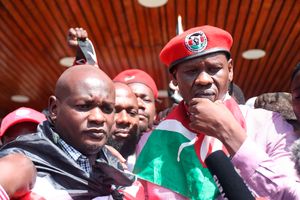
Kenyan activist Bob Njagi (second right) is received with family members and friends at Jomo Kenyatta International Airport in Nairobi on November 8, 2025, following their return home from Uganda where they had been detained.
Photo credit: Bonface Bogita | Nation Media Group
This period coincided with the last press briefing held by activists at Amnesty International Kenya offices, during which human rights defenders raised alarm over the deteriorating health condition of the duo.
The Kenyan government over the weekend noted that it played a big role in the release of the two rights defenders.
Prime Cabinet Secretary Musalia Mudavadi, who also doubles up as Kenya’s Foreign Affairs Cabinet Secretary, said that their release followed a “sustained diplomatic engagement between Kenya and Uganda.”
“Both governments maintained open and constructive communication that has culminated in the safe release of our nationals,” said Mr Mudavadi noting that Kenya, through its High Commission in Uganda, made its first official protest to Uganda on October 3, through note verbale.
A note Verbale is an informal, unsigned diplomatic communication written in the third person and is often used for a wide range of diplomatic exchanges.
It is more formal than an aide-mémoire but less formal than a signed note, and is often used for routine correspondence, official notifications, and to convey information to foreign officials.
In a letter dated October 31, Mr Mudavadi expressed frustration over Uganda’s silence despite a series of diplomatic correspondence and phone calls between officials from both countries.
“Nearly a month has elapsed since our initial communication, and the Government of the Republic of Kenya is yet to receive a formal response from the Government of Uganda regarding the whereabouts and well-being of our nationals.
“This incident has caused immense distress to their families, elicited intense public concern in our country and drawn international attention from human rights organisations,” he wrote.
Mr Mudavadi reminded Uganda that both governments are “duty-bound to the protection and safety of our citizens both at home and abroad,” emphasising that prompt action was necessary to uphold the values of the East African Community (EAC) and preserve the “strong, long-standing relations” between the two neighbouring nations.
He called on Kampala to “expedite a thorough and independent investigation” and share any findings or actions taken to date. Kenya, he said, remained ready to cooperate through diplomatic channels and EAC frameworks “to secure the release and safe return of the missing citizens.”
It is also claimed that the immediate former President Uhuru Kenyatta had a hand in the release of the two, though his private secretary was not available for a comment by press time on Sunday.
The disappearance and continued lock-up of the activists saw local and international rights defenders, including Vocal Africa and Amnesty International, pile pressure on both the Kenyan and Ugandan governments to release them.
“Bob and Nicholas represent a generation of young East Africans committed to justice, civic participation and the defence of human rights. Their suspected enforced disappearance is not just a violation of their individual freedoms but also a threat to the rule of law in the region,” Amnesty International, Vocal Africa and the Law Society of Kenya said in a joint statement on October 6.
“We reiterate our collective demand for their immediate release. Both governments must promptly uphold their domestic, regional and international human rights obligations.”
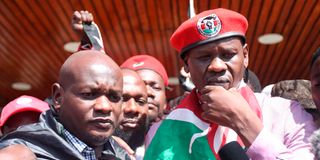
Kenyan activists Nicholas Oyoo (left) and Bob Njagi (right) who were detained in Uganda during a press conference at Jomo Kenyatta International Airport in Nairobi on November 8, 2025 upon their return to the country.
Photo credit: Bonface Bogita | Nation Media Group
Mr Njagi’s and Mr Oyoo’s colleagues in Kenya also staged demonstrations in the streets of Nairobi and at the Ugandan High Commission in the Kenyan capital. They called to East African heads of state to address the trend of abductions and to allow freedom of speech.
“We do not know their whereabouts and an injustice anywhere is a threat to justice everywhere. Seeing what has been happening in the context of abduction in our country, the people must be listened to,” activist Maryanne Kasina said yesterday.
On a more personal level, the families of the two activists appealed to both Mr Museveni and Uganda’s First Lady Janet to free their sons.
On October 16, Isabella Njagi, the mother of Mr Njagi, speaking in a video, appealed to Ms Museveni to intervene.
“I promise you that once released, I will personally talk to them and ask them never to step in Uganda again…. We love you and are glad to inform you that we are proud to see you mothering that nation,” she said.
President Museveni has held power since 1986 and in the January 2026 elections, he will be seeking to extend his 40-year grip on power as he eyes an uninterrupted seventh term in office.
As the pressure for the release of the two Kenyans intensified, the Ugandan police and the military denied the presence of the two men in their custody, even as the Kenyan rights groups lobbied the Ugandan authorities to free them.
In an affidavit filed in a Ugandan court, Colonel Silas Kamanda, a director at the Joint Staff Legal Services, Uganda, said that “rigorous investigations” established that the two Kenyan activists were not in the custody of the Uganda People’s Defence Forces.
This, even as Mr Kyagulanyi accused the Ugandan government of targeting the two Kenyans for associating with him.