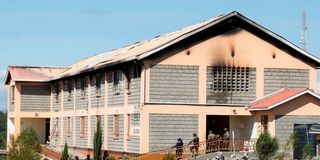
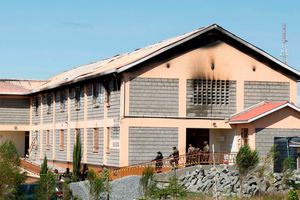
A performance audit report on fire safety preparedness in secondary schools, conducted by the auditor-general six years ago, revealed that schools in the country were ill-prepared to handle fire incidents.
Although the audit was conducted six years ago, its findings and recommendations remain relevant today. The report revealed that schools lack the necessary physical infrastructure, equipment and tools to handle fire incidents effectively.
The audit sampled 42 secondary schools in five counties as case studies, based on the prevalence of fire incidents between 2015 and 2019. These counties are Machakos, Siaya, Uasin Gishu, Kajiado and Kiambu.
Auditor-General Nancy Gathungu.
Photo credit: Wachira Mwangi | Nation Media Group
“In all the 42 schools visited, there was inadequate fire safety preparedness,” reads the report.
“The audit revealed that implementation of fire safety measures put in place by the Ministry of Education has faced a number of challenges, such as inadequate infrastructure, limited training on fire safety preparedness, insufficient guidance and counselling in the schools.
School safety standard manual requires schools to have fire extinguishers, fire blankets, and fire alarms, and in addition, post evacuation maps at every entrance and exit to buildings, classrooms, enclosed hallways, stairways and offices.
Selection and distribution of fire extinguishers in the workplace should be based on the classes of fire anticipated, size and the degree of hazard caused by fire.
“Physical verification in the 42 schools sampled indicated that none of the schools had posted an evacuation map in the buildings as required,” reads the audit report.
According to the report, 40 schools had fire extinguishers distributed in their buildings, with administration blocks having the highest number of serviced extinguishers, while halls had the least.
Five schools had fire blankets in the laboratory while six schools had them in the kitchen. Five schools had fire alarms fitted in the administration block, six in the dormitories and one in the kitchen.
“The audit revealed that schools were not able to acquire all the required firefighting equipment and tools due to lack of a functional sub-committee to inform the school management on the need of prioritising fire safety preparedness activities in schools,” reads the report.
In 2019, the ministry of education had directed schools not to use any monies from the maintenance and improvement vote in acquiring firefighting equipment.
According to section 6.2 of the manual for schools, in every classroom and dormitory, the doorways should open outwards.
However, physical verification revealed that 22 out of the 42 sampled schools had their doors opening inwards in the classrooms, and five out of the 40 sampled had doors opening inwards in the dormitory.
“In the event of fire, students are likely to lock themselves from the inside of the buildings as they struggle to get out given the population in the schools,” reads the report.
“In addition, some schools did not have doors at each end of the dormitory or clearly labelled emergency exits at the middle with doorways of the recommended five feet wide for ease of escape in the event of a fire. This is likely to hinder evacuation in the event of fire leading to injuries and loss of lives,” further reads the report.
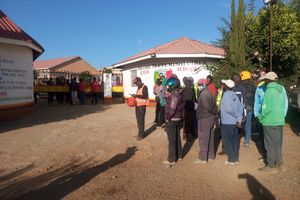
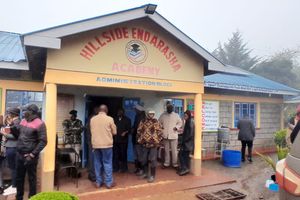
Parents at Hillside Endarasha Academy in Kieni, Nyeri County, in September 2024 following a fire tragedy that claimed the lives of 21 learners.
Photo credit: File | Nation Media Group
The audit also revealed that most schools are congested, hindering safe exit in the event of fire incident.
According to the report, 20 out of 40 schools visited exceeded the number stated in the registration certificate, with the highest school having an excess of 519 students.
In addition, 29 of the sampled schools had classes with more than 45 students, contrary to regulations.
According to the guidelines, beds should either be single or double-decker, and the spacing between the beds should be at least 1.2 metres with pathway space of not less than two metres.
The audit revealed that six schools had triple-decker beds, and 34 boarding schools had double-decker beds without the required spacing.
“Most of the dormitories were congested which was attributed to the government introducing 100 percent transition of students from the year 2017. Schools are therefore congested and this increases the risk of loss of lives in the event of fire,” reads the report.
The report also revealed that all 42 schools sampled had no safety sub-committee with the required composition.
The safety manual for schools requires that school management should invite county fire officers to give talks and demonstrations to learners on fire safety preparedness and take them through fire drills at least twice every term.
The report, however, revealed that only two schools had invited the local fire office to give talks and demonstrations on fire safety preparedness.
“Consequently, schools are not prepared to combat fire incidences as they lack comprehensive training in fire safety preparedness,” reads the report
The report also revealed that most schools don’t have qualified counsellors and counselling rooms as required by the Basic Education Act, 2015.
One of the recommendations in the report was the establishment of functional guidance and counselling departments in schools.
The document recommended that the selection and distribution of fire extinguishers in work spaces be based on the types of fire anticipated, size and the degree of hazard caused.
“Most of the schools had a copy of the school’s safety standards manual. However, they were not familiar with what was required of them in terms of fire safety preparedness. This was attributed to laxity in the implementation of the safety standards manual and minimal supervision by the ministry.”
The audit recommended that the ministry identify, and recommend for use in schools, critical basic firefighting equipment and facilities that may be the most essential.
It also called for reviewing classrooms and dormitories with a view to seeking opportunities for expansion in response to the increased student admissions and follow up on the implementation of the safety manual.