ODM is laying the ground to ensure full implementation of the 10-point Memorandum of Understanding it signed with President William Ruto’s United Democratic Alliance (UDA), in what could ultimately lead to a 2027 pre-election alliance.
The party, led by former prime minister Raila Odinga, is quietly pushing for the activation of the agreement as part of a broader strategy to cement its cooperation with the Kenya Kwanza administration—a move that could dramatically reshape Kenya’s political landscape ahead of the next General Election.
Although Mr Odinga and President Ruto were fierce rivals in the 2022 presidential contest, sources from State House, UDA party and the ODM camp have told the Daily Nation that the two sides are now charting a coordinated path forward, with the successful rollout of the MoU, inked on March 7, emerging as the cornerstone of a potential political deal in 2027.
Mr Odinga has already ruled out an early exit from the broad-based government formed last year, which saw some of his close allies appointed to the Cabinet and other advisory roles. He affirmed that he is fully aligned with President Ruto, at least until the next elections.
“We have said that we are in the broad-based government until 2027. Beyond 2027 are issues that we will discuss at the appropriate time, and the decision will be made by party members, not Raila Odinga alone,” the ODM leader said in a recent exclusive interview with the Nation .
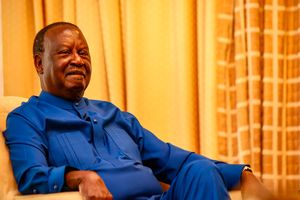
Former Prime Minister and ODM leader Raila Odinga during an interview at his home in Kare, Nairobi on July 19, 2025.
Photo credit: Wilfred Nyangaresi | Nation Media Group
Mr Odinga has since dismissed ongoing speculation about President Ruto’s chances of securing a second term, insisting only the Kenyan people can make that determination through the ballot.
"It’s not a matter of one term or two. The real question is; who decides? It is the people who hold that power at the ballot," he said.
He emphasized that electoral outcomes are tied to performance, not political slogans or threats, espousing his commitment to the implementation of the UDA-ODM agreement.
"It can be one term, it can be two terms, or even half a term. Ultimately, it is the people who will decide through elections.”
President Willam Ruto and ODM party leader Raila Odinga during the MoU signing event at KICC on March 7, 2025.
Photo credit: Francis Nderitu | Nation Media Group
Sources have revealed that both parties are now working round the clock to ensure the success of the MoU, which they view as the glue that could solidify a long-term political partnership.
The 10-point agenda includes: implementation of the National Dialogue Committee (NADCO) report; inclusivity in budgetary allocations and public appointments; strengthening of devolution; economic investment in the youth; promotion of leadership and integrity; elimination of government opulence; protection of the right to peaceful assembly; and compensation of victims of political violence.
Other pillars of the deal are an audit of the national debt and its usage, an intensified fight on corruption, ending wastage of public resources, upholding constitutionalism and the rule of law, protecting civil liberties such as press freedom, and ending abductions and enforced disappearances.
“Baba (Mr Odinga) himself disclosed that he is with Ruto until 2027, the 2027 election will be held in August, and the year will end on December 31, so you should know we are with Ruto at least until he secures re-election,” a top ODM member told the Nation .
Deputy President Kithure Kindiki, who is also the UDA deputy party leader, lifted the lid on a possible Ruto-Raila 2027 deal.
President Willam Ruto and ODM party leader Raila Odinga during the signing of a Memorandum of Understanding between ODM and UDA at Kenyatta International Convention Center in Nairobi on March 07, 2025.
Photo credit: Francis Nderitu | Nation Media Group
Prof Kindiki dismissed any doubts about the strength of the emerging alliance, suggesting his efforts coupled with a Ruto-Raila bloc would be too formidable for any opposition group. “We are focused on working for Kenyans. The time for campaigns will come. If you look at William Ruto, me, and now that we have His Excellency Raila Odinga in our team, do we look like people who can be defeated by those people during campaigns?”
On Friday, National Assembly Majority Leader Kimani Ichung’wah lauded Mr Odinga for standing with president Ruto to stabilize the country.
“We saw someone lecturing the former Prime Minister saying he will be irrelevant in Kenyan politics. Odinga has been fighting for the people, widows and those in the lower economic cadres when he was serving as an administrator in the Kanu regime,” said Mr Ichung’wah in Siaya.
National Assembly Budget and Appropriations Committee chairman Sam Atandi hinted at a President Ruto-Tosha movement resulting from a political coalition between ODM and UDA to give the president a second term.
The Alego Usonga MP, who was a guest at a women empowerment function in Gem, Yala sub-county, said the two outfits will work together and support President Ruto’s second term bid.
“We are going to form an alliance with the Ruto- led UDA in 2027 and we shall have him re-elected to serve his second term,” said Mr Atandi.
He went on: “We owe president Ruto a token of appreciation, he stood with Raila Odinga in 2007 in an election. The latter became the prime minister.”
Uriri MP Mark Nyamita said: “We have not seen any president who has considered us more than Ruto. No one will make us change our minds, some people are telling us to get out of the broad-based and seek another opportunity, we shall not do it.”
To operationalise the MoU agenda that insiders from both ODM and UDA camp say will be the springboard for the Ruto-Raila alliance, they note a joint roadmap has been drawn.
Key components of this roadmap include; creation of a compensation fund for protest victims and their families, national dialogue forums, a youth employment strategy, a joint anti-corruption campaign, and a bipartisan economic recovery plan. Other action points involve: a joint legislative agenda in Parliament, a shared vision for strengthening devolution, rollout of affordable housing in opposition strongholds, inclusive public appointments, a unified communication strategy, and early coalition planning—especially after ODM’s National Delegates Convention (NDC) slated for October.
On Tuesday, Mr Odinga chaired ODM Central Committee that resolved to ensure the party constitutes a technical team to work with their UDA counterparts as part of the political infrastructure to assist with the implementation of their MoU.
Mr Odinga had earlier told the Nation that the issue of compensating victims of police brutality was a concern to the party, adding that “a task force has been set up to oversee that process.”
“There is a contingency fund in the national budget. Compensation will happen soon. We have a task force handling it,” he said.
The former Prime Minister said his party has taken a structured approach to its participation in the broad-based government and will evaluate the arrangement based on results.
“We are not just going for the ride. We have clear expectations and benchmarks. If they are not met, we will act — not as Raila Odinga, but as ODM.”
ODM has already acknowledged the government’s commitment to strengthen devolution, following the increased disbursement of Sh415 billion to counties.
“While the party acknowledges the allocation of Sh415 billion to counties as an improvement on the previous disbursement, we will continue pushing for the raising of the allocation to a minimum of Sh450 billion or more, as had been proposed by Party Leader Rt Hon. Raila Odinga,” the Central Committee meeting said.
A source at State House told the Nation that behind-the-scenes coordination on the MoU implementation has intensified in recent weeks, with the two principals (Ruto and Raila) holding discussions about it at State House, Nairobi on Wednesday.
At the heart of this quiet alliance-building is a joint roadmap developed to operationalise their shared agenda. The plan outlines 12 priority action areas, with both parties now rolling out activities that signal a budding political rapprochement.
The joint taskforce being formed to identify victims of political protests and recommend compensation will include financial relief and psychosocial support to affected families—a critical trust-building step between the two camps.
Mr Odinga is also pushing for an intergenerational dialogue whose participants will be half the youth, targeting Gen Z and other youth groups.
These forums will focus on governance, job creation, political participation, and accountability.
Mr Odinga has said that the forums will culminate into a major national convention bringing together political, religious, youth, and civil society leaders.
The summit aims to define a unified national vision ahead of the 2027 polls, with a strong emphasis on youth inclusion and peaceful democratic engagement.
On the youth employment strategy, President Ruto is focusing on youth employment and digital innovation—with targeted jobs abroad, those in the housing programme, as well as a new bid to incorporate a Sh20 billion fund to promote employment.
Among the 10-point agenda on the fight against corruption, pro-Ruto team argue that already the Head of State has assented to the Conflict of Interest Bill as a sign of commitment to end the vice among public officers.
The technical teams from both parties will also work on a shared economic roadmap to stabilize the economy, lower the cost of living, and attract investment.
On the joint legislative agenda, UDA and ODM lawmakers are being mobilized to support critical legislation in Parliament to be spearheaded by Majority and Minority Leaders in both Houses.
In the National Assembly, Majority leader Kimani Ichung’wa and his Minority counterpart Junet Mohamed have been tasked to oversee this, while in the Senate, Majority leader Aaron Cheruiyot and Minority Leader Steward Madzayo will be the Ruto, Raila eyes.
Prof Gitile Naituli of Multimedia University of Kenya says that Mr Odinga is no longer in the opposition trenches, citing cooperation in Parliament.
"Raila Odinga is no longer in the opposition. That ended the moment ODM sat at the table with President Ruto and signed a deal with his regime. The so-called 10-point agenda wasn’t an opposition unity pact—it was a power-sharing agreement between ODM and Kenya Kwanza, disguised in the language of reform,” Prof Naituli says.