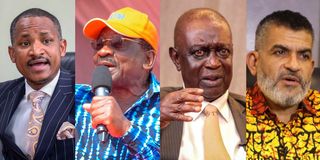
The Orange Democratic Movement is staring at one of its most defining ideological battles yet, as senior leaders clash over whether the party should reclaim its firebrand protest identity or embrace President William Ruto’s broad-based government through dialogue and negotiation.
What began as a commemoration of the party’s 20-year journey in Mombasa quickly morphed into a rare and unfiltered confrontation over the soul and direction of a movement built on defiance, sacrifice, and public resistance.
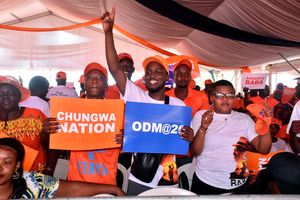
ODM supporters during the ODM@20 anniversary at Mama Ngina Waterfront in Mombasa on November 15, 2025.
Photo credit: Wachira Mwangi | Nation Media Group
At the centre of the storm stands Siaya Governor James Orengo, one of the party’s longest-serving ideologues and a veteran of Kenya’s pro-democracy struggle, who warns that ODM risks “dying like other liberation movements in Africa” if it abandons the people and retreats into comfort.
“But if ODM is strong, and you stand on the basis that your leader Raila wanted a strong and free country, we must fight everywhere,” he declared during one of his addresses at the three-day event in Mombasa.
“If there are cowards in this party, don’t sell fear to us. We are prepared to go back to the streets. As James Orengo, I am prepared to go back to the streets.”
Mr Orengo castigated what he termed growing timidity within ODM, arguing that those pushing a soft posture on the government were confusing the party’s strategic role as the leading opposition force in both Houses of Parliament.
“There are those roaring everywhere that we are in the broad-based arrangement,” he said. “But they forget that in Parliament, the party leading the Opposition in both the National Assembly and the Senate is ODM. Raila was clever—he left us both in the broad-based structure and as the voice of the people.”
He drew parallels with historic liberation movements, reminding delegates that Africa’s independence-era parties collapsed when they abandoned their base.
“If you go to Tanzania, CCM is dead. In Uganda, UPC died. In Zambia, Kaunda’s UNIP died. Everywhere, liberation parties died because they forgot the people,” he said.
The Siaya Governor also revisited the controversial death of blogger Albert Ojwang’ who died in police cells.
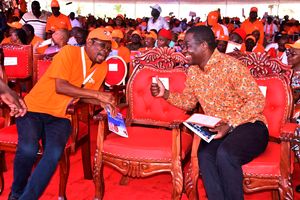
ODM Youth League patron and Siaya Governor James Orengo (centre) with other ODM leaders at the Party's Youth League Convention in Mombasa on November 14, 2025.
Photo credit: Wachira Mwangi | Nation Media Group
“Which government killed Ojwang’? Ni ya ODM or UDA?” he posed. “We must never forget what we stand for.”
And in perhaps his sharpest jab yet at ODM leaders warming up to President Ruto, Mr Orengo insisted: “Now as we speak, I dare say—Ruto needs ODM. It is not ODM that needs Ruto. ODM is a party with troops. We cannot beg Ruto. Hiyo ni ujinga kubwa sana. ”
He urged the party’s youth wing to take centre stage, invoking the historical example of South Africa’s ANC Youth League under Nelson Mandela.
Embakasi East MP Babu Owino, one of ODM’s most vocal youthful figures, amplified the maandamano call while simultaneously challenging the party’s leadership over his exclusion from recent appointments.
In a fiery speech, Mr Owino assured the late Odinga—whom he addressed as if present—that he remained committed to confronting the soaring cost of living through mass action.
“I want to assure Raila Amollo Odinga wherever he is,” he thundered. “Baba, if the cost of living rises, we shall protest, whether they like it or not! Baba, if school fees is hiked, we shall protest! If the cost of goods goes up, we shall protest!”
“Tafadhali, the party hierarchy must think again. We have carried the party on our backs during tough times,” he said.
His remarks were widely interpreted as the latest sign of growing disquiet among younger ODM MPs, who believe they deserve more influence in the party’s post-Raila transition.
However, the clarion call for maandamano did not go unchallenged.
ODM Party leader Dr Oburu Oginga, took a markedly different stance, arguing that the party must prioritise stability, policy influence, and constructive engagement within the broad-based arrangement created after Odinga’s agreement with President Ruto.
Dr Oginga warned that a fixation with street protests risked trapping the party in “opposition trenches” at a moment when it has a real chance to shape Kenya’s future governance and economic direction.
ODM acting party leader Oburu Oginga speaks during a memorial service for his brother Raila Odinga in Homa Bay Town on November 5, 2025.
Photo credit: George Odiwuor | Nation
“There is no way ODM will implement its progressive policies if it remains preoccupied with demonstrations,” he said.
His sentiments echoed those of National Treasury Cabinet Secretary John Mbadi, who supported dialogue and formal negotiations as legitimate tools of political change.
“Even for us to attain independence, there were boardroom meetings at Lancaster,” Mbadi said. “To get a new constitution, people sat at Bomas. There is nothing wrong when people dialogue.”
Mr Mbadi insisted that Kenya’s most consequential political gains were not won solely on the streets but through structured engagements that advanced national consensus.
Mombasa Governor Abdulswamad Nassir, one of ODM’s deputy party leaders, was blunt in defending the broad-based government arrangement, insisting ODM had both the mandate and moral right to be part of government.
“We are not apologetic about being in the broad-based government where Baba left us,” he said. “Who said ODM does not have the right to be in government?”
National Assembly Minority Leader Junet Mohamed stepped in with a call for restraint, urging members not to weaponise brief political turbulence to fragment the party.
“ODM has structures—National Executive Council, Central Committee, National Governing Council and National Delegates Convention,” he said. “Let us respect their decisions. If we disregard our structures, we risk dividing ODM so that each person walks away with a piece of it.”
Mr Mohamed emphasised that ODM’s strength has always come from cohesion, not personalised battles dressed as ideological fights.
At 20 years, ODM finds itself navigating an unfamiliar territory—power without its traditional leader at the forefront, and influence without certainty on whether to oppose or co-govern.
Mr Orengo, buoyed by Dr Oginga’s repeated declaration that ODM will not be swallowed,” insisted that the party must define its 2027 path clearly.
“Tell me—if in 2027 you make Ruto president, where does that leave ODM?” he asked. “You cannot go around the country telling wananchi that we will either be in government or part of the government. A strong party must be sure what it wants.”
President William Ruto during the ODM Founders' dinner at Sarova Whitesands in Mombasa on November 15, 2025.
Photo credit: Wachira Mwangi | Nation Media Group
He reminded the gathering that ODM has always produced strong presidential contenders and that talk of lacking a successor to Odinga was stupidity.
“Wale watu wanasema ODM cannot have a presidential candidate—hiyo ni upumbavu,” he said. “ODM is a party with troops.”
He also recalled how he personally initiated a motion to impeach President Moi at the age of 30.
The ideological contest inside ODM reflects a broader national question: what is the most effective way to address Kenya’s economic distress, political mistrust and governance challenges?
For two decades, ODM’s identity has been shaped by protest culture—from resisting the 2005 constitution which birthed the party, to battling electoral injustices, to leading anti-government demonstrations over the cost of living.
But the evolving political architecture—forces ODM to confront its next chapter: a movement that must balance revolutionary heritage with the pragmatism required for governance.
As ODM leaders filed out of the Mama Ngina Waterfront stage on Saturday, one thing was unmistakable: the debate over whether to return to the streets or reinforce the dialogue path is far from over.
Analysts say that whichever direction ODM chooses will decisively shape its future—and Kenya’s political trajectory ahead of the 2027 election.