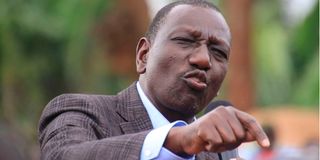
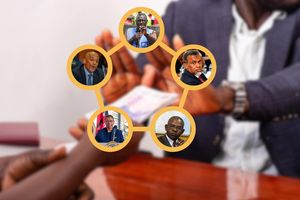
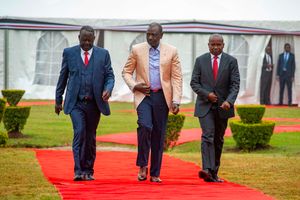
A day after vowing corrupt MPs will be arrested, President William Ruto established a multi-agency team on war against corruption, even as lawmakers sabotaged House business in an escalation of an ugly fallout between the Executive and the Legislature.
The development yesterday came immediately after MPs demanded that the Head of State provide evidence on claims Parliament has turned into a “House of extortion”.
Rattled, the legislators want National Assembly Speaker Moses Wetang’ula and his Senate counterpart Amason Kingi to immediately invoke Article 125 of the Constitution and summon President Ruto to appear before Parliament to provide evidence on the claims he has been making against MPs.
Ruto to MPs: Some of your colleagues pocketed Sh10m to pass anti-money laundering law
In an unprecedented move since the promulgation of the 2010 Constitution, the lawmakers want the two speakers to convene the Powers and Privileges committee to hear the evidence from the President; failure to which, they will initiate an impeachment motion against the two speakers.
In the National Assembly, members sabotaged a morning session that had been convened to consider government business, with Deputy Speaker Gladys Boss ending the session as only three MPs were present.
The constitution states that at least 50 of the 349 MPs in the National Assembly must be physically present in the Chamber for the House to transact business.
MPs also snubbed committee meetings that had been scheduled in the morning, with some lawmakers saying the go-slow was a protest against the attacks by the president.
Later during the afternoon session, at which they were to approve a month-long break, MPs continued their protests while contributing to a special motion by Tharaka MP Gitonga Murugara to discuss the corruption claims against Parliament.
Led by Leader of Majority Kimani Ichung’wah (Kikuyu) and his minority colleague Junet Mohamed (Suna East), the MPs complained about being used as punching bags by the executive.
“When we oversight, we don’t do it in favour of anybody. Not to the president nor judiciary,” said Mr Ichung’wah as he urged MPs not to be intimidated by the president’s remarks.
“This House has the powers to impeach those in the executive, and those in the executive can do nothing to remove you. I have suffered immensely from these corruption allegations,” added Mr Ichung’wah.
“People can’t demonise the institution of Parliament as a whole. If you have a problem with somebody, you say it. This is the institution that has the direct mandate to exercise sovereignty of the people,” said Mr Junet.
But in a swift rejoinder, the President unveiled the multi-agency team on the war against corruption, signalling he is not about to relent in the ensuing all-out war with MPs over matters of graft.
In a move he said will give fresh impetus to his administration’s anti-graft fight, Dr Ruto formally established the team under the State Department for Justice, Human Rights and Constitutional Affairs, bringing together key watchdog and investigative bodies.
They include the Executive Office of the President, that will chair the team, and the Attorney General, who shall serve as its secretary.
Others are the National Intelligence Service, Ethics and Anti-Corruption Commission, Office of the Director of Public Prosecutions, Directorate of Criminal Investigations, Financial Reporting Centre, Asset Recovery Agency, Kenya Revenue Authority, Central Bank of Kenya, and the Public Procurement Regulatory Authority.
“The membership is mandated to co-opt additional representation from designated agencies to further enhance its objectives,” the President said.
“The team shall, to the greatest extent possible, foster cooperation, coordination, and collaboration to enhance the effectiveness of the fight against corruption. For this purpose, the team shall be funded from the budgetary allocations of its member entities and other sources.”
In his proclamation, the Head of State noted that the new team shall ensure enhanced cooperation, coordination, and collaboration among the agencies and shall engage other relevant agencies, organs of government and the private sector to enhance the effectiveness of the anti-graft campaign.
This is in addition to helping in engaging both domestic and international relevant agencies for effectiveness and optimum realisation of the fight against economic crimes, organised crimes and recovery of proceeds of crime.”
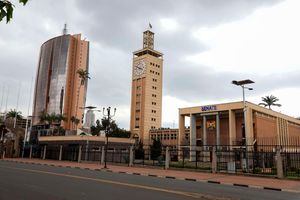
Senators, led by County Public Accounts Committee chairperson Moses Kajwang’ (right), at Bunge Tower, Nairobi, on August 19, 2025. The lawmakers have asked Speakers Moses Wetang’ula and Amason Kingi to summon President William Ruto to Parliament to present evidence supporting his claims of extortion within the legislature.
Photo credit: Dennis Onsongo| Nation Media Group
But in a charged Senate County Public Accounts Committee meeting on Tuesday, Homa Bay Senator Moses Kajwang’ said Article 125 of the Constitution gives committees of Parliament the power to summon any person to appear before them for purposes of giving evidence, and the President is not excluded.
He added that the Parliamentary Powers and Privileges Act, which governs how unethical behaviour is dealt with in Parliament, is executed by the two speakers as the chairpersons of the respective committees.
“Speaker Wetang’ula and Kingi, you are the heads of this institution; you must exercise Article 125 and summon the President. That Article does not exclude the President. It says Parliament has powers to summon any person,” said Mr Kajwang’.
“Let the President come before a committee of Parliament and repeat what he has been saying in public rallies. Let him bring the evidence so that it is processed in accordance with the law. The two speakers must stand up so that the public knows the truth, and if they are not going to do it, then the members will do unto them what they did to (Rigathi) Gachagua,” he added.
Article 125 states that either House of Parliament, or any of its committees, has the power to summon any person to appear before it for the purpose of giving evidence or providing information, where, for purposes of the provision, a House of Parliament and any of its committees has the same powers as the High Court.
The powers include enforcing the attendance of witnesses and examining them on oath, affirmation or otherwise; compelling the production of documents; and issuing a commission or request to examine witnesses abroad.
Mr Kajwang’ said Parliament is open to scrutiny, but that should be done in accordance with the law and statutes, and not in public or kangaroo courts.
“Mr President, do not be mourning and crying like any common person yet you have the privilege of access to raw intelligence. Kenyans want action. We have had enough talk. Let there be action on the part of perpetrators of this unethical behaviour,” said the senator.
“You cannot try Parliament in a kangaroo court when statutes have clear provisions on dealing with unethical conduct on the part of MPs.”
Nairobi Senator Edwin Sifuna pointed to weak leadership in Parliament for allowing the Executive to besmirch the reputation of MPs.
He said the leadership should have issued a statement defending the institution and putting the record straight.
“Our biggest frustration as the Senate is that we have a leadership that does not know how to defend the institution. Aspersions are cast about the conduct of Parliament and its committees, and you have a speaker, a majority leader and minority leader who say nothing. Our speaker is nowhere to be seen,” said the ODM secretary-general.
“I am putting the leadership of the Senate on notice. The speaker must defend his institution as the head of the House. They should call out the hypocrites pointing fingers at Parliament and yet we know they are the originators of corruption,” he added.
Nandi Senator Samson Cherargei said when Parliament is under attack, the leaders of the institution must and should be at the forefront to correct what is being peddled in public.
“We have very weak speakers and that is why we are being invaded by anybody. That is why you see contempt of Parliament. Both speakers of the House must be put on notice that they are walking on a dangerous path and if this accountability crusade is taken a notch higher, they might be the first casualties of what is happening. They will go before we go,” said Senator Cherargei.
Earlier in the day, civil society groups challenged the President to walk the talk in the fight against corruption in the country rather than issuing warnings.
Stung by President Ruto's recent comments on the corruption in Parliament, the lobby groups stated that the buck stops with the Head of State, after acknowledging receiving intelligence reports on MPs taking bribes.
In a joint statement issued on Tuesday in Nairobi, the four groups, including Kenya Human Rights Commission (KHRC), The Institute for Social Accountability (TISA), Inuka Kenya ni Sisi, and Transparency International-Kenya (TI-Kenya), among others, said that Ruto’s action will determine if he is a man on a mission in the fight against graft.
“Based on the fact that the President has a significant privilege and responsibility and sources of information, when he speaks and says that we are about to arrest them, we are happy, but how did we get here? We are looking forward to the prosecution of Members of Parliament,” TISA Executive Director Diana Gichengo said.
TI-Kenya Executive Director Sheila Masinde said that the President should move with speed and provide the evidence that he claimed to have received, and allow investigation bodies to probe the said suspects.
Davis Malombe from KHRC said that the cases of corruption in the public institutions, such as the loss of Sh9 billion on the e-Citizen platform as revealed in the Auditor General’s report and irregular procurement practices involved in Social Health Authority (SHA) smart system, raise concerns over President Ruto’s willingness to end corruption.
“The national government is part and parcel of this conundrum of corruption in the country,” Mr Malombe said, adding that the Conflict of Interest Act, 2025, presents an opportunity to reverse this legacy of extortion by Members of Parliament and the county level.
On the other hand, they said, Parliament can redeem itself by exposing the people who paid them not only in the recent cases but also during the impeachment of former deputy president Rigathi Gachagua, who had alleged that MPs were bribed to remove him from office.
“Nyani haoni kundule… I doubt the President. It feels like PR, but if that PR can birth the needed action within our system, we will celebrate it as we demand further and deeper action,” Ms Gichengo said.