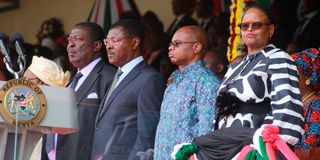
The National Assembly and the Judiciary have pledged closer collaboration, but insist this will not compromise their independence.
Chief Justice Martha Koome and National Assembly Speaker Moses Wetang’ula have agreed to ensure institutional independence among the arms of government and ensure they do not operate in rivalry.
During the joint forum of the National Assembly and the Judiciary attended by the parliamentary leadership, Inspector General of Police Douglas Kanja, Directorate of Criminal Investigation (DCI) boss Mohammed Amin and Director of Public Prosecution boss Noordin Hajji, among other leader,s agreed to approach issues between respective institutions in a dialogue manner that promotes unity rather than rivalry.
Ms Koome said the Constitution deliberately balanced institutional independence with interdependence and entrenched the separation of powers, while at the same time requiring dialogue, collaboration, and checks and balances among the three arms of government.
“The social transformation promise of our Constitution cannot be realized by any institution working alone or in silos. It demands that each arm of government faithfully discharges its mandate while also engaging in respectful and constructive dialogue with the others. Parliament, the Executive, and the Judiciary are each entrusted with distinct constitutional roles, but the effectiveness of those roles ultimately depends on how well we complement one another,” said the CJ.
The two institutions agreed each arm of government should stick to the Constitution, with the CJ saying that separation of powers “remains the bedrock of our constitutional order. It secures checks and balances, guards against overreach, and protects institutional independence.”
“We have institutional independence and decisional independence. At an institutional level the arms of government can engage however, decisional independence must always remain sacrosanct,” said Ms Koome.
The CJ defended the Judiciary on a number of rulings saying they are done constitutionally and are meant to ensure independence in the arms of government.
“Judiciary observes the delicate balance between parliamentary privilege and judicial oversight, too often this relationship has been portrayed as adversarial, yet in truth both principles safeguard constitutionalism. From the Judiciary’s perspective, our courts have adopted a posture of restraint where ongoing parliamentary processes are concerned,” said Ms Koome.
On budget allocation, the CJ said even though this financial year it was allocated more funds compared to previous years, she urged parliament to prioritise budget allocations.
“For a long time, the Judiciary has not received funding commensurate with its constitutional obligations, limiting our ability to perform optimally. One of our goals has been to establish a magistrates’ court in each constituency, yet we currently have only 143 magistrates courts as compared to 210 constituencies,” said Ms Koome.
She added, “In a constrained fiscal environment, collaborative constitutionalism calls on us to prioritise so that constitutional mandates are not unduly hampered. Adequate resourcing of the Judiciary is therefore a safeguard for the rights of the people, your constituents to access justice, by ensuring the infrastructure of justice from court buildings, our Small Claims Courts roll-out programme, to the digital transformation of our systems is sustained.”
During the session, Mr Wetang’ula insisted that the independence of arms of the government is not isolation in a manner in which they conduct their affairs, but united in a common good of the country and whatever the Judiciary does, Parliament does, and the Executive's goal is to hold the country together.
Mr Wetang’ula, on the other hand, admitted there has been bad blood between the two arms of government, hence the conference will play a key role in addressing a number of issues.
“Our relationship has not been without hitches, that is why we have come to talk to each other to address human frailties. This relationship must be nurtured, respected and must be carried with dignity and some delicate growth to the extent where when matters concerning us come to you we do not feel frightened and when you bring your issues and request to us you don’t feel frightened either,” said the Speaker.
Mr Wetang’ula said Parliament holds a pivotal responsibility for the country, especially in resource allocation, hence the need to consider balanced budgets of all arms of government not to stall their operations.