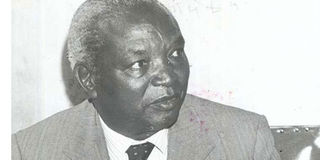
Did a former head of civil service, the late Geoffrey Kariithi, grab a chunk of land — now worth more than Sh2 billion — belonging to a civil servants’ club when he was the trustee?
That is the matter that the Court of Appeal is grappling with as Jomo Kenyatta and Moi era mischief, when there was a thin line between public interest and private greed, continues to mushroom in political and court corridors.
Few people know about the story of the Public Service Club (PSB) in Upper Hill, Nairobi, mainly because it originally drew its membership from civil servants who ran it down after independence.
In 1985, at the height of his paranoia, President Daniel Moi described the club as an anti-government gossip centre.
Civil servants fled, lest they were marked for either dismissal, demotion, or transfer to North Eastern — then regarded as the dustbin of “worthless” public officers.
The PSB was at one point the only place senior civil servants would hobnob to compare notes, cut deals, and spend the evenings away from politicians, influence peddlers, and racketeers.
Here, some officials became millionaires; and that is the untold story of PSC.
Established in 1922 to provide recreational and social facilities for senior colonial-era civil servants, this was the place that the then all-white officials would fraternise with the governor and away from settlers.
Its original name was European Civil Servants Club of Chamberlain Road, Nairobi, and its equivalent, then, was Asian Civil Servants Club which had been founded in 1917 by Mr S.R Rodrigues of the Treasury and Mr Leandro de Mello, and had its club in Eastleigh, near Pangani police.
Slightly before independence, the European Civil Servants Club changed its name and started admitting the first Africans who had been recruited to join the civil service after graduating from Makerere University College or Fort Hare in South Africa.
There were the likes of Jeremiah Kiereini, Charles Njonjo, Bill Kimutai Martin, Kenneth Matiba, Peter Shiyukah, Duncan Ndegwa and Geoffrey Kariithi as some of the pioneer African members of the Civil Service Club, as it was once known before members voted to change the name to Public Service Club to accommodate the heads of parastatals.
Bill K. Martin, as he was better known, was actually the first African chairman of the Public Service Club, a position that was taken by either the District Commissioner of Nairobi, or the Provincial Commissioner.
Later on, the Head of Civil Service was an obvious choice to the chairmanship of the club. But that was during the halcyon days.
He was also a pioneer trustee of the club after members decided to put the future of the club into the hands of trustees.
Some of the pioneer trustees were Mr Kimutai, Mr Kariithi and Mr John Godhard Mburu, who were nominated in July 1974.
It was during this time that Mr Kariithi managed to curve 3.5 acres of the club and registered it in his name with an LR number 209/9629.
How Mr Kariithi did this in June 1975 without the knowledge of the original trustees is not clear, but Mr Kimutai would later tell the court that the suit property had never been subdivided and that the only entry on its records was the change of name on June 8, 1974, from Civil Service Club to Public Service Club.
Because there was no memoranda entered to register the changes and also since there was no resolution by the club to alienate the land, some former members now think that Mr Kariithi abused his role as a trustee and gabbed part of the club’s land.
Another parcel, LR No. 209/9627, was also excised from the main title and granted to a Mr Andrew Washington Njenga.
What we now know is that there were further subdivisions of Kariithi’s parcels done on May 11, 1981, some 20 months after he had been removed as Head of Civil Service and replaced by his bosom friend Jeremiah Kiereini.
The private members club had started falling apart in late seventies and it appears that Mr Kariithi took advantage of that managerial void.
In his book, A Daunting Journey , Mr Kiereini recalls how Mr Kariithi once asked him: “Can’t you save this club? I would like you to investigate and try to rescue it.”
Mr Kiereini found a club on its deathbed. “There was no one who was responsible for the welfare of the club, and those who were members of the committees that were meant to keep things running were the biggest offenders when it came to paying their bills. They were actually the worst enemies of the club!” he told Mr Kariithi.
Whether this is the loophole Mr Kariithi used is not known although it appears that it was through a committee and not the trustees that he managed to secure the land.
In court, there is an undated resolution of the Public Service Club recommending that title be surrendered to the Commissioner of Lands.
While the title given to Mr Kariithi is genuine, the court seeks to determine whether it was possible to have two titles for the same land without the original being surrendered.
Already, the National Land Commission has cancelled Mr Kariithi’s title, but the matter is still ongoing at the Court of Appeal.
It is a case that will shine light on Mr Kariithi, previously seen as one of the 'Mr Clean' of public servants.
But there is one problem: The lower court had decided that the suit is time-barred under section 7 of the Limitations of Actions Act since it was filed on June 18, 1993, 18 years after the excision of the land in March 1975.
It is a case that haunts Mr Kariithi’s family to date and, until it is settled, doubts will still linger on whether he grabbed the property when he was a trustee.