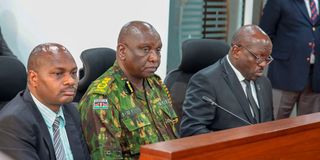
The Inspector-General of the National Police Service Douglas Kanja (centre) CEO of the National Police Service Commission Peter Leley (right) and Commissioner Edwin Cheluget appear before the National Assembly Public Accounts Committee on July 29, 2025.
A parliamentary committee has stepped in to mediate over the escalating row between the National Police Service Commission (NPSC) and the Inspector General of Police over the human resource function.
The National Assembly Constitutional Implementation Oversight Committee (CIOC) wants the two tussling parties to appear before them next week over control of the payroll system of the police.
The committee chairman Caroli Omondi said the two agencies preside over a critical sector that they should engage in unnecessary fights that can be resolved through a correct interpretation of the constitution.
“We have already written a letter to them, to us. This is a constitutional interpretation issue that falls within the mandate of our committee. We want to handle it as fast as possible so that there is harmony in the police service,” Mr Omondi said.
Suba South MP Caroli Omondi makes his contributions during a past session in the National Assembly.
Mr Omondi said the constitution under Article 244 and 245 clearly demarcates the roles of both the Inspector General of Police and the National Police Service Commission, and the two just differ on the interpretation.
“I know the problem here is just the interpretation of the law. Each entity is interpreting both Article 244 and 245 in their own way, creating the tussle, but we are going to deal with it as a committee because we don’t want divisions within the security sector,” Mr Omondi said.
The lawmaker warned that if not handled well, there is a risk of creating a wider rift in the police service between officers of different ranks.
Read: Court to decide who controls police payroll in IG–NPSC dispute
“This is a sensitive issue, and it has the potential to cause division between police in the lower ranks and their seniors. I know one would like the payroll to be handled by the commission while another cadre would be comfortable with the current arrangement for obvious reasons,” Mr Omondi said.
The dispute started last month after the National Assembly’s Public Accounts Committee (PAC) directed Mr Kanja to transfer all accounting and human resource functions of the National Police Service (NPS) to the NPSC.
Payroll management
Mr Kanja remained defiant on the grounds that payroll management, particularly in relation to active duty police officers, falls within the operational command and control mandate. This is because payroll processing directly affects the deployment, readiness, and discipline of police officers.
For its part, the Commission asserted that payroll management is part of its human resource mandate under the Constitution, citing its role in determining remuneration and benefits.
The committee in its first meeting where Mr Omondi was elected unopposed as the new chairman following the reconstitution of committees last month, also said the meeting with two entities will also provide an opportunity for them to shed light on the upcoming online police recruitment.
Read: Storm over hiring of 10,000 police officers
“We also want to understand from the police how the online recruitment will be done because we have known that physical examination and performance of the recruits in the field is critical, so how are they going to do it this time round? Posed the chairman.
While launching the system in May this year, Chief Executive Officer National Police Service Commission Peter Leley said the new recruitment system is secure, fast and efficient.
The new recruitment, which will be a departure from the current system, where those aspiring to serve in the disciplined forces turn up in the field and physically go through rigorous exercise before the best candidates are selected to proceed to the training camps.
Since independence, police recruitment has been conducted manually, with thousands of young, energetic Kenyans turning out in their thousands, accompanied by their families, to try their luck.
However, Mr Leley termed the current system as an outdated approach that has made it difficult for many Kenyans, especially those in rural areas, to access equal opportunities to serve
He explained that in every recruitment cycle, the government spends millions on printing forms, transporting documents, and paying allowances for manual verification.