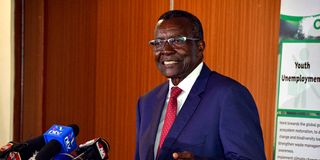
Former Chief Justice David Maraga has criticised President William Ruto for assenting to eight controversial bills last week, accusing him of betraying the Constitution and eroding Kenya’s sovereignty through what he termed as draconian and unconstitutional laws.
“Fellow Kenyans, at exactly the same time that the nation was grappling with the news of the demise of our Right Honourable Raila Odinga, President Ruto was in State House signing a law, not one, but eight bills, some of which are quite draconian. What a shame that the President can be doing this,” said Mr Maraga during a press conference in Nairobi.
The former Chief Justice listed the laws as the Computer Misuse and Cybercrimes (Amendment) Act, the Privatization Act, the Land (Amendment) Act, the National Land Commission (Amendment) Act, the Wildlife Conservation and Management (Amendment) Act, the National Police Service (Amendment) Act, the Air Passenger Service Charge (Amendment) Act and the Virtual Asset Service Providers Act. He accused the Executive and Parliament of constantly betraying the will of the people by passing laws that serve the interests of the ruling elite.
“When, truly, will the State decide to work for its people? Time and again, the Executive and the National Assembly have conspired to betray our nation and the sovereign will of its citizens,” he said.
Mr Maraga said his greatest concern lay in two of the new laws, the Privatisation Act and the Computer Misuse and Cybercrimes (Amendment) Act, which he warned threaten the country’s freedoms and sovereign assets. “What is a nation without its sovereign assets and its freedoms?” he posed.
The former CJ described the new Privatisation Act as a dangerous piece of legislation that effectively transfers control of public assets from Parliament and the people to the Executive.
“The new law introduces a privatisation process mainly in the hands of the Executive through the Treasury Cabinet Secretary and the Privatisation Authority. It grants the CS Treasury power to create a privatisation programme that may include an unlimited number of public entities earmarked for sale,” he said.
He cited sections 22 and 23 which compel the National Assembly to ratify a privatisation programme within 60 days, failing which the process automatically proceeds within the next 30 days without parliamentary approval.
“Once approved, the programme remains valid for eight years; eight years of unchecked power in the hands of the Executive,” Mr Maraga warned.
He further condemned the lack of valuation requirements in the ratification process, saying this omission was deliberate and meant to circumvent parliamentary oversight and neuter public participation.
According to him, the Act even exempts the disclosure of buyers’ identities when public entities are sold through Initial Public Offerings (IPOs).
He warned that the law gives the Treasury Cabinet Secretary and the Privatisation Authority, both under the President’s control, unchecked powers to dispose of national assets.
“In essence, the new Privatisation Act grants President Ruto powers to do as he pleases with national assets, including strategic ones,” Mr Maraga said, adding: “Kenyans must overwhelmingly come out and say no to this egregious grabbing of public resources.”
Commenting on the Computer Misuse and Cybercrimes (Amendment) Act, Mr Maraga said the law’s true intent is to control and crush political dissent under the guise of fighting cybercrime.
“The addition of Section 6JA to the Act gives the National Computer and Cybercrimes Coordination Committee unconstitutional powers to issue directives that can render any website or mobile app inaccessible for allegedly promoting illegal activities,” he said.
The former CJ termed the committee unconstitutional, questioning its powers to close down any website, blog, or social media platform, including Facebook, X, TikTok, YouTube, or Instagram, on the pretext of fighting illegality. Mr Maraga warned that the committee would now act as investigator, prosecutor, and judge, effectively undermining Kenya’s constitutional freedoms of expression and media enshrined in Articles 33 and 34.
“These amendments are unconstitutional, null and void They confirm my assertion that President Ruto has lost legitimacy to continue leading this country. A president who has no regard for the Constitution under which he governs has no moral or legal right to continue governing,” he said.
He urged Kenyans to resist what he called a systematic attempt to dismantle constitutional freedoms and plunder national assets. “We shall not allow the freedoms of speech, media, fair hearing, and fair administrative action to be buried silently with the Right Honourable Raila Odinga,” he said.
“There are already people going to court to oppose this privatisation process and the Cybercrimes Amendment Bill,” he said.
Responding to reports that 11 state corporations have already been earmarked for sale, Mr Maraga warned that the government was rushing to act before legal challenges take effect.
“That tells you the corner-cutting nature of the process. The government knows Kenyans are unhappy, so it’s moving fast before the courts can intervene.”
In his closing remarks, Maraga was emphatic,
“We must not allow this government to sell our birthright under the cover of law. We owe it to those who died for our freedom, and to those yet unborn, to stop this assault on our nation’s soul.”
Quoting Article 1 of the Constitution, he reminded the government that sovereignty belongs to the people.
“We stand here today to defend the meaning of our nation, to guard the inheritance of those who fought for our freedom, and to protect the patriotism of those yet to be born. The power lies with us, not with Parliament, not with the Executive, and not with foreign investors,” he said.