The family of former President Daniel arap Moi has once again been thrust into the limelight following a sensational murder claim levelled against one of his sons by the father of a British tourist murdered in the Maasai Mara more than 20 years ago.
Last week, Mr John Ward accused Mr Moi’s eldest son, Jonathan, of raping and murdering his daughter Julie in early September, 1988.
The accusation comes hot on the heels of a warrant of arrest issued against another of Mr Moi’s sons, Philip, in a matter relating to his divorce proceedings.
Though unrelated, the two incidents add to a growing litany of civil and criminal court actions and accusations that are stalking the family of the second President nearly 10 years into his retirement.
Writing in the Nairobi Law Monthly magazine, Mr Ward claims that the younger Moi used his name to cover up his crime and further accuses the British Government of complicity in shielding Jonathan Moi.
In the article, Mr Ward also claims that Jonathan had his brother-in-law and long-time friend Ishmael Choge, an alleged witness to the crime in the Mara, killed after he threatened to go public with the story of the murder.
Jonathan has strongly denied the accusations. “I am totally shocked to hear this. I had no relationship with the said lady (Julie) and I even didn’t know her. I never did such a thing, and it has never crossed my mind to do it,” he told The Star newspaper after the story was published.
He also denied involvement in Choge’s death saying he was saddened by the death of his brother-in-law and motor rallying co-driver.
The matter will probably end up in court, but even then the accusations undoubtedly further damage the Moi family’s reputation that has been going through testing times lately.
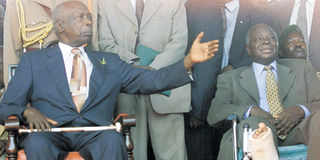
Indeed when the 87-year-old former President ought to be enjoying his State-funded retirement, he is spending a considerable amount of his time and resources briefing lawyers as he fights off a growing catalogue of cases filed mostly by former political and business associates.
In his biography, Moi: The Making Of An African Statesman, author Andrew Morton says the elder Moi has enjoyed his family life.
But if the tumultuous family lives of his sons are anything to go by, then he must be devastated.
Mr Moi has five sons and two daughters: Gideon, Raymond, Dorris, John Mark, Jonathan, June and Philip. Almost all of them have come under scrutiny at different times in their lives over various issues.
Philip’s drawn-out drama-filled divorce case with his wife Pluda has led to a warrant of arrest being issued against him for contempt after he failed to pay maintenance for his wife and children as directed by the court. (READ: Moi’s son steps up fight against arrest )
Earlier in 2003, Jonathan, popularly known as JT by his close friends, had to contend with a messy divorce in which his wife claimed that he had been having an illicit love affair with a primary school teacher’s wife for several years.
In 2010, John Mark’s wife requested the court to recognise her as her husband’s guardian in a case in which 22-year-old Esther Wanjiku, who claims to be John Mark’s daughter, was suing for support. John Marm is schizophrenic, his wife told a Nakuru court.
Apart from the family feuds, a majority of the cases brought against Mr Moi and his family are of economic nature, mostly instigated by former political allies. A few of the cases have been of a criminal nature.
In 2007, the anti-secrecy website WikiLeaks released a confidential report commissioned by the government and which had detailed the source and location of the Moi family’s enormous wealth.
Commissioned in 2003 by President Kibaki, the Kroll Report, as it is commonly known, alleged that Mr Moi and his sons, principally Gideon and Philip, had amassed a fortune of more than a billion dollars, mainly through questionable activities.
The government, however, dismissed the report, and its findings were not officially released. But that’s not all. Mr Moi and members of his family have been mentioned in other reports locally and abroad.
Earlier last year, Gideon was sensationally mentioned in Parliament as one of the powerful personalities in the country who had been dealing in illicit drugs and arms trade. Gideon’s name was contained in a report prepared by the US Embassy and which was tabled by Internal Security minister George Saitoti.
But the embassy later cleared him, saying his name was not in their original report. His name had been inserted mischievously.
Raymond was one of the two directors in Simba Airlines, a collapsed aviation firm, which the UN said was being used to traffic the arms. The other director was Sanjivan Ruprah, named by the report as one of the key illegal arms dealers in the region.
However, Raymond was never charged with any crime locally or internationally.
In 1999 Philip was again accused by a parliamentary committee of importing a car under the guise of diplomatic privilege and later changing the number plate after avoiding duty and VAT.
Philip, a retired army major, would again get into trouble in 2000 after a company associated with him, Cut Tobacco, which manufactured Horseman cigarettes, was accused of using counterfeit stamps to evade tax. After a hide-and-seek game with the police, the company was closed but later reopened following a court order to the Kenya Revenue Authority to open it.
By and large, Moi’s daughters have kept out of trouble unlike some of their brothers. However in 1998, June sued the Finance Magazine for linking her to grabbing of land in Karura forest.
Mr Moi the elder is currently embroiled in several cases himself. The most recent one involves a bitter fallout with his former point men in the Coast province, Mr Rashid Sajjad and Mohammed Bawazir.
Mr Sajjad and Mr Bawazir have taken the former President to court claiming he employed State resources to harass them into altering the terms of an agreement for a 0.49 acre piece of beach land that Mr Moi allegedly sold them for Sh7.5 million in 1993.
For the 24 years that he ruled, Mr Moi enjoyed presidential immunity, meaning no civil or criminal suits could be filed against him. Only election related suits could be brought against him.
Under the old Constitution, the President enjoyed immense powers, among them the power to make appointments to key positions in the judiciary. The President appointed judges to the High Court and Court of Appeal.
“Ideally it was a judiciary that owed their positions to the Presidency. No matter how meritorious a case was, there was always suspicion that they could never be truly impartial,” said Mr Paul Mwangi, a lawyer who has represented two clients who have sued Mr Moi over business-related disputes.
However, legal experts now contend that in the absence of this privilege and an increasingly assertive judiciary, all those who had grievances against the former President have every reason to believe they can get justice now.
In February 2004, soon after Moi’s retirement, Malcolm Bell, a large-scale farmer in Nakuru became the first person to sue Mr Moi after he left power.