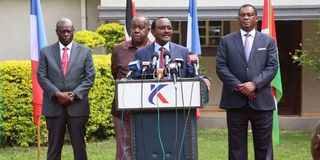
The United Alternative Government on Wednesday launched what it termed a "People's Budget" and mounted a fierce attack on President William Ruto's Sh4.82 trillion spending plan, calling on Members of Parliament to reject both the 2026 Finance Bill and the national budget.
Led by Wiper leader Kalonzo Musyoka, the opposition figures accused the Kenya Kwanza administration of presiding over an economic crisis marked by rising debt, punitive taxation, underfunded public services and growing public frustration.
"I am standing here today because of her and because of every Kenyan like her who has run out of time to wait on a regime that has lost its moral authority to lead," Mr Musyoka said.
The press briefing was attended by key opposition figures, including former Deputy President Rigathi Gachagua, former Interior Cabinet Secretary Fred Matiang'i and former Attorney-General Justin Muturi.
The opposition coalition unveiled what it described as a fully costed People's Budget, which it said would prioritise education, healthcare, job creation and lower taxes while reducing the government's reliance on borrowing. The coalition framed its proposal as a direct alternative to the government's Sh4.82 trillion budget that is set to be read in Parliament.
Mr Musyoka said the government's spending plan had abandoned ordinary Kenyans and instead prioritised debt repayment, bureaucracy and misplaced priorities.
"This is the largest spending plan in the history of the Republic of Kenya," he said, noting that the government plans to spend Sh4.82 trillion while collecting only Sh3.63 trillion in revenue, leaving a deficit of approximately Sh1.11 trillion.
"The difference of Sh1.11 trillion is borrowed. And it is borrowed on behalf of a child in Turkana who is four years old today, who has never signed a loan agreement and who has never attended a budget committee hearing. That child will repay this debt with interest. That is not fiscal management, ladies and gentlemen, that is generational slavery,” Mr Musyoka said.
The opposition leaders particularly targeted funding gaps in education, arguing that despite constitutional guarantees of free education, schools continue to face shortages in capitation and learning resources.
Mr Musyoka claimed the budget had failed to adequately fund Free Primary Education, Junior Secondary Schools and Free Day Secondary Education while administrative costs within the Ministry of Education remained disproportionately high.
According to the coalition, Free Day Secondary Education faces a funding shortfall of Sh28.4 billion while Junior Secondary Schools have been allocated Sh30.9 billion against a requirement of Sh42 billion.
"A Form One student arriving at a public day school, supposedly free, finds no desk and no textbooks," he said.
"The Budget Estimates show an estimated Sh112 billion allocated for administrative overheads at the Ministry of Education headquarters. One hundred and twelve billion shillings for the bureaucracy that runs education. Sixty-five billion for the children being educated. That is not a budget. That is an insult."
The coalition proposed increasing the education allocation from the government's Sh668.3 billion to Sh737.3 billion. It pledged to fully fund Free Primary Education, close the Sh28.4 billion capitation gap in secondary schools, fully finance Junior Secondary Schools and revive the Kenya School Equipment Scheme.
"We will cut Sh22.4 billion from the ministry's Sh112 billion administrative overhead and redirect every shilling to our children. Free means free. All the way from Class One to Form Four. For every Kenyan child."
The coalition also cited recent incidents of unrest and fires in schools as evidence of a broader crisis in the education sector, accusing the government of neglecting student welfare, school safety and mental health programmes.
Mr Musyoka noted that the opposition would establish a dedicated national school mental health programme, reinstate Edu Afya and conduct a nationwide safety audit of boarding schools.
On healthcare, the Wiper leader said the government's transition from NHIF to the Social Health Authority had failed to deliver the promised improvements and had instead created uncertainty for patients seeking medical care.
"SHA, in its current form, is not a health policy. It is a compulsory tax with a hospital logo."
The coalition claimed the budget had failed to address existing gaps within the healthcare system and questioned the government's decision to proceed with a Sh104 billion technology contract linked to SHA while health facilities continue to face shortages of medicines and personnel.
"We shall cancel the Sh104 billion SHA technology contract and redirect every shilling to frontline care, stocking dispensaries, paying nurses and buying medicines."
The opposition proposed increasing the health budget from Sh170.7 billion to Sh242.3 billion, reinstating Linda Mama and Edu Afya programmes, increasing KEMSA funding from Sh18.8 billion to Sh30 billion and guaranteeing free care in public hospitals up to county level.
The coalition also unveiled an Sh80 billion National Youth Employment Compact aimed at creating 200,000 jobs through public works programmes, technical skills training and support for youth-owned enterprises.
On the Finance Bill 2026, Mr Musyoka accused the government of introducing new tax measures through what he described as technical amendments hidden within the legislation.
DCP party leader Rigathi Gachagua (DCP), Jubilee deputy party leader Fred Matiang’i, Wiper Party leader Kalonzo Musyoka and DAP-Kenya’s Eugene Wamalwa during a press briefing at the SKM Centre, Nairobi, on the opposition’s alternative budget proposals and key economic priorities.
Photo credit: Wilfred Nyangaresi | Nation Media Group
He specifically cited the proposed 16 percent VAT on mobile money transaction fees and a 25 percent excise duty on mobile phones.
"The grandmother in Wajir waiting to receive Sh1,000 from her grandson working in Mombasa will pay more for that transfer. The mama mboga in Gikomba paying her supplier through M-Pesa will pay more. The boda boda rider sending money home to his mother in Nyamira will pay more.This Ruto regime has found a way to tax the poor even when they are not buying anything. They are taxing the movement of money itself,” he said.The coalition further raised concerns over provisions that would expand Kenya Revenue Authority access to financial information and transaction data, arguing that the proposals could increase state surveillance over taxpayers without sufficient safeguards.
At the same time, the opposition unveiled measures aimed at reducing the cost of living, including abolishing the Housing Levy, removing the Import Declaration Fee, Railway Development Levy and Road Maintenance Levy on fuel imports, and introducing a targeted Sh30 per litre fuel subsidy for agricultural use.
According to the coalition, the measures would lower diesel prices to approximately Sh170 per litre while increasing workers' take-home pay.
Among the headline proposals was the immediate abolition of the Housing Levy, one of the most controversial policies introduced by the Kenya Kwanza administration.
Mr Gachagua declared that scrapping the levy would be among the first actions undertaken by a future opposition government.
"The first thing we will do once we take over government next year is doing away with the Housing Levy," said Mr Gachagua.
The former Deputy President also warned Kenyans against purchasing affordable housing units associated with the government's housing programme.
"I want to put you on notice, those who are buying Ruto's affordable houses, please do not buy them. You will lose your money next year when we take over government."
Mr Gachagua further urged Kenyans against purchasing public assets that may be sold before the next General Election.
"Do not buy public assets between now and the next general election because you will lose your property once we take over government," he warned.
"It is the first time in the history of the country that the budget is being read when the Head of State is away," said Mr Muturi.
"He is the same person who tells Kenyans to tighten their belts yet he is always on the skies with executive jets. He is so ashamed that he cannot be in the country when the budget is being read."
Former Interior Cabinet Secretary Fred Matiang'i focused on Parliament's role in the budget-making process, challenging lawmakers to reject both the Finance Bill and the budget estimates.
"We call upon the MPs to reject the Finance Bill. Reshuffling the PSs will not change anything. We want to urge them to listen to what our MPs are saying and they need to reject this completely."
The coalition also proposed cutting State House expenditure from Sh12.6 billion to Sh6.3 billion, reducing the National Intelligence Service budget from Sh58.6 billion to Sh35 billion and abolishing the police vehicle leasing programme. The savings, it said, would be redirected to irrigation projects in arid and semi-arid counties to boost food security.
"You were not elected to be a rubber stamp. A mother woke before dawn, walked to a polling station, queued for hours and marked your name because she believed you would go to Nairobi and fight for her."