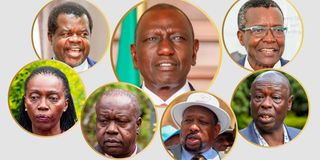
With less than two years to the 2027 General Election, Kenya’s presidential race is no longer a question of who is running but what they are offering.
From the incumbent William Ruto defending an ambitious development agenda to challengers promising economic rescue, constitutional renewal and moral leadership, the contenders are laying out sharply different visions for the country.
At stake is not just power, but the direction of Kenya’s economy, governance and social contract with its citizens. The contest is fast becoming a referendum on leadership, governance and the future of the Kenyan State.
Whereas Kenya still grapples with persistent fiscal deficits and burgeoning offshore debts, it's model Singapore enjoys balanced budgets buoyed by a robust strategic fiscal policy.
Photo credit: Nation Media Group
With President Ruto seeking to defend his record and a diverse opposition challenging his vision, voters are being asked to weigh competing promises of prosperity, reform, stability and justice.
From the incumbent president defending an ambitious development blueprint, to former insiders turned critics, technocrats, and activists promising a break with the past, the emerging field reflects a country at a crossroads.
President Ruto is seeking to define his legacy — and his re-election pitch — around scale, ambition and transformation.
In his third State of the Nation Address, he laid out a bold vision to lift Kenya from a developing to a First World economy, anchored on an estimated Sh5 trillion investment over the next decade.
Dr Ruto’s roadmap rests on four pillars: expanded access to education; turning Kenya from a net food importer into a net exporter; adding 10,000 megawatts of power within seven years; and an aggressive infrastructure drive that includes dualling 28,000 kilometres of roads and developing 2,500 highways.
He frames this not merely as growth, but as a national awakening — a deliberate rejection of what he calls “small thinking and ordinary expectations.”
The President has repeatedly invoked historical parallels, notably John F Kennedy’s moonshot speech, to argue that transformative leaps require courage and patience.
President William Ruto launches the dualling of 175km Rironi-Mau Summit road at Mau Summit in Nakuru County on November 28, 2025.
Photo credit: Boniface Mwangi | Nation Media Group
He cites achievements such as the Hustler Fund, stabilisation of fuel supply, debt servicing reforms and the redemption of the Eurobond as proof that his agenda is working, even as critics point to high taxation, rising cost of living and public discontent.
For Ruto, the 2027 choice is about continuity versus disruption. He is asking Kenyans to buy into a long-term, high-stakes vision, insisting that the pain of reforms today will yield prosperity tomorrow.
But he is facing a fierce challenge from critics coalescing under United Opposition, led by his former deputy Rigathi Gachagua and Wiper Patriotic Front leader Kalonzo Musyoka.
Once President Ruto’s deputy and political enforcer in the Mt Kenya region, Mr Gachagua now presents himself as an alternative.
Though he has lately touted Mr Musyoka as the best opposition flag bearer, Mr Gachagua has previously argued that he himself is the most formidable challenger to Ruto.
In his addresses mid this year, Mr Gachagua promised a return to “true” free education as introduced under former President Mwai Kibaki, arguing that hidden levies and school charges have hollowed out the policy.
He has also prioritised health reforms, including the revival of free maternity care, and has vowed to abolish the housing levy, which he says burdens already strained taxpayers.
Mr Gachagua’s message is calibrated to ordinary households feeling squeezed by taxes and levies. He presents himself as a corrective force, one who is now willing to dismantle policies he believes hurt citizens.
Kalonzo Musyoka (left) and Rigathi Gachagua during a meeting by leaders of the Opposition in Nairobi on September 8, 2025.
Photo credit: Pool
His challenge, however, lies in convincing Kenyans that his break with Dr Ruto is ideological rather than merely political fallout.
For Mr Musyoka, he remains one of Kenya’s most enduring opposition figures following former ODM leader Raila Odinga’s death in October.
Mr Musyoka has pushed back against President Ruto’s challenge that the opposition lacks a development agenda, insisting that his plan will be unveiled to Kenyans — not to the President.
For now, he has chosen to frame his candidacy around a single, unifying objective: removing Ruto from power in 2027. “Agenda number one is Ruto must go,” he has said, dismissing the President’s critique as deflection.
Yet behind the rhetoric, his appeal rests on experience, moderation and coalition politics.
As a former Vice President and long-serving Cabinet minister, he positions himself as a stabilising figure capable of restoring trust, repairing institutions and lowering political temperatures.
Multi Media University don, Prof Gitile Naituli however, warns that opposition movements rarely fail because they lack numbers; but because they lack coherence.
As Kenya heads toward the 2027 General Election, he warns that fragmented ambition, not voter apathy, is the opposition’s greatest weakness.
Power, he argues, “thrives not merely on strength but on the inability of its challengers to organise themselves into a single, believable alternative.”
Prof Naituli calls for a decisive reset, a closed-door Opposition Leadership Retreat in January 2026 bringing together key opposition figures, with the goal to be explicit and ambitious — a united strategy aimed at securing a 70 per cent electoral victory in 2027.
Among opposition luminaries, former Interior and Education Cabinet Secretary Fred Matiang’i is also emerging as a formidable contender with a carefully choreographed strategy.
He has accused the Kenya Kwanza administration of corruption, mismanagement and reckless governance. But behind the scenes, insiders describe a disciplined operation aimed squarely at State House.
Dr Matiang’i’s offer to Kenyans is built on three pillars: restoring integrity, fixing the economy and investing in human capital. He draws heavily on his reputation as a no-nonsense enforcer during the Uhuru Kenyatta era, contrasting his technocratic approach with what he calls a “heist culture” in the current government.
Former President and Jubilee Party leader Uhuru Kenyatta (left) with former Interior Cabinet Secretary Dr Fred Matiang’i during Jubilee Party Special National Delegates Conference at Ngong Racecourse in Nairobi on September 26, 2025.
Photo credit: Bonface Bogita | Nation Media Group
He has promised a “People’s Economic Compact” focused on debt restructuring, reducing wastage and supporting local industries, alongside sweeping education and health sector reforms. Central to his strategy is mobilising young voters, whom he urges to reject handouts in favour of dignity, order and stability.
Analysts say his strength lies in competence and clarity; his weakness is the perception of authoritarianism that shadowed his earlier tenure — a record he will have to confront head-on.
Ms Martha Karua’s presidential bid is anchored on a radical proposition in Kenyan politics; a self-imposed one-term presidency.
The People’s Liberation Party leader argues that demystifying power is essential to democratic renewal, and that five years are enough to lay a strong foundation for prosperity.
Her appeal is rooted in governance reform, constitutionalism and integrity.
A veteran of the second liberation struggle and former Justice Minister, she positions herself as a bridge between Kenya’s reformist past and its uncertain future.
Within the united opposition, Ms Karua has acknowledged that individual candidacies will eventually give way to a single ticket.
Safina Party leader Jimi Wanjigi is offering perhaps the most radical economic rethink among the contenders.
Safina Party Leader Jimi Wanjigi during an interview at his Kwacha House offices in Nairobi on October 8, 2025.
Photo credit: Evans Habil | Nation Media Group
Casting Kenya’s debt crisis as a product of state capture, Mr Wanjigi argues that much of the country’s debt is odious and illegal — and should not be repaid. His plan centres on auditing national debt, scrapping illegitimate loans, cutting taxes dramatically and shrinking government to its core functions.
By halting payments on what he terms criminal debt, Mr Wanjigi says Kenya could free up nearly Sh2 trillion annually for healthcare, education and job creation.
He also proposes ending government borrowing from domestic markets to unlock cheap credit for citizens and businesses, and slashing VAT to stimulate demand.
DAP-K leader Eugene Wamalwa presents himself as a moderate reformist with strong roots in coalition politics.
A former Cabinet minister, Mr Wamalwa has consistently argued for inclusive governance, youth empowerment and regional equity. His offer to Kenyans revolves around strengthening devolution.
Former Agriculture CS and Meru Governor Peter Munya’s presidential pitch is closely tied to devolution and economic production. He argues that Kenya’s future lies in empowering counties as centres of manufacturing, agribusiness and innovation.
Former Attorney-General Justin Muturi has emerged as one of President Ruto’s fiercest critics, accusing him of corruption and abuse of office. His credibility rests on his claim that his fallout with Dr Ruto is principled, not personal.
Former Public Service Cabinet Secretary Justin Muturi addresses journalists at Ufungamano House in Nairobi on April 2, 2025.
Photo credit: Bonface Bogita | Nation Media Group
Mr Muturi has painted a picture of an administration driven by schemes designed to “mint money,” citing alleged pressure to sign questionable billion-shilling deals.His offer to Kenyans is accountability and a promise to restore legality and respect for public finance laws.
Former Nairobi Governor Mike Sonko is attempting a political resurrection through the National Economic Development Party. He speaks of economic transformation, youth inclusion and grassroots mobilisation, while insisting the party — not necessarily himself — will decide its presidential flag bearer.
However, Sonko’s ambitions are constrained by legal hurdles stemming from his impeachment and disqualification from office. His case now rests on ongoing legal battles, making his 2027 role uncertain but politically disruptive.
Activist Boniface Mwangi has framed his presidential bid as a “third liberation” — from corruption, poverty and state violence.
Activist Boniface Mwangi appears before the Kahawa Law Courts.
Photo credit: Billy Ogada| Nation Media Group
Mr Mwangi’s agenda focuses on free education, universal healthcare, clean water and justice for victims of brutality.
Busia Senator Okiya Omtatah’s campaign is a constitutional crusade. He wants to dismantle what he calls the imperial presidency by creating an independent Treasury and restoring Parliament’s control over public finances.
Anchored in the Constitution, Mr Omtatah’s vision appeals to citizens frustrated by politicised development and fiscal opacity. His presidency, he says, would be about draining the swamp through strict adherence to the law.
Former Chief Justice David Maraga has entered the race as a defender of the rule of law, promising to end impunity, corruption and police brutality. Rejecting ethnic politics and money-driven campaigns, Mr Maraga says his bid is inspired by concern over the treatment of young Kenyans.
Projecting himself as a Gen Z ally despite his age, Mr Maraga is betting that integrity and constitutionalism can still mobilise a disillusioned electorate.
“Shifting from spontaneous protest politics to disciplined organisation, data, turnout and vote protection is key. Policy alignment is also very crucial for any serious contender. Criticism alone is insufficient; the opposition must articulate a simple, shared governing agenda answering the question: what happens the day after victory?”
He urges the opposition to project itself as national, inclusive and future-oriented, resisting ethnic framing and premature obsession with the presidential ticket.
Leadership selection, he insists, is a process, not an event.