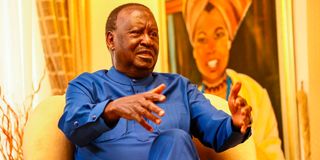
Orange Democratic Movement (ODM) leader Raila Odinga has dismissed claims that he personally benefited from his political truce with former President Uhuru Kenyatta, insisting he did not secure any government positions or personal gains during the ‘Handshake’ era.
Speaking during an interview with the Nation , Mr Odinga said that, contrary to the perception that he struck a back-room deal with Mr Kenyatta following his political détente with his then-nemesis in March 2018 christened the ‘Handshake’, the partnership was solely about pursuing national reforms rather than personal or political rewards for himself or his allies.
“None of my people were appointed in Uhuru’s government. What did I get? I got nothing,” said the ODM leader, while further clarifying that President Kenyatta’s only support came during the 2022 General Election, a gesture Mr Odinga said was not transactional.
“Uhuru was going. He said he would support me, and he did. That was the only thing that happened. So, how did I compromise with Uhuru? I did not compromise with him,” Mr Odinga explained.
The handshake symbolised the political truce between President Uhuru Kenyatta and opposition leader Raila Odinga, which ended the acrimony that followed the 2017 presidential election.
Photo credit: File | Nation Media Group
According to the former Prime Minister, an offshoot of the Handshake was the Building Bridges Initiative (BBI), a constitutional reform process that sought to address systemic governance and electoral issues. He blamed the collapse of the initiative squarely on the Judiciary.
“We agreed on reforms as conceptualised under the BBI. It was the courts that rejected the BBI. Otherwise, it would have passed, and 2022 would not have happened the way it did,” he said, adding that the BBI process would have restructured key institutions, including the electoral agency.
He cited the controversial conduct of the Independent Electoral and Boundaries Commission (IEBC) as proof that electoral reforms were urgently needed.
“Wafula Chebukati (former IEBC Chairperson) would have been removed. And remember, Chebukati and three commissioners said one thing (about the outcome of the 2022 presidential election), and four others said a different thing,” he said. Mr Odinga was referencing the incident in 2022 when, minutes before Mr Chebukati announced the presidential results, four commissioners left the national tallying centre and held a press conference at Serena Hotel.
Led by Vice-Chairperson Juliana Cherera, the four rejected the results citing the opaque manner in which the process had been conducted. The four commissioners were Francis Wanderi, Justus Nyang’aya, Irene Masit and Cherera.
On Mr Chebukati’s side were Boya Molu and Abdi Guliye. In his interview, Mr Odinga also criticised the ruling by the Supreme Court—which is led by Chief Justice Martha Koome—that upheld President William Ruto’s victory, saying it defied logic.
“For the first time, the Supreme Court accepted that three was bigger than four. Why are people not talking about the Supreme Court ruling? They’re only talking about Raila,” he protested. Mr Odinga said that, after the apex court’s verdict, his options were exhausted.
“Once the Supreme Court made the ruling, my hands were tied. It is the court that messed up, not me,” he said.
His remarks come amid renewed debate over the 2018 Handshake legacy, the legitimacy of the 2022 elections and his evolving political alliance with President Ruto under the broad-based government. He said the country was still navigating a national crisis and that ODM’s decision to cooperate with President Ruto’s administration was made purely in the interest of national stability.
Mr Odinga described his collaboration with Dr Ruto as a response to last year’s wave of youth-led anti-government protests, which had risked plunging the country into a situation similar to Somalia, Haiti, or Sudan.