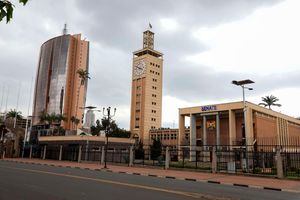
Parliament is set to play a pivotal role in actualising the priority areas outlined by the Independent Electoral and Boundaries Commission (IEBC) ahead of the 2027 General Elections.
In the lead-up to the 2022 polls, the National Assembly rejected several proposed legal amendments by the IEBC meant to improve election management. To avoid a repeat of that experience, the commission intends to begin engagements early.
Under Section 5 of the Election Campaign Financing Act, 2012, the IEBC is required to draft rules that must be submitted to Parliament for approval at least 12 months before a General Election.
From approving supplementary budgets for voter registration to reviewing the Elections Act and key statutory Bills, Parliament will be central to the IEBC’s preparations.
The agency will also require parliamentary approval for the delimitation of boundaries and any further review of electoral regulations—again, within the 12-month threshold set by law.
Among the pending Bills before Parliament are the Elections (Amendment) Bill, 2024, the Political Parties (Amendment) Bill, 2024, the Election Offences (Amendment) Bill, 2024 and the County governments (Amendment) Bill, 2024.
Other proposals are contained in the Election Campaign Financing (Amendment) Bill, 2024, which will determine how campaigns will be funded and the Referendum Bill, 2024
An IEBC official using the voter identification equipment at the Bisil Boarding Primary School polling station in Kajiado. Investigations into the failure of electronic kits during the last General Election have been extended to three foreign countries.
Photo credit: File | Nation
In addition, Parliament could soon debate ODM leader Raila Odinga’s proposal to allow the use of national ID cards for voting—eliminating the need for a separate voter card. In an interview with the Nation, Mr Odinga argued that Kenya’s costly electoral system stems from redundancies.
“If you have an ID, you should vote,” he said. “There are areas where people don’t have voter cards, and this skews the register.”
This week, the IEBC is expected to notify the National Assembly and Senate of declared vacancies ahead of upcoming by-elections.
Parliament will also be instrumental in resolving issues related to the recall clause. The High Court invalidated parts of the Elections Act, 2011, that govern how Members of Parliament can be recalled. The IEBC has written to Parliament asking it to align the law with the ruling, but no action has been taken so far.
Photo credit: Nation Media Group
IEBC CEO Marjan Hussein Marjan previously told petitioners in Tharaka Nithi seeking to recall their senator that the commission was unable to act due to the legislative gap.
“As such, there is no proper mechanism to process a recall petition. The declaration of key sections of the recall law as unconstitutional has made implementation impossible,” Mr Marjan explained.
In 2017, a three-judge bench—Justices Kanyi Kimondo, George Odunga, and Chacha Mwita—declared sections of the Elections Act and County Governments Act governing recall procedures unconstitutional in a case filed by Katiba Institute.
Under the Constitution and Elections Act, an MP may be recalled on grounds such as gross violation of the law, committing an offence under the Elections Act, or mismanagement of public funds. However, the law also requires a High Court judgment confirming such grounds before a recall can proceed.
Another pressing area where Parliament's input is needed is the approval of the IEBC’s budget for continuous voter registration—a top priority for the commission.
“Once the supplementary budget is tabled, MPs will expedite its passage so that the IEBC has the resources it needs to register voters across the country,” said Mr Wetang’ula.
“The IEBC does not take instructions from anyone—not even the President. Politicians must stop issuing public directives to the commission. Let it operate freely and fairly,” he stated.
The IEBC announced on Saturday that it had completed internal preparations and would soon gazette timelines for the resumption of Continuous Voter Registration (CVR).
On the sensitive matter of boundary review, the commission said it is awaiting guidelines from the Supreme Court, but emphasised that Parliament will still need to amend relevant laws, since statutory timelines have already lapsed.
The Constitution mandates the IEBC to review constituency and ward boundaries every 12 years. The last review was completed on March 5, 2012, meaning the next was due by March 6, 2024—but was delayed due to the commission’s lack of quorum.
Parliament has previously rejected some of the IEBC’s key reforms. For instance, ahead of the 2022 elections, MPs annulled a proposed cap on presidential campaign spending of Sh4.4 billion, arguing it lacked parliamentary approval and public participation.
In June 2022, Parliament also rejected IEBC regulations aimed at sealing gaps in the voting system. These included proposals to address issues with results transmission, transparency of electoral technology, and the appointment of returning officers. Lawmakers cited poor drafting, late submission, and lack of public participation.
These same issues—transparency, voter registration, and campaign financing—are now once again before Parliament, as the IEBC gears up for another high-stakes election.