Premium
Widow of Moi-era minister Adhu Awiti loses her torture compensation claim
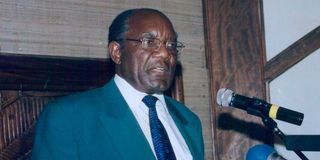
The late Dr Adhu Awiti served as Cabinet Minister for Planning and National Development under President Daniel Arap Moi.

The High Court has denied former Cabinet Minister Paul Adhu Awiti compensation for his detention and torture by the Kanu regime over alleged association with the outlawed Mwakenya Movement of 1987.
Awiti, who served as Karachuonyo MP (1997 -2007) and Cabinet Minister of Planning and National Development in the same regime in 2001 under President Daniel Moi, was detained in March 1987 for being a member of unlawful society. He died in May 2014.
Court papers show that as a result of his suffering in detention at Nyayo House and Kamiti prison, he developed health complications including high blood pressure, eye problems, pain in the lower joints and numbness of the body.


His widow Wilkister Aketch sued in 2019 seeking a declaration that Awiti's rights and fundamental freedoms were contravened and grossly violated by the Kenya police in arresting him without a warrant of arrest, detaining and subjecting him to cruel torture, inhuman and degrading treatment for 33 days.
She wanted the court to find that she was entitled to payment of damages and compensation for the violation and contravention of Awiti's rights.
But Justice Lawrence Mugambi dismissed the petition over unexplained delay in filing the claim and the petitioner's reliance on hearsay evidence.
"I do not think the delay of almost 29 years in bringing this petition is excusable in the circumstances. The petition appears to have been instituted as an afterthought on behalf of Awiti. It is the classical case of delay defeats equity or equity aids the vigilant and not the indolent," said Justice Mugambi.
The court questioned why Awiti failed to file the petition himself to fight for his constitutional rights since 1990 when he was released from prison. Also questioned was why the widow took five years to file the petition after his death (from 2014 to 2019).
Read: Suddenly in money
"Evidently, Awiti prioritized serving in government over his constitutional rights. It was a choice he made and not because the operating environment was hostile. In fact he was a government functionary the reason given that he was in government hence the reason why he could not sue the same government he was serving may also not entirely be correct," said Justice Mugambi.
"The Petitioner did not demonstrate that he served his entire lifetime in government considering that he passed away in 2014 well after the passage of the present Constitution which had removed all pre-existing barriers and made it conducive to anyone seek justice without any form of retribution from any quarters," said the judge.
He stated that the failure to file the petition at an appropriate time could be attributed to a discretionary choice on the part of the petitioner or Awiti himself.
"In fact, even after the death of Awiti in 2014 it took the petitioner another five years to institute this petition in 2019," observed Justice Mugambi.
In regard to the evidence, the court found that what Ms Aketch provided in support of the petition as evidence substantially comprised hearsay statements that were uncorroborated by any other tangible evidence.
"The substance of the petition is thus not substantiated by appropriate admissible evidence," said the judge.
Ms Aketch testified that at the time her husband was arrested, he was working as the Director of Housing at the defunct Kisumu Municipal Council.
The court heard that he was arrested on February 10, 1987 while at work by 10 police officers. Before being detained, the police conducted a search at his office and home in Kanjira where they confiscated some books and magazines related to his work.
Upon arrest he was taken to the Divisional Police Headquarters in Kisumu before being transferred to Nairobi, where he was held incommunicado for 33 days.
He was subjected to torture, cruel and dehumanizing treatment at Nyayo House and Kamiti Maximum Prison.
The widow said that he was denied food and water and placed in waterlogged cells for nights. During the ordeal, he was also stripped naked and had to endure freezing air alternated with hot choking air that was pumped into the cells. Ms Aketch noted that his ankles and knees were also hit with broken wooden pieces.
The family came to learn of his fate a month later on March 12, 1987 through the newspaper, which reported that he had been imprisoned for four-and-half years. She stated that the previous day he had been charged with two counts of being a member of unlawful society and neglect to prevent a felony.
He appeared in court without an advocate, pleaded guilty to the charges and was convicted on the same day. He soon after appealed and the sentence was reduced to three years.
Upon release in 1990 he suffered constant harassment causing him to flee the Country for Netherlands.
Explaining why her husband did not file the petition even after returning from Netherlands, Ms Aketch said he joined politics and became Member of Parliament of Karachuonyo and the Minister of Economic Planning. So, she said, he could not sue the government he was working with.
About the delay, she argued that there was no limitation of time to constitutional petitions.
The Attorney General had opposed the petition, stating that Awiti was lawfully detained at the time and through proper legal mechanism contained in the repealed Constitution of Kenya and other Acts of Parliament.
The court heard that Section 85 of the repealed Constitution provided for the issuance of a detention order in accordance with the Preservation of Public Security Act.
The AG argued that detention without trial was properly sanctioned by the existing legal regime governed by the repealed Constitution as well as the Public Security [Detained and Restricted Persons] Regulations.
"The petitioner has failed to adduce evidence to support the allegations of inhuman treatment, torture or harassment on the part of Awiti. The petitioner’s allegations of ill-treatment during his detention only point to the prevailing conditions of all prisons in Kenya at the material time. There is no justification whatsoever for the award of exemplary and general damages," said the Attorney General.